
Identifying Scale Insects on Houseplants & Management
Scale insects (Superfamily Coccoidea) are common pests that can damage the health and appearance of houseplants. Once present indoors, they can be challenging to control and may affect a wide variety of plants.
Scale insects have a fascinating but problematic morphology, feeding habits, and reproductive traits, including the following:
- Scales are classified into two groups: soft scales with smooth, tortoise-like shells and armored scales with flat, oyster-like shells.
- The waxy shells or armors provide nymphs, adult female scales, and eggs protection from predators and resistance to oil or soap spray treatments.
- Prolonged feeding from nymphs and adult females (especially toxin-rich armored scales) can cause yellow spots, leaf drop, or stunted growth in young plants. Honeydew from soft scales can attract ants and sooty mold fungi, leading to unsightly black spots on the leaves.
- Scale insects often go unnoticed due to their camouflage-like appearance and can spread through infested plants, gardening tools, or even clothing.
- The eggs typically hatch within 1-3 weeks during warm seasons. Armored scale eggs may become dormant underneath the adult female scale’s shell to survive over winter.
- The crawlers or live young are mobile, actively looking for suitable feeding sites, such as leaf veins, petioles, or stems, where they can pierce through plant tissue to feed on phloem sap (soft scale) or cell sap (armored scale).
- The nymphs are typically immobile or slow-moving and start secreting the waxy coating or scale, which hardens and darkens over time.
- Adult female scales can live for a few weeks to over a year, depending on the species and environmental conditions. Outdoors, immature female soft scales can remain dormant underneath their waxy shells in winter and become active in spring and summer, laying around 50-2000 eggs or live crawlers throughout their lifespan.
- Adult males are mostly winged, gnat-like, non-feeding, and live only 1-5 days.
This article will help you identify the physical traits of common scale insect species that affect houseplants and the symptoms or damage they cause. I’ll also share actionable steps to treat and prevent a scale insect infestation in houseplants effectively.

Quick Guide
| Common Name(s) | Brown soft scale Cochineal scale Hemispherical or coffee scale Fern scale Palmetto scale |
| Scientific Name | Coccus hesperidum Dactylopius spp. Saissetia coffeae Pinnaspis aspidistrae Comstockiella sabalis |
| Pest Type | Insect (Superfamily Coccoidea) Family Coccidae, Dactylopiidae, and Diaspididae |
| Commonly Affects | Cacti and succulents, foliage houseplants, herbaceous perennials |
| Size | Adults: 1-9 mm (0.04-0.35 in) Nymphs or crawlers: <1 mm (<0.04 in) |
| Color | Brown, tan, yellow, white, red, or waxy (blends with plant surface) |
| Signs of Infestation | Hard or soft bumps on stems Localized yellowing on stems and leaves Leaf drop Sticky honeydew Black sooty mold Ants |
| Preferred Conditions | Warm environments Excellent tolerance to dry or freezing conditions |
| Damage Level | Moderate to severe |
| Prevention Methods | Quarantine new plants, inspect regularly, or apply neem oil as a deterrent |
| Treatment Options | Manual removal, rubbing alcohol, neem oil, insecticidal soap, systemic insecticides for severe infestations |
Classification, Life Cycle, Behavior, and Development
Scale insects belong to the superfamily Coccoidea, which consists of over 8000 species of sap-feeding insects closely related to other common houseplant pests like aphids and mealybugs.
Below are the main categories of scale insects:
- Soft scales have soft, pliable, tortoise-shaped shells about 1/16-⅜ inches (1.6-9 mm) in diameter. Most species are mobile in the crawler and early nymph stages. Adult males are winged, whereas adult females are wingless and immobile. Many species are all-female or hermaphroditic and can reproduce without fertilization. Most produce only one generation per year due to slow development. Nymphs and adult females excrete honeydew after feeding on phloem sap.
- Armored scales are flatter with hard, oyster-like shells roughly 1/16-⅛ inches (1.6-3.2 mm) long. They’re only mobile in the crawler stage (except for species with winged adult males). Each generation is completed within around 40 days, resulting in more generations yearly. Armored scales don’t excrete honeydew but have toxins in their saliva, causing more severe plant damage.
Among thousands of soft and armored scale insect species, five commonly affect indoor ornamentals:
| Species | Traits | Life Stages |
| Brown Soft Scales (Coccus hesperidum) | Attack a wide range of houseplants Known for their pale brown, flat shells that become darker and rounder as they age 1-2 generations annually (more generations indoors) No visible eggs because they hatch within the adult female and emerge as live crawlers Adult males are rarely observed, and reproduction is mainly asexual | Crawlers: emerge in hundreds; less than 0.5 mm long; move through the plant within 1-2 weeks to settle in one feeding spot Nymphs: female nymphs are miniature adults that go through two instar stages within 6-8 weeks Adult Females: yellowish or whitish legless insects with pale or dark brown mottled shells about 1/16-⅛ inches (1.6-3.2 mm) long |
| Cochineal Scales (Dactylopius spp.) | A soft scale species that commonly feeds on different species of prickly pear cactus, such as bunny ears (Opuntia microdasys) Have 2-3 generations per year Extensively used in manufacturing red dye from the carminic acid they produce to repel predators. | Eggs: over 200 microscopic red dots underneath the white fluff of each adult female Crawlers: first instar; pinkish and less than 1 mm long Nymphs: two instar stages; secrete a sticky, white, waxy covering as protection from the sun, hiding the red insect body underneath Adult Female: red body about 1/16-¼ in (1.6-6.3 mm) long, covered in sticky white wax; immobile, swells once fertilized Adult Male: 3 pupal stages before maturity; non-feeding, winged with long tail filaments |
| Hemispherical scales (Saissetia coffeae) | Generalist soft scales that can feed indiscriminately on woody or herbaceous houseplants Also known as coffee scales due to their dark brown to black shells The life cycle from eggs to adults lasts around 40 days, resulting in multiple generations annually, especially in indoor conditions No known males, reproduction is asexual | Eggs: over 100 pinkish eggs around 0.7 mm long underneath the adult female shell Crawlers: pinkish and spindly, about 1 mm long, with distinct rear filaments Nymphs: immobile and flat yellow/pink that gradually become bumpy after secreting dark brown wax with an H pattern Adult Female: dark brown or black, bumpy shell around 4.2 mm (0.16 inches) in diameter |
| Fern scales (Pinnaspis aspidistrae) | Armored scale species commonly affecting ornamental ferns, such as staghorn fern and sword fern Adult females camouflage easily because they’re almost the same color as the fern sori (which contain spores). | Eggs: up to 1000 oval eggs, less than 0.2 mm long under the female armor Crawlers: around 0.2 mm long, yellowish, and with distinct red eyes and rear filaments Nymphs: Females have light brown armor and are up to 0.8 mm long; males have white armor and are around 1 mm long Adult Females: a little over 1.6 mm (0.06 inches) long; dark brown, oyster-shaped armor Adult Males: gnat-like winged insects that are rarely seen |
| Palmetto scales (Comstockiella sabalis) | Host-specific armored scales common in indoor ornamental palms, such as the Mexican blue palm and majesty palm Native to the southern US and Mexico Cause chlorotic splotches on infested leaves Coated in white, fluffy skin/wax similar to mealybugs, but lacks segmentation | Eggs: oval and pinkish, less than 1mm long Crawlers: oval and slightly larger than the eggs, mobile Nymphs: Female nymphs are miniature adults, less than 1 mm long, and grow a white armor; male pupae are pinkish and elongated but shorter than female nymphs Adult Female: ovate and light pink, about 1-1.5 mm (0.04-0.06 inches) long with snow-white thick armor and yellowish wax Adult Male: tiny, winged, rarely seen |
Adult female scale insects can stay on the plant, feed, and reproduce within a few weeks to several months.
Favorable indoor conditions can promote longevity and encourage rapid development as they go through the five life stages below:
- Egg: Adult females typically lay eggs within their shells or a waxy ovisac. In some species, the eggs hatch within the body of the adult female and emerge as crawlers.
- Crawlers or first instar: The mobile stage, which actively searches for a suitable feeding spot, such as a leaf vein, petiole, or stem. Crawlers typically have noticeable legs and rear filaments when viewed underneath a microscope or a 30x magnifying glass.
- First nymphal stage: After crawlers attach their needle-like mouthparts to the plant, they start feeding and begin molting into nymphs, which secrete a pale waxy covering or shell. Soft scales also excrete a sticky, colorless waste material called honeydew just outside the shell.
- Second nymphal stage: The young nymphs morph into the second stage underneath the shell and excrete more honeydew after continuous feeding.
- Adult: The final molt yields an adult that is almost twice as big as the first nymph. The adult female secretes a darker waxy covering that thickens the one initially produced by the nymphs.
On the other hand, male scale insects are short-lived, typically lasting 1-5 days after emergence to look for a mate.
However, before full development, they go through more stages, including the following:
- Egg: Indistinguishable from the female eggs
- Crawler: Similar to female crawlers, start of feeding and mobile stage
- Nymph (2 stages): Paler or white shell or armor; feeding stage
- Pupa (3 stages): Non-feeding stage
- Adult: Non-feeding, one pair of wings, mosquito or gnat-like, rarely seen
Feeding Behavior
Scale insects have stylets or needle-like mouthparts used to pierce through plant tissue and draw sap like a straw.
Note that the feeding behavior of scale insects (and the resulting plant damage) varies between soft scale and armored scales:
- Soft scales draw food from phloem sap by injecting their stylets into phloem sieve elements. The sugar-rich food source results in a honeydew excretion.
- Armored scales draw food from cell sap, so they don’t excrete honeydew. Instead, they use their stylets to transfer toxic saliva and wastes back into the plant, resulting in chlorosis. Severely infested plants may shed leaves or have stunted growth.
Regardless of the food source, scale insects share similar traits in the hunt for a feeding spot and development:
- Crawlers move out of the shell of the mother scale to look for a feeding spot, where they can easily access plant sap.
- Each crawler actively feeds on plant sap and molts into the nymphal stage, which secretes a waxy covering to protect its lightweight, immobile body from predators or the elements (i.e., wind, rain, sun).
- The two nymphal stages of male or female scales continue feeding using their stylets.
- Male nymphs create a cocoon to pupate, gradually losing their mouthparts and feeding ability.
- Adult female scales emerge from the second nymphal molt and feed on plant sap throughout their lifespan, which can last several months. Continuous nourishment is crucial to reinforce the waxy shell and produce eggs sexually or asexually.
Environmental Factors Favoring Scale Infestations
Scale insects can wreak havoc in indoor gardens because of the following factors that favor their rapid development and reproduction:
- Warm air temperatures (around 77 °F or 25 °C) promote lower mortality and higher fecundity in female scales, increasing the number of eggs they can lay.
- Sufficient moisture in the soil also facilitates continuous movement of moisture to leaf cells for armored scales and sugary materials in the phloem for soft scales.
- Over-fertilization or excess nitrogen in spring and summer can trigger a growth spurt with abundant but weak leaves and stems vulnerable to scale attacks.
- The lack of natural predators like parasitoid wasps, ladybugs, and lacewings makes it challenging to control scale populations naturally.
Note: Other sources claim that scale insects thrive in dry conditions or low humidity. The fact is that they can tolerate a wide range of humidity because of their waxy shell or armor and manner of feeding.
- Dry conditions (below 40% relative humidity) can prompt higher transpiration rates, pulling moisture and sugars rapidly through the phloem and plant cells, making them accessible to scale insects.
- Humid conditions (over 40% relative humidity) help plants retain fluid in their cells, allowing intracellular-feeding armored scale insects to draw sufficient food through their stylets.
In addition, scale insects can survive winter by remaining dormant in the egg (armored scales) or immature female (soft scales) form during freezing conditions.
In controlled indoor conditions, scale insects continue to develop or feed all year round and produce multiple generations because they don’t enter dormancy.
Where Do They Come From?
Scale insects can spread indoors in the following ways:
- Bringing in infested new plants from nurseries: Scale insects are hard to detect with the naked eye because of their microscopic size (eggs and crawlers) or camouflage. They can easily be concealed along stems or on leaf undersides.
- Outdoor plants brought indoors: Crawlers can move between nearby plants through touching foliage or may be blown by the wind. As such, they may unknowingly hitch a ride with your potted plants.
- Contaminated tools, hands, or clothes: Improper sanitation of hands and gardening tools when pruning or repotting can easily transfer the scale crawlers between houseplants. Outdoor clothes may also carry crawlers blown by the wind.
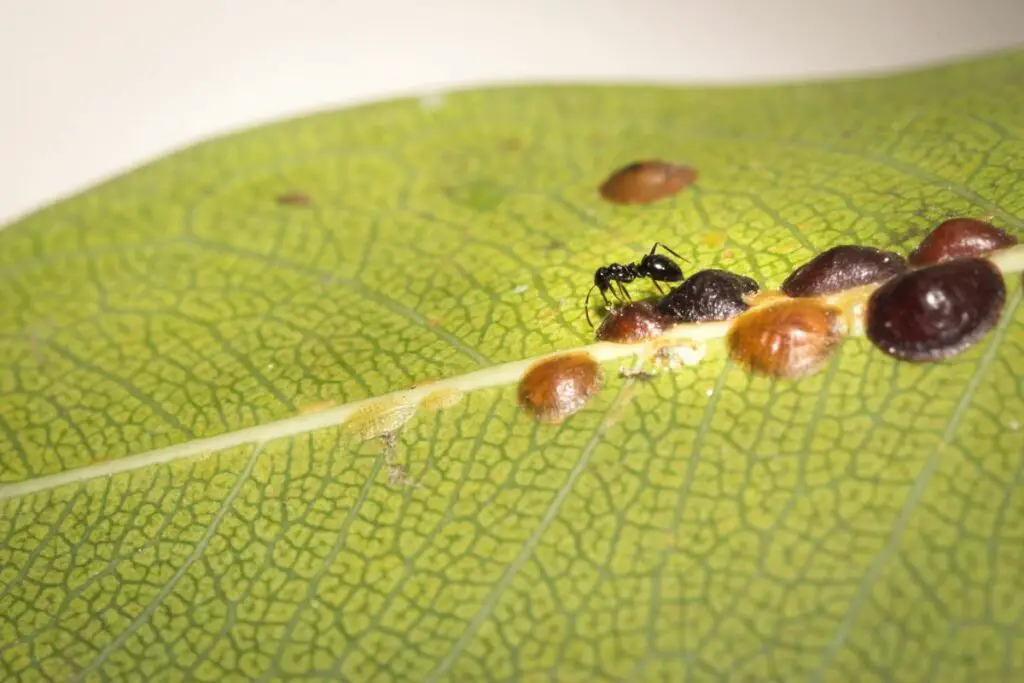
- Ants: You may find ants in a congested indoor garden with honeydew-excreting pests like mealybugs and scale insects, especially in warmer regions or climates. In the U.S., ants are more likely in partly enclosed environments, such as greenhouses or conservatories. Ants protect and farm scale insects for honeydew, and occasionally transport the crawlers between pots.
Symptoms of Scale Infestation
Plant damage from a mild scale infestation can often go unnoticed. However, severe infestations can lead to irreversible damage that can discolor or defoliate plants.
Early Signs
The diagnosis of scale infestations and the identification of the species involved primarily depend on the appearance of the shells or armors of adult female scales because adult males are typically winged and rarely seen.
Here are the symptoms to watch out for to detect an early scale infestation:
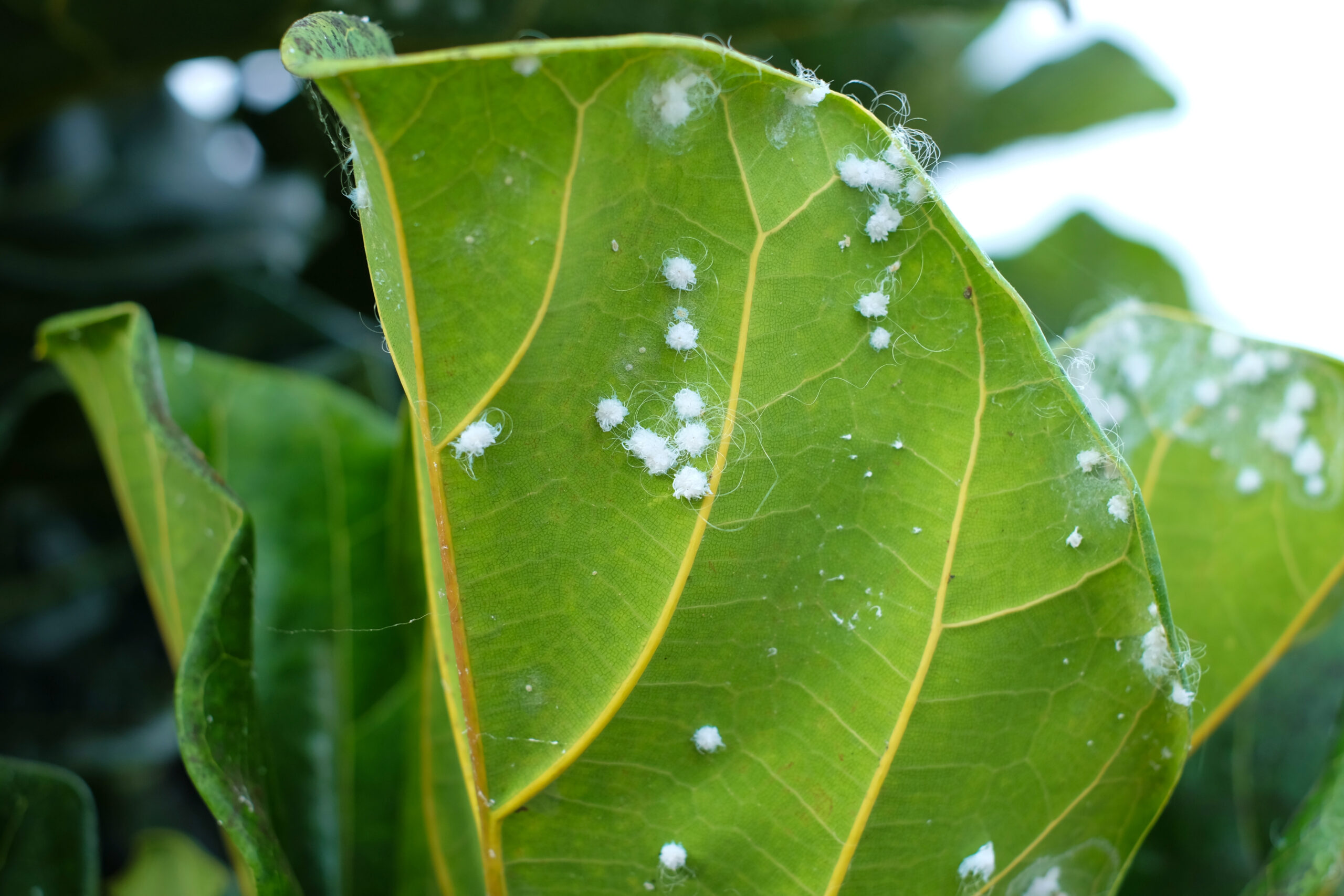
- Small, raised bumps (shells) on stems, petioles, or leaf veins. The bumps can be found on or underneath leaf surfaces and may appear light to dark brown or fluffy white, depending on the scale species. The size can range from 0.04-0.35 inches (1-9 mm).
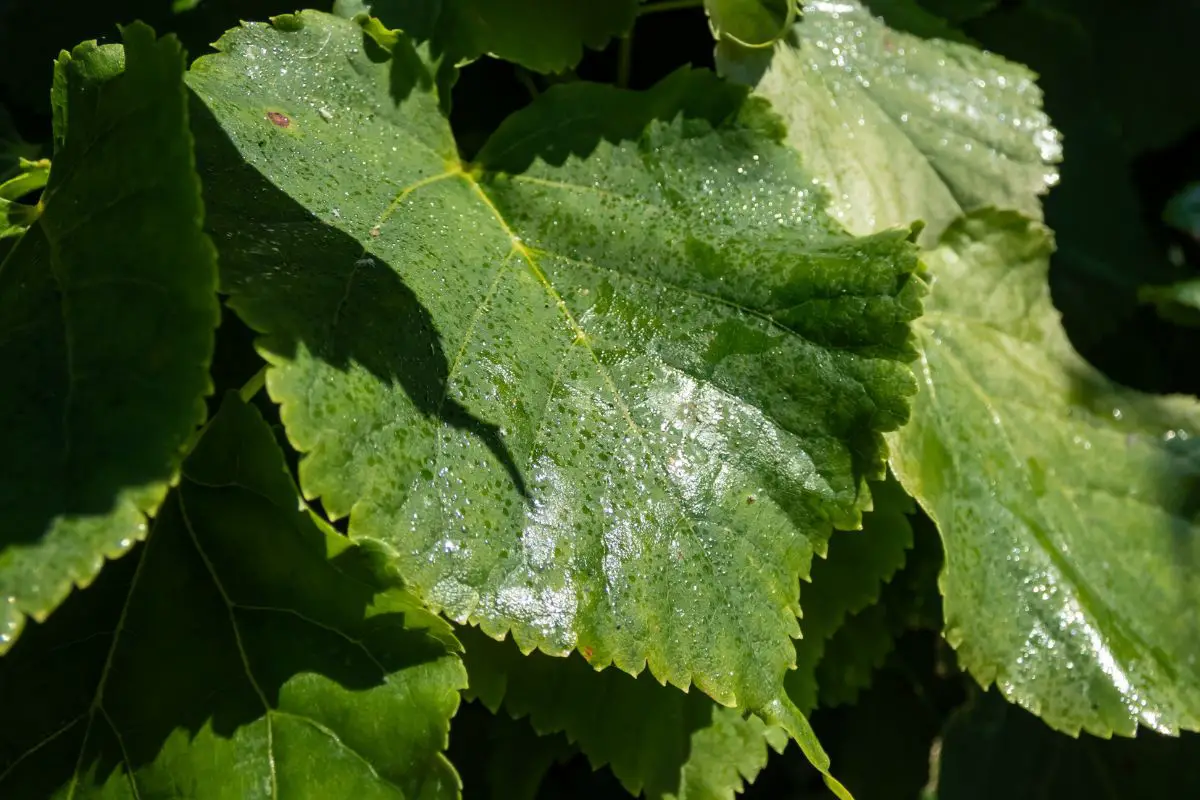
- Sticky honeydew residue close to the scale shells. Occasionally, soft scales may eject the sugary liquid over an inch (2.5 cm) away from the shells to prevent contamination of the developing eggs or newly hatched crawlers, resulting in honeydew dripping over leaf surfaces, floors, or tabletops.
- Localized yellowing in the infested area
- Curling leaves from the lack of moisture or nutrients at the leaf tips
Advanced Infestation Symptoms
Prolonged and severe infestations can lead to the following symptoms:
- Black sooty mold growth or ants close to leaf surfaces infested with scale nymphs and adult females. If the sooty mold covers a large portion of the leaf surface, it can block light and reduce the plant’s photosynthetic capacity.
- Large, hardened clusters of scale insects. Some bumps may be empty shells of adult females or cocoons of male scales.
- Dropping of leaves connected to severely infested petioles or stems
- Stunted growth or branch dieback if the stem is heavily laden with scales
Confirmatory Tests
Scale insects may sometimes camouflage with woody stems, leaf nodes, colored foliage, or even dust and dirt.
You can confirm a scale infestation with the following tools or methods:
Magnifying Glass
Use a 10-30x magnifying glass and focus on suspected scales along stems, petioles, leaf veins, or leaf surfaces. Although adult female scales are easy to spot with the naked eye, nymphs and crawlers may require at least a 10x lens.
Phone Camera
You may also use a phone camera to zoom in on the infested plant tissue and look for the characteristic yellowish or pink crawlers with rear filaments, pale brown or whitish nymph shells, and darker and larger tortoise- or oyster-shaped shells.
Scrape Test
Try gently scraping a bump with a fingernail, the blunt side of a knife, or tweezers. If it moves or oozes, it’s most likely a scale insect. You can also remove the entire shell and find the adult female with a translucent body within it. Some empty shells may remain on the plant, even after the adult female scale dies.
In contrast, if careful removal of the bumps reveals green plant tissue, it indicates that the bumps are a natural part of the plant (i.e., bark or node) and you can rule out a scale infestation.
Note: At first glance, a brown scale insect surrounded by a halo of yellowing leaf surface can look like a bacterial or fungal leaf spot disease with a necrotic or spore-filled center. Scraping the insect’s shell off the plant can rule out leaf spot diseases.

Sticky Tape Test
Place a sticky tape over the stems and carefully detach it. Observe the tape underneath a magnifying glass to locate and identify crawlers. Repeat the process on multiple spots so you can identify areas where you must focus treatment applications.
You can then attach the tape over a glass slide and check it underneath a microscope (if you have one handy) to identify the scale crawlers.
Note: Other sources suggest shaking the stem to dislodge the crawlers over a piece of paper. However, I don’t recommend this, as the process might drop the crawlers over the soil, floor, or plant shelf surfaces, further spreading the infestation.
Treatment
Minor scale infestations don’t pose a serious threat to plant health. For instance, my woody ornamentals, such as fiddle leaf figs and rubber plants, had scale insects on their dark stems for a while before I noticed the infestation. Thankfully, there was no severe damage.
However, large populations can be unsightly and may cause aesthetic damage to houseplants, such as yellow splotches, black sooty mold, or leaf drop.
I have plenty of herbaceous and foliage plants, and the brown bumps of brown soft scales and hemispherical scales are an unpleasant sight against the green stems and leaves. The fluffy white cochineal scales on cacti are also unsightly, and squishing them can lead to red stains on the cactus pads.
It’s crucial to treat your plant right away after confirming a scale infestation to prevent long-term and irreversible problems.
Immediate Actions
Here are the first steps to take after confirming a scale infestation:
- Identify and isolate all affected plants to prevent spread. Choose a location with bright indirect light and ideally similar temperature and humidity conditions as the indoor garden to prevent relocation stress that can worsen plant health and delay recovery.
- Prune heavily infested areas and dispose of plant material properly. Ensure the pruning shears or scissors are cleaned with rubbing alcohol or bleach before use. Continue sterilizing the blades between cuts. Pro Tip: Position the leaf over the garbage bag before cutting the petiole so any crawler will fall directly into the bag and not on the lower leaves or potting soil.
- Wipe the honeydew off the leaves and stems with a clean, damp cloth to improve the plant’s appearance and photosynthetic capacity. Repeat this process every few days or before oil or soap treatments to prevent sooty mold growth. It will also prevent any indoor ants from being drawn to your plants.
Physical Removal
You must manually remove the scale insects because organic oil or soap treatments are ineffective against scale shells or armors. Even the empty shells may remain attached to the plant tissue and cause aesthetic issues, so it’s crucial to remove them as well.
Follow these tips to minimize damage to the plant:
- Prepare a cup of soapy water (1 ml liquid soap in a half cup of water) and position it underneath the infested plant area to catch the shells and any eggs or crawlers within.
- Use a blunt tool to scrape the shells off the plant. I often use the blunt end of a knife or tweezers.
- Repeat this process every 2-3 days until you can no longer find scale armor or shells.
Note: Other sources may suggest water sprays or sticky tapes to remove scale insects manually, but they may be counterproductive due to the following reasons:
- Water spray: The waxy shells protect the nymphs and adults, and the water jet or stream will only move the crawlers to other parts of the plant without killing them.
- Sticky tapes: Sticking and peeling off tapes on multiple plant parts to remove scale crawlers can damage sensitive plant tissue by removing a portion of the bark (for woody ornamentals) or the trichomes (hair-like fuzz on leaves, such as in African violets).
Natural & Organic Remedies
The waxy shell or covering of eggs, nymphs, and adult females is resistant to common organic remedies like neem oil and insecticidal soaps. The goal of using organic treatment is to eliminate the crawlers and inhibit further pest development.
After removing the shells and exposing the newly hatched crawlers, follow these tips to apply organic treatment properly:
- Neem oil spray: Mix 1 tbsp neem oil + 1 tsp dish soap + 1 quart (1 liter) water and spray weekly. Apply it after sunset to prevent leaf scorch. Aim for areas previously inhabited by adult scales or spots that showed an infestation when using the sticky tape test. Neem oil effectively disrupts a scale insect’s life cycle by destroying the crawlers.
- Insecticidal soap: The sturdy armor or shells of adult scale insects don’t easily degrade from insecticidal soaps. Note that higher soap concentration won’t help either because it can degrade the leaf cuticle before the scales. Insecticidal soaps are effective against crawlers but require repeat applications every 2-3 days (after sunset) to promptly catch and eliminate newly hatched crawlers.
- Horticultural oil spray: You can find OMRI-listed products that contain essential oil extracts from garlic, clove, citrus, rosemary, and peppermint, which have wax-dissolving effects against scale insects and mealybugs. However, mature scales have thicker shells and are resistant to oil sprays. Apply the oil spray weekly, ideally after sunset, to prevent sunburn on the leaves.
Note: You may come across tips online about the effectiveness of alcohol spray against scale insects. I don’t recommend alcohol treatment because it won’t work immediately to dissolve the waxy armor or shells and is more likely to degrade leaf cuticle and cause more severe plant damage.
Biological Controls (Predatory Insects)
Outdoors, scale insect populations are controlled by predators and parasites, making it unlikely for scales to cause life-threatening damage to plants. This phenomenon is often used as a basis for using predatory bugs and parasitoid wasps to control scale insect populations indoors.
Note: Beneficial bugs are also sensitive to neem oil, insecticidal spray, and other chemical insecticides. You can’t use them when practicing integrated pest management, which can render the beneficial bugs ineffective.
Let’s explore the common insects used to manage a scale infestation and the pros and cons of using them in indoor gardens:
| Beneficial Insects | Advantages | Disadvantages |
| Ladybugs or ladybeetles (Chilocorus pustulatus) | Larval and adult forms primarily feed on soft and armored scales | Also sensitive to organic or chemical insecticides Vulnerable to ants Require nectar from flowering plants as a food source |
| Lacewing larvae (Chrysopidae, Hemerobiidae, Coniopterygidae) | Feed indiscriminately on soft scales (Coccidea) and armored scales (Diaspididae) Numerous neuropterid lacewing species to choose from | Not all eggs from commercial sources are viable; even viable eggs may take time to hatch Only the larvae can be used against scales Flying adults may be repulsed by neem oil or insecticidal soaps, inhibiting natural reproduction |
| Parasitoid wasps (Coccophagus lycimnia) | Target hundreds of soft scale species The larvae parasitize and feed on nymphs Adult female wasps feed on both mature female scales and honeydew, reducing the risk of sooty mold growth Adult male wasps feed on nymphs or immature female scales | Time to maturity takes 3-4 weeks Adults live only 2 weeks (relatively shorter than the lifespan of adult female scales, which can last several months) Also sensitive to organic and chemical insecticides |
Note: Other sources recommend bringing your pest-infested houseplants outdoors in late spring until summer for natural exposure to predatory bugs.
However, this can lead to several additional issues, including the following:
- Many indoor plants are sensitive to direct sunlight because they’ve been raised in moderate indoor lighting. Proper acclimatization to brighter light intensity is necessary to prevent relocation shock, which can worsen stress symptoms from pest damage.
- Bringing houseplants outdoors can expose them to more damaging pests, such as aphids, mealybugs, spider mites, caterpillars, snails, and slugs.
- Predatory bugs like lacewings and ladybugs feed on scale crawlers, which aren’t protected by a shell or armor. The adult scales inside the shells may continue reproducing even after bringing the potted plants back indoors.
Chemical Treatment
Below are insecticides with mild systemic activity that may be used as a last resort against scale insects:
- Imidacloprid soil drench: The active ingredients are translocated through the xylem to individual plant cells, making it effective against armored scales but not soft scales.
- Imidacloprid-based foliar sprays: The chemical can kill soft and armored scale crawlers on contact. Plant tissues may absorb the active ingredients, and the leaf veins may translocate them to short distances, potentially killing soft scale nymphs and adults as they feed.
- Pyrethrin-based sprays: These are contact insecticides that can damage the nervous system of crawlers, effectively disrupting the scale insect’s life cycle. However, they require multiple applications to eliminate scale insects.
Safety Warning: Be cautious when using chemical insecticides, which can pose the following issues:
- Imidacloprid applied at high dosages may not be safe for edible indoor herbs.
- Many pyrethrin-based sprays are recommended only for outdoor use because they can trigger asthma-related symptoms.
Each insecticide product has its own safety and application guidelines. Be sure to read and follow product-specific instructions regarding dosage and application frequency to maximize the effectiveness of the treatment while minimizing potential risks for plant health and indoor use.
Signs of Recovery and Post-Isolation Steps

Adult female scales can lay hundreds of eggs or live crawlers over several months before eventually dying. The eggs can hatch several days or weeks apart, and the crawlers can remain undetected until they molt into nymphs and excrete a waxy shell.
Therefore, a good rule of thumb is to keep your plant isolated for up to 8 weeks with regular treatment (i.e., neem oil, insecticidal soap, or chemical spray).
You can tell that your plant is recovering when you observe the following:
- No new bumps appearing on stems or leaves: Be sure to remove all the shells or armors during treatment because the empty shells of dead scales can remain on the plant, leading to a false impression of a persisting scale infestation.
- No honeydew residue or sooty mold growth: Honeydew is a telltale sign that there are live soft scales left on the plant. Note: Armored scales don’t excrete honeydew, so the recovery sign is based on the absence of their characteristic armor.
- Healthy new growth with no visible scale: Once fully recovered, your plants should have healthy green leaves.
After clearing the 8-week treatment without any new signs of scales, you may move the plant back to its usual spot. However, continue spraying your plant with neem oil every 2 weeks to prevent a re-infestation.
Clean the plant shelves and the floor with soap-based cleaners to eliminate any crawlers that may have fallen off the plant during treatment.
Troubleshooting Common Problems
Scale infestations are generally non-life-threatening to houseplants, and I’m honestly more worried about aesthetic damage. However, prolonged and unmanaged infestations can be detrimental to plant health.
Here are some common problems associated with scale infestations and how to address them:
Severe Infestation: When to Consider Discarding a Plant
You can control and eradicate a scale infestation by using integrated pest management methods, including the following:
- Identification and isolation of severely infested plants
- Manual removal of visible nymphs and adult females
- Regular applications of neem oil spray (weekly) or insecticidal soap (every 2-3 days). Pro Tip: Apply insecticidal soap 3-4 days after neem oil treatment to expose scale insects to more organic products that can eliminate crawlers as they hatch.
- Routine checking and cleaning of the plant’s foliage to catch and treat any new signs of infestations
However, there are a few instances where I feel it’s best to discard your plant, including the following:
- Prickly pear cacti have pointy spines or glochids on their pads that can be painful to touch, making cochineal scales hard to eliminate. I’ve once had scale problems on a few prickly pear cacti. I collected the least infested and healthiest-looking pads, propagated them, and tossed the mother plants.
- Small or young plants can have severe damage from a scale infestation and are unlikely to grow normally. If over 50% of the plant is affected, consider discarding it and start with a healthier, pest-free plant.
- Large or mature plants with a severe infestation (over 50% of the leaves and stems) can be treated, but they require tedious work. If you feel like it’s too much work than you can handle, collect a few healthy cuttings, discard the infested mother plant, and start fresh with propagating a healthy new plant.
Scale Insects Keep Coming Back
Scale problems can recur due to the following:
- Hatching of protected eggs: The hard shells of adult scales and egg sacs allow egg survival despite rigorous treatment applications. Be sure to manually remove the adult scales before using organic or chemical treatment to properly deal with and end an infestation.
- Hidden infestations: Scale eggs and crawlers may fall to the soil, pots, and plant crevices during manual removal of the shells and evade treatment. The crawlers—although slow-moving—can survive several weeks while crawling up the plant to search for a feeding spot. You may spray the soil and pot with neem oil during treatment to eliminate the crawlers that fell off the plant.
- Contaminated gardening tools: Eggs and crawlers can survive and remain undetected in pots and gardening tools like pruning shears, trowels, and hand cultivators. Wash the pots and gardening tools with 10% bleach, rinse thoroughly with water, and allow them to dry completely before use. You may also spray the gardening tools with rubbing alcohol before and during use.
Ineffective Treatments: DIY Sprays
DIY sprays are all the rage among DIY gardeners. However, for inexperienced gardeners, homemade concoctions may harm plants more than pests.
Here are some common misconceptions and mistakes associated with DIY sprays:
- Homemade insecticidal soaps using liquid dish soap dissolved in water and a bit of vegetable oil can indeed kill scale crawlers, but they’re equally damaging to plant tissue. The soap can degrade the waxy leaf cuticle, making the plant more susceptible to light or heat damage and dehydration.
- Alcohol sprays are usually made by mixing alcohol and water in a 1:1 ratio. However, most commercial alcohol products contain only up to 70% alcohol. Diluting them further with water can reduce their effectiveness, especially against scale insects, which are protected by thick waxy layers (shells). The plant leaves, on the other hand, are more vulnerable to the dehydrating effect of alcohol sprays.
- Vinegar sprays work by dehydrating insects and disrupting their nervous system. Horticultural vinegar (20% acetic acid) is too concentrated and harmful to plant leaves, whereas kitchen vinegar (5%), which is typically diluted in water, isn’t a very effective pesticide. Exposure to sunlight after a vinegar spray application can increase the risk of browning or sunburn on leaves.
Pro Tip: This section doesn’t aim to discredit DIY sprays but, instead, is a warning to be cautious when using them. To maximize their effectiveness while ensuring plant safety, apply the solution on 1-2 leaves and wait at least 24 hours to see signs of sensitivity (yellowing or bleaching). If there’s none, you may use the spray on your plant—ideally, only once weekly.
Ant Infestations
Soft scale insects produce honeydew, which is a valuable food source for ants. In return, ants may help transport crawlers to suitable leaves and protect scales by attacking the eggs and larvae of natural predators like soldier beetles, ladybugs, and lacewings.
Note: Ants may cultivate armored scales and feed on the nymphs and adults because of the lack of honeydew excretions.
Managing ants is crucial to preventing an infestation, especially when using biological control methods indoors.
Here are some tips to control the ant population around your houseplants:
- Place the pot on a pebbled tray with water, which will deter ants from reaching the pots.
- Wrap a double-sided tape around the pots to catch ants and prevent them from getting to your houseplants.
- Place a yellow sticky trap on the floor and shake the plant over it to dislodge and catch the ants.
Preventative Measures
Scale insect infestations may be troublesome, but preventable with the following tips:
Quarantine New Plants
Make it a habit to quarantine new plants for 6-8 weeks before placing them in your indoor garden. This period is crucial to reveal any hidden pest infestations or diseases and prevent transmission to your other houseplants.
Regular Inspections & Maintenance
Check stems and leaf undersides weekly for any signs of scale infestations, such as pale brown or white bumps. Wipe leaves to remove dust and prevent pests from settling and prune overgrown leaves and branches for better air circulation and easier pest detection.
Always use sterile tools when pruning or tending to your houseplants to prevent pest transmission.

Use Natural Repellents
Inspect new plants thoroughly and proactively treat them with neem oil spray once every 1-2 weeks before placing them with other plants.
For existing houseplants, apply neem oil spray every 2 weeks starting from early spring as a preventive treatment. The solution can kill emerging crawlers and prevent an infestation.
Encourage Strong Plant Health
Healthy plants generally have better resistance to pest damage, and proper care can prevent an infestation.
Here are general houseplant care tips to maintain a thriving and pest-free indoor garden:
- Avoid overwatering and use a well-draining substrate to maintain root health. Overwatering can increase moisture and sugar movement through the plant, attracting sap-feeding pests. Weakened roots from soggy soil also reduce a plant’s ability to fend off or tolerate a pest infestation.
- Use half-strength liquid fertilizers or a thin layer of granular fertilizer only in spring and/or summer to promote plant health. Avoid over-fertilizing, as this leads to rapid but weak leaf growth, which attracts scale insects.
- Maintain moderate indoor temperatures (65-75 °F or 19-24 °C) and humidity (40-60%) for optimal plant health and to discourage rapid scale development or reproduction.
Houseplants Prone to Scale Insect Infestations and Symptoms
While most soft scale species are generalist pests, fern and palmetto scales can be host-specific.
Below are common houseplants likely to be attacked by scale insects:
| Plant | Scale Insect Species | Symptoms |
| Boston Fern (Nephrolepis exaltata) | Fern scales Soft brown scales | white or brown, tough, oyster-like bumps on the fronds Yellowing fronds |
| Bunny Ear Cactus (Opuntia microdasys) | Cochineal scales | fluffy white clusters around the glochids or spines Honeydew and sooty mold close to the scale clusters Red stains after squishing the scale clusters |
| Cornstalk Dracaena (Dracaena fragrans) | Soft brown scales Hemispherical scales | light to dark brown or blackish bumps along the veins on either side of the leaves Yellow splotches close to the site of infestation |
| Dumb Cane (Dieffenbachia seguine) | Soft brown scales | light to dark brown bumps and localized yellowing that may camouflage against the variegated leaf surface |
| English Ivy (Hedera helix) | Soft brown scales Hemispherical scales | light to dark brown bumps on leaf underside and vines with localized yellowing |
| Fiddle Leaf Fig (Ficus lyrata) | Soft brown scales Hemispherical scales | light to dark brown bumps along stems, petioles, and leaf veins The brown bumps may be hard to spot against the woody stem without close inspection (scrape test or magnifying glass) |
| Jade Plant (Crassula ovata) | Soft brown scales Hemispherical scales | light to dark brown bumps on the stems and the upper and lower surfaces of the leaves |
| Majesty Palm (Ravenea rivularis) | Palmetto scales | snow-white bumps along the leaves Yellowing along the center of infested leaves |
| Mexican Blue Palm (Brahea armata) | Palmetto scales | snow-white bumps along the leaves Yellowing along the center of infested leaves |
| Peace Lily (Spathiphyllum spp.) | Soft brown scales Hemispherical scales | light to dark brown bumps along leaf or flower stalks or leaf undersides Drooping or yellowing leaves |
| Pothos (Epipremneum spp.) | Soft brown scales Hemispherical scales | light to dark brown bumps on leaf undersides or along the stems or vines Localized yellowing, honeydew, and black sooty mold Leaf drop |
| Rubber Plant (Ficus elastica) | Soft brown scales Hemispherical scales | light to dark brown bumps along stems, petioles, and leaf veins The brown bumps may be hard to spot against the woody stem without close inspection (scrape test or magnifying glass) |
| Saw Palmetto (Serenoa repens) | Palmetto scales | snow-white bumps along the leaves Yellowing along the center of infested leaves |
| Staghorn Fern (Platycerium bifurcatum) | Fern scales | white or brown, tough, oyster-like bumps on the undersides of the fronds Yellowing fronds |
| Sword Fern (Polystichum munitum) | Fern scales | white or light to dark brown scales on the undersides of the fronds Sticky honeydew and sooty mold (from soft scales only) Gradual yellowing after several weeks or months, followed by the dropping of fronds |
| ZZ Plant (Zamioculcas zamiifolia) | Soft brown scales Hemispherical scales | light to dark brown bumps on leaf undersides or along the stalks Localized yellowing and leaf drop |
Comparison to Other Common Houseplant Pests
Scale insects are sap-feeding insects that are usually easy to distinguish from other common houseplant pests because of their distinct shells or armors.
The table below will guide you in distinguishing among different indoor plant pests:
| Pest Name | Size and Appearance | Symptoms |
| Scale Insects | Common adult indoor scales have an average size of 1/16-⅛ inches (1.6-3.2 mm) Soft scales: immobile light to dark brown or fluffy white dome-shaped shells Armored Scales: snow-white or brown oyster-like armor | Brown or white bumps on leaf undersides, along leaf veins, petioles, or stems Honeydew, sooty mold, ants Splotches of yellow at the site of infestation Leaf drop or curling from severe infestations |
| Mealybugs | 1/16-⅛ inches (1.6-3.2 mm) Each insect has a segmented body with a cottony wax covering and occasional rear filaments, depending on the species | Clusters of white fluff on leaf undersides, typically close to the veins Honeydew, sooty mold, ants Localized yellowing Potential leaf drop |
| Aphids | 1/16-⅛ inches (1.6-3.2 mm) Translucent white, green, black, orange, or pink insects | Honeydew, sooty mold, ants Localized yellowing at the site of infestation |
| Spider Mites | Less than 1/20 inches (<1 mm) Black or translucent spider-like body with two distinct dots; typically red during the cold season | Fine webs between leaves and stems Stippling or speckled white or yellow leaf surface |
| Thrips | 1/16-⅛ inches (1.6-3.2 mm) Slender orange or brown insect with light wings | Silver or bronze patches on leaf surface Tiny black specks |
Final Thoughts
Scale insects are resilient houseplant pests that can survive through common organic or chemical treatments because of their waxy shells or armors.
Although usually not fatal to plants, prolonged and severe scale infestations can cause aesthetic damage to your indoor garden.
You can treat an existing infestation and prevent a recurrence with the following care routine and treatment methods:
- Inspect the plants thoroughly to identify and confirm a scale infestation.
- Isolate infested plants in an environment with similar conditions to prevent relocation stress.
- Prune and properly discard severely infested leaves using sterile shears.
- Scrape the shelled nymphs and adult scales with a blunt tool and drop them in a cup of soapy water.
- Spray the plant liberally with neem oil, especially the areas previously inhabited by adult females. You can also use insecticidal soap between neem oil applications.
- Manage ant populations using sticky traps, pebbled water trays, or by regularly wiping honeydew off the leaves.
- Monitor plant recovery and check for any new signs of scales weekly for up to 8 weeks to catch and treat any recurrence promptly.
Seeing scale insects on your precious houseplants can be alarming, even for experienced gardeners like me. If you’ve had a similar experience, feel free to leave a comment to ask questions or share how you managed the problem.