
Identifying Thrips on Houseplants & Management
Thrips are a common yet often overlooked houseplant pest. They can reproduce quickly, especially in warm conditions, allowing them to produce multiple generations in indoor gardens.
Thrips can be troublesome houseplant pests because they:
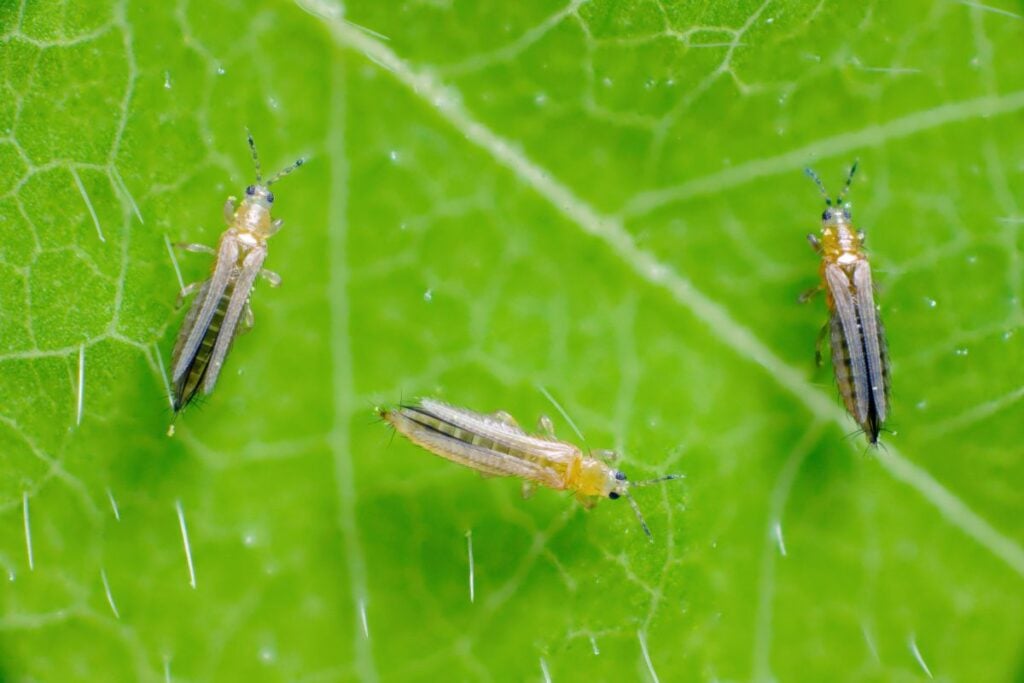
- Are hard to spot with their tiny size, ranging from 0.02-0.06 inches (0.5-1.5 mm) for eggs and larvae and only up to 0.13 inches (3.2 mm) for adults.
- Suck sap or burrow into leaf tissue, causing stippling or silvery/brown scars on the leaves.
- Can reproduce sexually or asexually, with each female producing 15-50 eggs that hatch into actively feeding larvae.
- Complete a life cycle within 2 weeks in stable, warm indoor conditions, resulting in 8-20 overlapping generations a year.
- Spread easily through new plants, outdoor exposure, contaminated tools, or even by flying short distances indoors.
- Are resistant to organic contact pesticides after burrowing in leaf tissue, pupating in the soil, or becoming flying adults. As such, proper thrip management requires additional pesticides with mildly systemic effects, such as spinosad and imidacloprid.
This guide will cover the identification of thrips based on their appearance and symptoms, and explore multiple treatment options and prevention methods in detail.
Quick Guide
| Common Name(s) | Thrips, Thunderflies, Storm Flies |
| Scientific Name | Order Thysanoptera Family Thripidae and Phlaeothripidae |
| Pest Type | Insect |
| Commonly Affects | Flowering plants, foliage houseplants, succulents, herbs |
| Size | Eggs: <0.5 mm (0.02 inches) Larvae and Pupae: Around 1 mm (0.04 inches) Adults: 1.6-3.2 mm (0.06-0.13 inches) |
| Color | Black, brown, yellow, or pale translucent |
| Signs of Infestation | Silvery or bronze streaks on leaves Distorted flowers and leaves Tiny black specks (excrement) Stippling on leaves |
| Preferred Conditions | Warm, dry environments |
| Damage Level | Moderate to severe |
| Prevention Methods | Quarantine new plants, use sticky traps |
| Treatment Options | Leaf pruning, water spray, soil drench, neem oil, insecticidal soap, systemic insecticides (spinosad) for severe infestations |
Life Cycle, Behavior, and Environmental Triggers
Thrips (singular and plural noun) are slender, winged insects that belong to the order Thysanoptera. They feed on plant sap and, depending on the species, may even deposit their eggs into leaf tissue. As a result, affected plants may exhibit stippling or scarring on the leaves and distorted leaves or flowers.
There are over 5,000 thrips species recorded worldwide, and hundreds have been introduced to the U.S. through the plant trade. Not all thrips feed on plants, as many species are predatory.
Here are the common thrips species that affect indoor plants:
- Banded greenhouse thrips (Hercinothrips femoralis)
- Cuban laurel thrips (Gynaikothrips ficorum)
- Greenhouse thrips (Heliothrips haemorrhoidalis)
- Western flower thrips (Frankliniella occidentalis)
The above species can vary in the following aspects:
- Appearance: Shape of eggs, banding, color, size
- Feeding behavior: Host-specific or polyphagous (multiple hosts)
- Location at different life stages: Laying eggs on leaf undersides or by depositing into leaf tissue (using an ovipositor), larvae on or below leaf surfaces, pupae in soil or on leaf surface
- Lifespan: Completion from egg to adult and longevity of reproductive adults
- Damage/symptoms: Silvery or bronze scars, stippling, gall-forming

Below is a guide to the distinct traits of the common thrips species affecting houseplants:
| Species | Appearance at Different Life Stages | Plant Damage |
| Banded Greenhouse Thrips (Hercinothrips femoralis) | Egg: Translucent, oblong, <0.5 mm, laid on leaf undersides Larva: White or yellow body with red eyes, gradually growing to around 1 mm Pupa: White or yellowish with wing pads and antennae tucked backwards Adult: Yellow to brown body about 1/16 inches (1.6 mm) long with fringed grayish wings with white bands Development from egg to adult typically takes 5-6 weeks, and adults can live up to 40 days | Polyphagous, can affect succulents, flowers, broadleaf foliage plants Silvery/bronze patches form on leaves after larvae feeding Potential shedding of severely infested leaves |
| Cuban Laurel Thrips (Gynaikothrips ficorum) | Egg: Cylindrical, translucent white, <0.5 mm, laid within curling leaves Larva: Translucent white body with red eyes, gradually grows up to ⅛ inches (3.2 mm) Pupa: 2 stages; similar in size and appearance to larvae but developing wing buds and antennae Adult: Dark brown to black body up to ⅛ inches (3.2 mm), fringed whitish wings Development takes about 4 weeks, and each adult can live for 2-3 weeks | Host-specific on Ficus plants, including rubber plants Larvae feed on the upper surfaces of new leaves, creating purplish, gall-like spots. The leaves shrink and curl upward, providing hiding spots for thrips |
| Greenhouse Thrips (Heliothrips haemorrhoidalis) | Egg: White, banana-shaped, <0.5 mm, laid inside leaf tissue Larva: White to yellowish, red eyes, around 0.5-1 mm Pupa: Yellow body, less mobile, around 1 mm long Adult: Brown body about 1/16 inches (1.6 mm) long, yellow legs, pale and narrow fringed wings Development takes 5-6 weeks, and adults live up to 7 weeks | Polyphagous, can affect succulents, flowers, broadleaf foliage plants Larvae suck sap within leaf tissue, causing silvery or bronze patches on leaves (new and old) Black specks (excrement) on leaf surface Yellowing and potential leaf drop in severe infestations |
| Western Flower Thrips (Frankliniella occidentalis) | Egg: White, kidney-shaped, <0.5 mm, laid inside plant tissue Larva: White, yellow, or orange body, red eyes, around 0.5 mm Pupa: Yellow or orange body with wing pads, <1 mm long, may fall onto the ground along with the infested leaves or flowers Adult: Yellow or orange body around 1 mm long with whitish fringed wings Development takes 2-6 weeks, and adults can live 13-75 days | Polyphagous, infests flowering plants Larvae feed within the tissue, causing silvery or brown scars Black specks (excrement) on leaf surface Can transmit Tomato Spotted Wilt Virus or Impatiens Necrotic Spot Virus acquired from larval feeding |
Thrips that infest houseplants share the following common traits:
- Six life stages (egg, 2 larval stages, 2 pupal stages, adult)
- Eggs are either laid on leaf undersides or injected within plant tissue.
- Larvae gradually increase in size and darken in color after molting twice.
- Prepupae look similar to second-stage larvae but have wing pads/buds and are non-feeding.
- Pupae are also non-feeding, have longer/larger wing pads/buds, and have antennae tucked backward over their heads.
- Adult females have four fringed wings over a cigar-shaped body, initially taking on the pupae color but gradually darkening to brown or black over time. They can reproduce asexually, producing 3-10 eggs at once at 3-7-day intervals.
- Adult males are rarely seen or described.
Note: Adult thrips are active during the warm season (spring and summer). They’re weak fliers and depend on the wind to cover large distances, making them less likely to intentionally attack indoor plants.
Still, several species are polyphagous and can attack over 100 plant species, thereby increasing their chances of entering greenhouses or houseplant nurseries.
Causes of Indoor Transmission
Thrips are common pests outdoors where there’s a surplus of neighboring plants to infest when their primary hosts become weaker.
However, thrips may occasionally invade an indoor garden through:
- New plants from greenhouses or nurseries carrying hidden eggs, larvae, pupae, or even adults
- Outdoor exposure to infested plants or soil
- Contaminated gardening tools or clothing
Note: The Western flower thrips and its close relatives under the genus Frankliniella are drawn to the colors yellow, blue, and ultraviolet. Be mindful when purchasing flowering plants during the blooming season, as they may carry thrips eggs and larvae.
Environmental Factors Favoring Thrip Infestations
Thrips flourish and cause severe plant damage indoors under the following conditions:
- Stable warm temperatures during day and night (over 65 °F or 18 °C) promote faster development from egg to adult and a high fecundity rate in adult females.
- Low indoor humidity (<40%) increases nitrogen or sugar concentrations in leaf tissues, providing nourishment to the developing thrips larvae and reproductive adults.
- Plant stress from underwatering can reduce tolerance or resistance to pest damage, resulting in a rapid decline in plant health and appearance.
- Overfeeding with nitrogen- or phosphorus-rich fertilizers promotes tender green growth or flower buds that attract thrips.
- The lack of natural thrips predators or parasites indoors results in uninterrupted thrips development and a rise in population.
Reproductive and Feeding Behavior
Once in a protected environment indoors, thrips can cause more pronounced damage to plants due to their unique developmental and feeding behaviors.
Reproduction
Thrips belonging to the suborder Terebrantia inject their eggs into leaf tissue using an ovipositor with serrated or saw-like edges.
Common houseplant thrips that possess an ovipositor include:
- Greenhouse thrips
- Banded greenhouse thrips
- Western flower thrips
The oviposition process causes physical damage to the leaves, turning the surface pale, brown, or white. It also makes the eggs hard to spot and eliminate. Actively feeding larvae then hatch within the scarred leaf tissue and remain hidden.
Feeding
The larvae and adult thrips possess piercing-sucking mouthparts that help tear the plant tissue (leaf, stem, or flower) and draw sap, creating air-filled cells that are pale, dry, and stunted.
As new cells grow around the feeding site on leaves and flowers, the tissue may expand and curl over the dried-out patches.
Virus-carrying thrips may also cause chlorotic spots on the leaves of susceptible plant species after feeding. For instance, the tomato chlorotic spot virus (TCSV) from Western flower thrips can cause yellow or brown spots on Christmas cacti (Schlumbergera truncata) and wax plants (Hoya spp.)
Symptoms of Thrip Infestation

Thrips reproduction and feeding can lead to the following symptoms:
Early Signs
- Winged insects hovering around the plant
- Silvery patches or stippled streaks on leaves
- Tiny black dots (thrip feces) on leaf surfaces
- Slow, crawling motion of larvae underneath the leaf tissue upon close inspection
Advanced Infestation Symptoms
- Curling leaves
- Deformed or discolored flowers and buds
- Distorted new growth
- Leaves turning yellow/brown, dry, and brittle
- Extensive scarring on leaves and stems
- Leaf drop
Confirmatory Tests

Plant damage from thrips can sometimes be mistaken for damage from spider mites or sunburn.
You can confirm a thrips infestation with the following methods or tools:
White Paper Test
Prepare a few pieces of white paper below the plant. Spread them evenly over the soil to prevent pests from entering the soil. Gently tap or shake the plant to dislodge tiny thrips larvae or pupae.
Note: This method may not be effective if the larvae are hidden within leaf tissue.
Magnifying Glass or Smartphone Camera
Inspect the larvae or pupae that fall on the white paper using a magnifying glass (at least 10x) or zoom in using your smartphone camera. Look for the characteristic red eyes and/or wing pads.
You may also use the magnifying glass or camera to inspect the leaves for eggs on leaf undersides or black specks (thrips excrement).
Yellow Sticky Trap
Yellow sticky traps are excellent tools for distinguishing different types of flying houseplant pests, such as thrips, winged aphids, fungus gnats, and whiteflies.
Install the traps around your houseplants to catch flying insects. Check the trapped insects with a magnifying glass or camera and look for the characteristic two pairs of fringed wings.
Treatment

Seeing adult thrips flying around your houseplants indicates that there are several eggs or larvae lurking underneath leaves or within leaf tissue. It’s essential to address the issue promptly, as thrips damage can significantly impact the appearance of your plant.
I once mistook adult thrips for fungus gnats and focused more on maintaining low soil moisture, which is the primary control method for moisture-loving gnat larvae. As a result, the immature thrips on the foliage thrived until the plant sustained irreparable damage.
I had to prune up to 30% of the severely infested plants’ foliage to remove all damaged leaves. It took about a year of thorough treatment, observation, prevention, and consistent care before they grew sufficient new and healthier leaves.
Here are the different treatment methods I’ve found helpful against thrips:
Immediate Actions
Upon confirming a thrips infestation, take the following immediate steps:
- Isolate affected plants to prevent spread. To avoid further stress, place them in a room with similar light conditions and moderate temperature (around 70-75 °F or 21-24 °C) and humidity (30-60%). Avoid direct sunlight when using contact pesticide sprays to prevent leaf scorch.
- Prune heavily infested areas. Use sterile scissors or shears and sanitize the blade between cuts using an alcohol spray and cotton balls to prevent transferring the larvae from one plant part to another.
- Discard pruned plant parts properly. Check if your community permits burning plant waste, as this method eliminates plant pests and/or diseases. Otherwise, pack them securely in a trash bag and dispose of them in the designated garbage collection area. Avoid composting pest-infested plant waste, as the thrips might survive the composting process.
- Inspect nearby plants carefully. Check the leaf undersides and the new growth for the characteristic eggs, larvae, pupae, or black excrement. Identify and isolate all infested plants in a separate room.
Note: Other sources may recommend using a humidity dome or a plastic bag to encase infested plants because thrips dislike high humidity. I don’t recommend this method because excessive humidity can keep the leaves moist, increasing the risk of mold growth or fungal infections.
Physical Removal
After pruning the infested foliage, you can remove the remaining thrips from plants by rinsing the leaves with a water spray.
Follow the tips below:
- Cover the mouth of the pot with plastic to prevent thrips from falling into the soil. Non-feeding prepupae and pupae can survive in the soil and emerge as flying adults.
- Bring the pots to the tub or a shaded spot outdoors where water runoff won’t have access to grass or soil. Thrips eggs and larvae won’t survive without a host, but prepupae and pupae can.
- Lay the pots to the side to minimize plant damage and prevent thrips pupae from landing in the potting soil.
- Use the shower spray setting and rinse the leaves and stems thoroughly. Roll the pot to the other sides to rinse all the leaves.
- Scrape the top inch (2.5 cm) of the soil with a hand trowel to eliminate thrips larvae that may have fallen during the rinse. Add a handful of fresh soil mix around the plant, keeping the surface at least half an inch (1.3 cm) below the rim of the pot.
Note: Since thrips larvae and eggs may be deposited within plant tissue, rinsing won’t completely eliminate the pests. It helps to use organic contact pesticides and/or systemic chemical treatments to eliminate thrips effectively.
Natural & Organic Remedies
Thrips that openly feed on plant foliage can be easily controlled using OMRI-approved or certified organic contact pesticides.
Here are some effective organic pesticides that work against thrips on contact:
- Neem oil spray: Mix 1 tbsp neem oil + 1 tsp dish soap + 1 quart (1 liter) water in a spray bottle. Spray the solution on all areas and nooks of the plant, such as leaf undersides and even the soil surface. Neem oil affects the thrips’ nervous system, preventing them from further feeding and developing into adults. Apply neem oil at night to prevent leaf scorch, and repeat the application weekly for 6-8 weeks.
- Insecticidal soap: Use lab-formulated products (not homemade) for a higher efficacy rate and plant safety. Insecticidal soaps are effective on contact but require repeated applications. Apply at night every 3-5 days on thrips hiding spots.
- Horticultural oils: Lab-formulated horticultural oils (petroleum or plant-based) may also be effective against thrips, but only on contact. Select an OMRI-approved product and follow the product-specific instructions for application frequency to achieve optimal results.
Note: Other sources recommend growing basil, oregano, and garlic next to your houseplants to repel thrips naturally. However, thrips have also been found to feed on basil and oregano leaves.
Garlic plants, on the other hand, can naturally repel pests like thrips because of their pungent odor. Still, I don’t recommend companion planting as a treatment method against thrips, as garlic takes 4-8 weeks to germinate.
Chemical Treatment
Thrips eggs and larvae hidden inside plant tissue will remain unaffected by organic contact pesticides. Pro Tip: Prune leaves with emerging silvery patches as they likely harbor thrips eggs or larvae within the tissues.
Using a few chemicals with contact or systemic effects alternately with organic pesticides can help treat thrips more effectively without encouraging them to develop resistance.
Here are some safe and effective chemicals to use against thrips on houseplants:
- Spinosad-based sprays have a mild systemic activity. The chemical is translocated from sprayed surfaces to short distances along plant tissue, effectively killing even the larvae hiding within the leaves.
- Imidacloprid granules, soil drench, or foliar sprays have systemic activity that effectively kills thrips as they feed on plant sap through the leaf tissue.
- Pyrethrin sprays are also effective for contact control but often require multiple applications.
Note: Always read and follow the product-specific instructions for proper handling, dosage, and application frequency to maximize the treatment’s effectiveness while minimizing potential risks associated with indoor use.
Biological Controls (Predatory Insects)
Numerous beneficial bugs can be used to control thrips. However, they may present some problems when used indoors.
Here are some commercially available and commonly used beneficial bugs in greenhouses for thrips management:
- Green lacewings (Chrysoperla carnea)
- Predatory mites (Amblyseius cucumeris)
- Minute pirate bugs (Orius insidiosus)
- Parasitic wasps (Thripobius semiluteus)
Here are more details to help you decide whether it’s feasible to use beneficial bugs in your indoor environment:
| Beneficial Bugs | Pros | Cons |
| Green Lacewings (Chrysoperla carnea) | The larvae are generalist predators of thrips, aphids, mealybugs, scale insects, and spider mites Feeding larval stages last 2-3 weeks | Eggs may not hatch due to transport and storage problems, requiring repeat applications Adults aren’t predatory and may fly away through open windows or stay indoors and be a nuisance |
| Predatory Mites (Amblyseius cucumeris) | Generalist predators that feed on thrips, aphids, spider mites, mealybugs | Eggs might not hatch if humidity is low (<50%) |
| Minute Pirate Bugs (Orius insidiosus) | Attack thrips at various life stages (especially Western flower thrips) Also feed on spider mites and aphids | Can inject eggs into plant tissue, causing brown spots or scars Can feed on plant sap if the pest population is low |
| Parasitoid wasps (Thripobius semiluteus) | Parasitizes greenhouse or banded greenhouse thrips larvae Not harmful to humans or pets | Less likely to attack other thrips species Parasitized thrips larvae appear black and unsightly, requiring manual removal Flying adult wasps may fly around indoors or out the window if thrips population on houseplants is low |
Note: Biological control methods are less effective when used in conjunction with organic or chemical pesticides. Beneficial bugs are also vulnerable to common pesticides/insecticides.
Signs of Recovery and Post-Isolation Steps

In my experience, after extensive pruning of infested leaves, the thrips population can be effectively controlled with two spinosad applications spaced 10-14 days apart.
Contact pesticides, such as neem oil, insecticidal soap, and pyrethrin, typically took up to 2 months of weekly applications (or every 3-5 days) before my houseplants cleared isolation.
Here are the signs that your plant has recovered from a thrips infestation:
- No new silvery streaks, scarring, or black fecal spots on the remaining leaves
- Healthy, undistorted new growth
- No thrips found during white paper or sticky trap tests and routine inspections
A week before placing the plant back in its usual space in your indoor garden, follow these tips to prevent potential recurrence:
- Remove any fallen leaves from the potting soil to eliminate hiding spots for prepupae and pupae. Properly discard the leaves in a sealed trash bag.
- Spray the soil surface generously with neem oil solution to eliminate any larvae or pupae that may have fallen.
Troubleshooting Common Problems
Here are some common problems associated with thrip infestations and their corresponding fixes:
Severe Infestation: When to Consider Discarding a Plant
Thrips damage hardly kills a mature houseplant. However, it can cause a significant decline in your plant’s overall appearance. Although thrips are relatively controllable with integrated pest management methods, the treatment process can be tedious.
Evaluate your plant carefully to determine if it’s worth saving or if you’ll be better off with a new, pest-free plant.
I recommend discarding your plant if it shows the following issues:
- More than 50% of the plant’s foliage has thrip damage (silvery patches, stippling)
- Thrips persist after several treatment cycles (i.e., more than two spinosad treatments or over 4 contact pesticide applications)
Thrips Keep Coming Back
If thrips infestation keeps recurring in your indoor garden, it may be due to:
- Eggs or larvae hidden inside plant tissue and survive initial treatments
- Pupae remaining undetected in the soil and emerging as flying adults
- Reinfection from nearby untreated plants
Integrated pest management is crucial for effectively treating a thrips infestation and preventing re-infestation.
Here’s my go-to treatment routine to eliminate thrips in my indoor garden:
- Identify all infested plants and isolate them in a separate room with similar environmental conditions for 6-8 weeks.
- Proactively protect the remaining plants from thrips using neem oil spray. Apply at night every 2 weeks.
- Install sticky traps to catch and quickly confirm a persistent thrips infestation in your indoor garden.
- Prune and properly discard all symptomatic leaves. If over 50% of the plant is damaged, you can decide whether to continue the treatment method or discard the plant.
- Rinse the remaining leaves with a shower spray to dislodge any remaining and exposed thrips.
- Apply a spinosad-based spray, keeping the room well-ventilated up to 24 hours after application. Repeat spinosad treatment after 10-14 days.
- Observe the plants for an additional 2 weeks. Surviving eggs typically hatch within 2 weeks, and you’ll see feeding damage on the leaves from newly hatched larvae.
- If the plant remains asymptomatic, apply neem oil on the leaves and soil surface as a preventive measure one week before moving the plants back to their usual spot.
Preventing Spread to Houseplants
Thrips are generally outdoor pests. You can prevent them from invading your indoor garden with the following measures:
- Quarantine new plants for at least 4 weeks to reveal any hidden infestations.
- Use yellow or blue sticky traps to monitor and control flying adults.
- Disinfect gardening tools using 70% isopropyl alcohol and a clean towel or cotton balls before use (and during use for pruning or cutting tools).
- Clean the tools using a 10% bleach solution after use and rinse thoroughly with clean water.
- Routinely inspect the plant for stress symptoms or pest damage for prompt diagnosis and treatment.
- Maintain an optimal environment and consistent care routine, as healthy plants have better resistance to thrips damage.
Houseplants Prone to Thrip Infestations and Symptoms
Polyphagous thrips species can affect over a hundred unrelated plant species, making them a serious threat in indoor garden spaces.
Here are common houseplants that are vulnerable to thrip infestations:
| Plant | Thrips Species | Symptom or Damage |
| African Violets (Saintpaulia ionantha) |
|
|
| Bunny Ear Cactus (Opuntia microdasys) |
|
|
| Cast Iron Plant (Aspidistra elatior) |
|
|
| Cornstalk Dracaena (Dracaena fragrans) |
|
|
| Croton (Codaeium variegatum) |
|
|
| Dumb Cane (Dieffenbachia seguine) |
|
|
| English Ivy (Hedera helix) |
|
|
| Fiddle Leaf Fig (Ficus lyrata) |
|
|
| Kalanchoe (Kalanchoe spp.) |
|
|
| Peace Lily (Spathiphyllum spp.) |
|
|
| Rubber Plant (Ficus elastica) |
|
|
| Snake Plant (Dracaena trifasciata) |
|
|
| Spider Plant (Chlorophytum comosum) |
|
|
| String of Pearls (Curio rowleyanus) |
|
|
| Wandering Jew (Tradescantia spp.) |
|
|
Comparison to Other Common Houseplant Pests
Thrips are common houseplant pests that exhibit similar traits and display similar damage symptoms to other pests.
Here’s a brief guide to distinguish among different houseplant pests:
| Pest | Size and Appearance | Symptoms or Damage |
| Thrips | 1/16-⅛ inches (1.6-3.2 mm) Yellowish or brown segmented body with four narrow fringed wings | Silvery or bronze patches on the leaves Stippled white or grey dots on leaf surface or flowers Black fecal specks (excrement) |
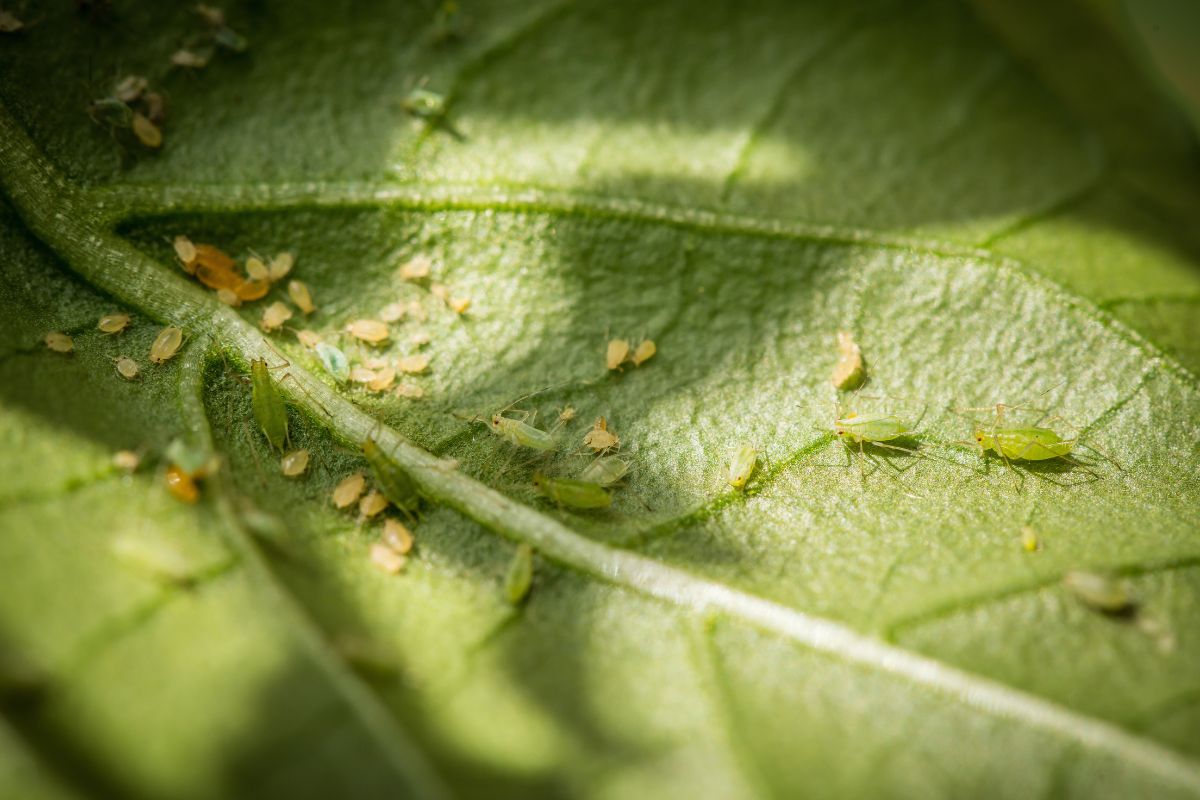
| Aphids | 1/16-⅛ inches (1.6-3.2 mm) Translucent white, green, pink, orange, or black, pear-shaped body with two rear cornicles Winged adults are darker but with distinct cornicles | Localized yellowing at the site of infestation Honeydew Sooty mold and/or ants |
| Spider Mites | <1 mm (microscopic) Spider-like with 8 legs (6 for nymphs) | Speckled white or yellow discoloration on leaf surface Fine webs on leaf surface or between leaves and stems |
| Fungus Gnats | 1/16-⅛ inches (1.6-3.2 mm) Black or dark gray body with one pair of grayish wings Mosquito-like | Wet, soggy soil surface several days after watering More pronounced root rot symptoms, such as yellowing leaves, mushy brown spots on leaves and stems, wilting |
| Whiteflies | 1/16 inches (1.6 mm) White, waxy wings over a white or yellowish body | Stippling or yellowing of leaves Honeydew Sooty mold and/or ants |
Final Thoughts
Thrips are common but relatively manageable pests of houseplants when diagnosed and treated promptly.
My favorite treatment tool is a spinosad spray that kills thrips on contact and has a mild systemic effect, killing even the larvae hiding within the plant tissue. Two applications of spinosad treatment usually do the trick. Be sure to follow the product label for proper and safe use.
Prolonged infestations without treatment efforts can significantly damage the plant’s overall appearance because thrips can reproduce quickly, and massive feeding can scar leaves and defoliate the plant.
Remember to monitor plants routinely, maintain healthy conditions, and act swiftly at the first signs of trouble.
Do you have a recent problem with thrips? Share your experiences or ask questions in the comments.