
When and How Often to Water Fiddle Leaf Figs
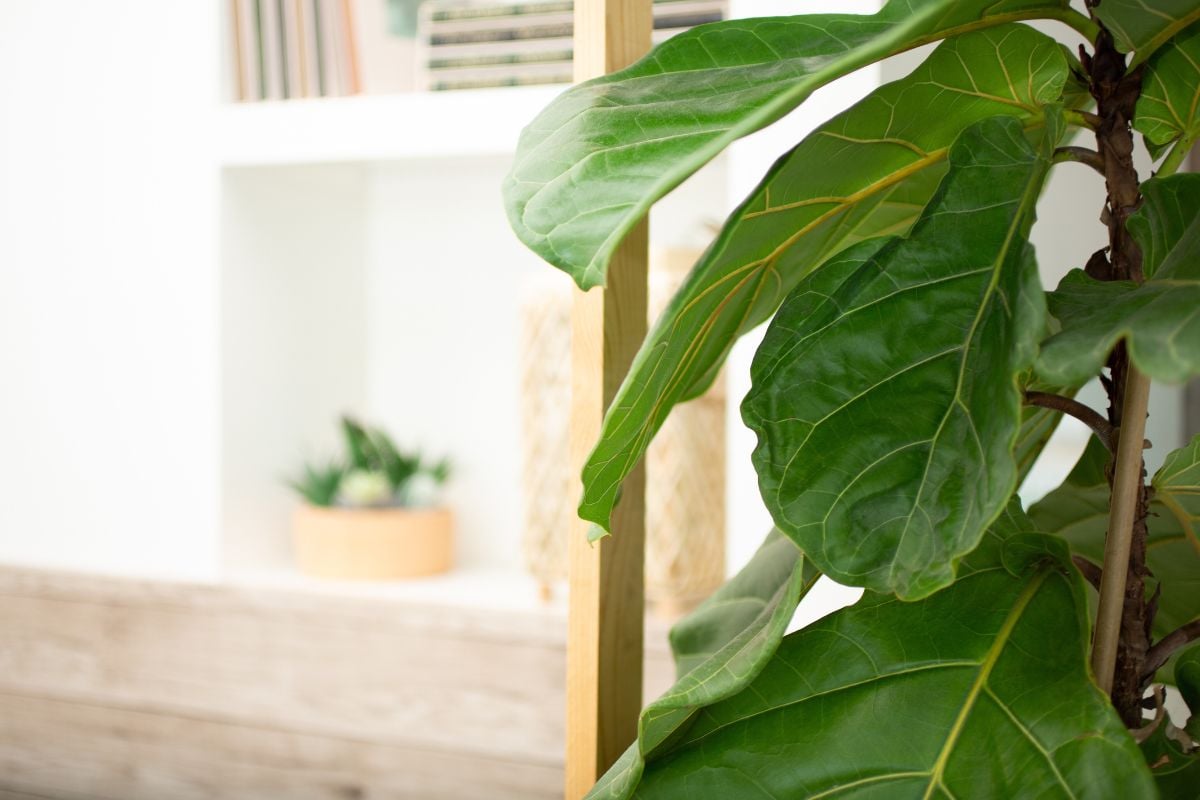
Fiddle leaf figs are amazing indoor trees admired for their striking leaves and elegance. However, they’re also known for being fussy, especially because their watering needs are tricky.
Here are some essential guidelines for a fiddle leaf fig’s watering needs:
- Use well-draining, loamy soil rich in organic matter (compost) for optimal drainage, rehydration, and nutrient retention.
- Use a pot with drainage holes at the bottom to avoid waterlogging and root rot.
- Deeply water the plant when the soil’s top 1-2 inches (2.5-5 cm) is completely dry.
- Older plants close to 10 years old with extensive roots in large pots can wait until the soil is dry halfway through.
- Avoid shallow watering, which unevenly rehydrates the soil, leading to hydrophobic soil clumps and partially dehydrated roots and leaves.
- If you must spray the leaves for routine cleaning, wipe them dry with a clean towel to prevent fungal and bacterial growth.
Proper watering is vital to a fiddle leaf fig’s overall health and aesthetic appeal. The rest of the article will provide a practical guide on correctly watering your plant and preventing water-related issues like leaf discoloration, microbial infection, and leaf drop.
Natural Habitat and Environmental Adaptations
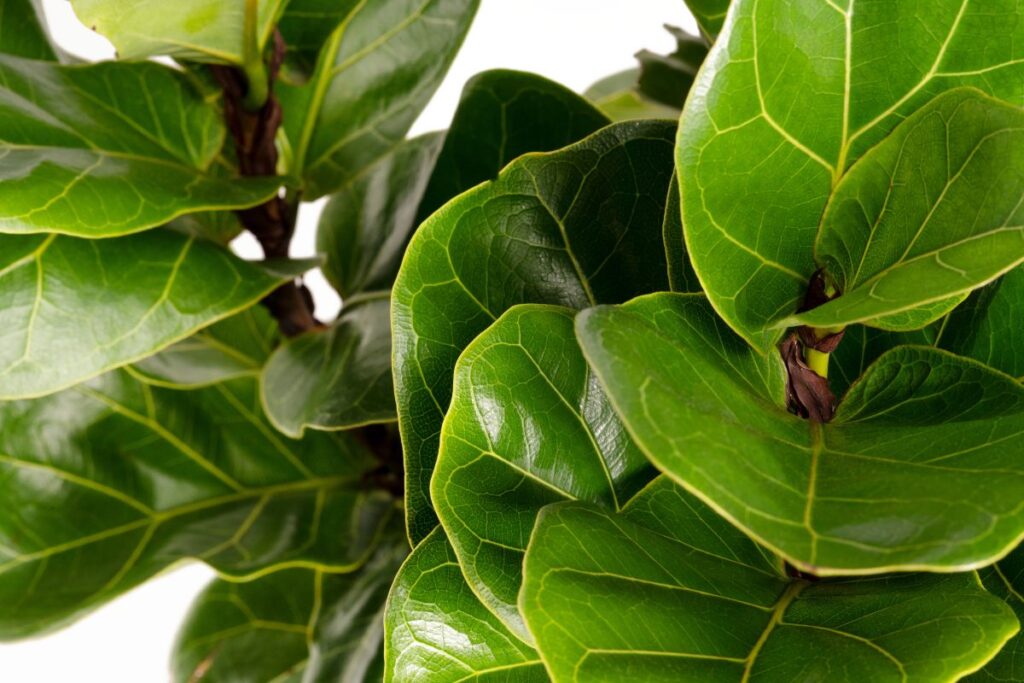
Fiddle leaf figs (Ficus lyrata) are moisture-loving tropical trees native to West and Central African rainforests.
In nature, they’re exposed to the following environmental conditions:
- Rainfall: Most rainforests in West and Central Africa receive an average of 40-80 inches (100-200 cm) of rain annually. Sometimes, it can reach over 120 inches (300 cm).
- Humidity: The average humidity is around 70%. It drops to around 60% during the dry season but can reach over 80% during the wet season.
- Sunlight: The leaves of taller fiddle leaf figs receive direct sunlight, whereas younger and shorter plants receive filtered or dappled sun. The soil also remains evenly moist because sunlight hardly reaches the forest floor.
- Temperature: The temperatures range from 70-86 °F (21-30 °C) and seldom drop below 55 °F (13 °C). The moist environment and abundant rainfall provide the fiddle leaf figs resistance to higher temperatures.
- Nutrients: The warm and moist conditions in tropical rainforests promote continuous microbial activity that breaks down organic matter and cycles nutrients for the steady growth of fiddle leaf figs all year round.
- Soil: Fiddle leaf figs have been found growing in light (sandy) to heavy (clayey) soil. They can tolerate different soil types as long as they drain well.
Adequate moisture in the soil and air significantly influences the fiddle leaf fig’s morphology in the following ways:
- The extensive fibrous roots grow close to the surface and spread wide for better anchorage, prevention of soil erosion from rainwater runoff, and access to moisture and nutrients at the top humic area. The thin roots will likely rot in soggy conditions, so it’s important for fiddle leaf figs to grow in well-draining soil.
- The wide leaves are susceptible to rapid moisture loss from transpiration, but the moist soil and humid air in the rainforests protect them from drying out.
How Indoor Conditions Affect Watering Needs
Although fiddle leaf figs (FLFs) can adapt to indoor conditions, they can be fussy and won’t look as majestic as they would in the wild. FLF leaves are prone to turning yellow or brown or falling off when kept in dry soil or air.
Consider the factors below to help indoor fiddle leaf figs utilize water efficiently and maintain their vibrant foliage:
Light
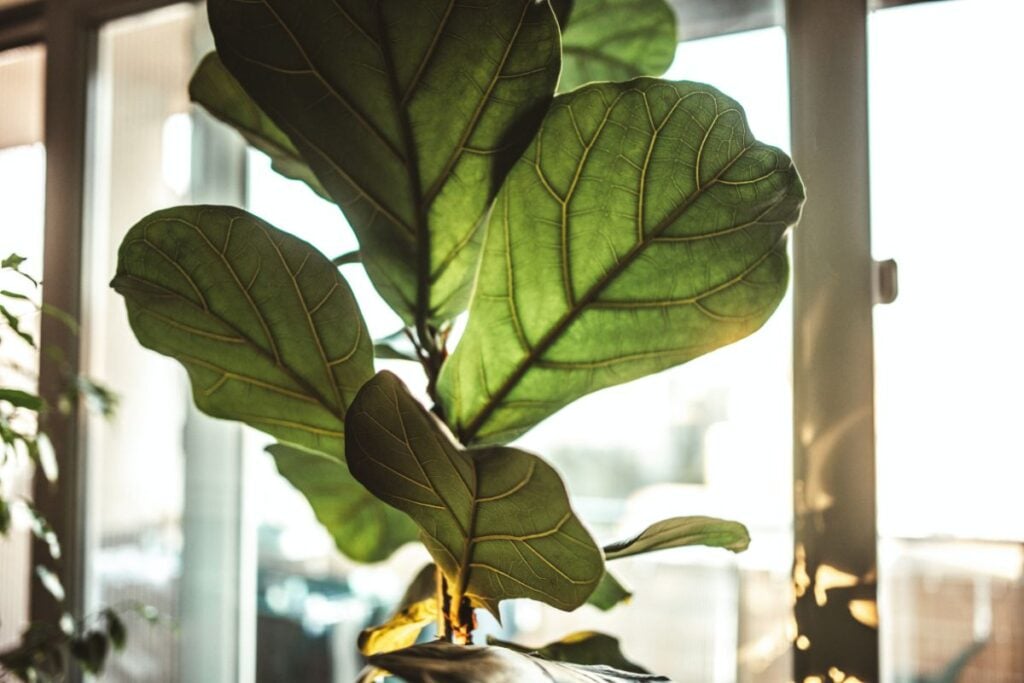
Varying light conditions play a significant role in how often you need to water your fiddle leaf fig. Bright light accelerates the plant’s metabolism, increasing water uptake and evaporation rates.
Here’s how light impacts watering:
- Direct morning sunlight (up to 4 hours): Larger trees with darker leaves thrive in these conditions, but their soil tends to dry out faster, requiring more frequent watering. For instance, I sometimes water my sun-exposed FLFs every 3-5 days during the peak of summer because the soil dries out sooner.
- Bright indirect light (at least 8 hours daily): Plants in these conditions use moderate amounts of water and can sometimes last several weeks before needing another drink. Check soil moisture regularly to avoid underwatering.
Pro tip: Rotate the pot every time you water to ensure even light distribution, which promotes balanced growth and prevents parts of the plant from drying out unevenly. Keep in mind that prolonged direct sunlight can cause the leaves to dry out or scorch, which may necessitate more frequent watering to combat dehydration.
Temperature and Humidity
Maintain the following indoor conditions for the optimal health and water use of fiddle leaf figs:
- Temperature: 65-75 °F (18-24 °C)
- Humidity: 40-60%
Hot and dry conditions can cause fiddle leaf figs to lose moisture more quickly through evaporation and transpiration. If the soil dries out too quickly, you may notice yellowing or browning leaf edges—a clear sign to adjust your watering routine.
Soil Quality
The quality of your fiddle leaf fig’s soil is crucial for maintaining proper watering practices. Well-draining soil rich in organic matter ensures that water is distributed evenly and prevents overwatering or waterlogging.
After years of trying out different potting mixes, I found a recipe perfect for fiddle leaf figs at all life stages, starting from the initial transplant of newly rooted cuttings.
Here’s my go-to recipe:
- High-quality houseplant potting mix (60%): Commercial potting mixes typically contain moisture-retaining materials like peat moss, vermiculite, coir, and compost. Some products may also have real soil, like loam and sand.
- Perlite (30%): Although commercial potting mixes have perlite, adding up to 30% more pure perlite (or pumice) can help improve drainage and aeration.
- Compost (10%): Compost can help improve the texture of the soil, add organic matter, and boost beneficial microbe populations.
Pot Size and Drainage

The size and drainage of your pot significantly affect how your fiddle leaf fig retains and utilizes water.
Here are some considerations for choosing the right pot size for fiddle leaf figs:
- Young FLFs (1-3 years old): Plant young FLFs in a pot 2 inches (5 cm) wider and deeper than the rootball to encourage growth. They may be repotted every spring until they’re about 3 feet (0.9 m) tall.
- Older FLFs: Use a pot 2-4 inches (5-10 cm) wider than the old pot. Older FLFs may gradually slow down vertical growth and can be repotted every 2-3 years or as soon as they show signs of being rootbound, such as roots growing out of the soil surface or through the drainage holes. Use a similar-sized pot if you must prune up to a third of the rootball due to root rot or desiccation.
In addition, here are some tips for pot drainage and design:
- Ensure the pot has adequate drainage holes at the bottom to avoid waterlogging.
- Place a wire mesh over the drainage holes before planting to avoid flushing soil out every time you water the plant. It can also prevent soil plugs that may inhibit proper drainage.
- Place large and heavy pots over a grilled or lattice-designed plant caddy and position a drip tray underneath to catch the excess water and keep the floor clean.
Note: Some sources may recommend self-watering pots for fiddle leaf figs. I tried using them for my young plants but ended up overwatering and drowning the roots because the soil stayed unnecessarily moist for too long.
A friend recommended using self-watering ceramic spikes only when I have to be away from home for several weeks or a month, and they worked great.
They’re easy to use, but remember the following tips:
- Follow the product-specific instructions on how to set up the spikes for maximum efficiency.
- Be sure to use a pot with drainage holes for optimal drainage, even when using the spikes.
- Keep the water reservoir at the same level as or up to 5 inches (13 cm) lower than the pot for slow and even moisture transfer, which is suitable for fiddle leaf figs. If the reservoir is too low, the plant will dry out; too high and it’ll drown.
Timing & Frequency
Several sources suggest sticking to a consistent watering schedule for plant health. However, I don’t recommend following a strict schedule when watering fiddle leaf figs because many factors can influence how much and how quickly they can consume water.
Instead, it’s best to check the soil moisture regularly to prevent over- or underwatering. A good rule of thumb is to water fiddle leaf figs when the soil is dry 1-2 inches (2.5-5 cm) deep.
I use one of these methods to check when it’s time to water my plants:
- Finger test: Check the soil dryness by digging your index finger 2 knuckles deep into the soil.
- Chopstick test: Calibrate a wooden chopstick (1-2 inches or 2.5-5 cm) and insert it into the soil to check if it is dry enough.
- Moisture meter: Wipe the metal probe with a clean, dry cloth and insert it into the soil ⅔ or ¾ of the way. Get the reading and repeat the process 3-4 times at different spots. If the average reading shows 4, it’s time to water the plant.
It can take some time to see the convenient watering pattern based on the seasonal changes in your area and your fiddle leaf fig’s growth rate. However, with enough patience and attention to your plant’s response, you can find a schedule that may work for you.
In my experience, this usually means watering my FLFs with the following frequencies:
- Spring to early summer: Every 7-10 days
- Peak of summer: Every 3-7 days
- Fall and winter: Every 10-14 days
Let’s explore a few factors below that can influence a fiddle leaf fig’s water use so you may properly adjust your watering routine:
Plant Size and Age

Fiddle leaf figs have varying moisture requirements at different life stages.
- Smaller and younger plants tend to soak up moisture quickly to fuel their rapid growth, so I deeply water them when the soil’s top 1-2 inches (2.5-5 cm) dry out. Note that young plants can’t absorb much water at once, so it’s crucial to avoid oversized pots and excess soil that can keep the developing roots sitting in soggy conditions.
- Older and larger plants have thicker and more extensive roots that can store extra moisture, requiring less frequent watering. They can wait until the soil is dry halfway through.
Note: Watering your plant with a fixed volume (i.e., number of cups) weekly, depending on the size or age, may seem like a convenient approach.
However, this method only works if the following indoor conditions are controlled:
Sticking to a strict watering amount and schedule can end up over- or underwatering your plant. Be flexible with your schedule as weather changes, like clear and hot or cloudy and cool days, can change your plant’s water consumption rate.
Shallow watering with a few cups weekly may also cause uneven rehydration of the soil and create some hydrophobic clumps. The roots in hydrophobic soil sections may dry out, leading to common problems like yellowing or browning leaves and leaf drop.
Soil Type and Drainage
Different types of soil mixes have varying moisture retention and drainage capacities.
- Loose soil mixes with larger portions of perlite, horticultural sand, or cactus mix will naturally require more frequent watering—ideally when the top 2 inches (5 cm) dry out.
- Peat-based soil mixes have excellent moisture retention and can take longer to warrant another watering.
Fiddle leaf figs prefer soil rich in organic matter like peat moss, which decomposes and shrinks over time, leading to compaction and poor water infiltration.
To address this, I usually aerate the soil with a wooden chopstick every month and rake in a handful of fresh compost to the top 1-2 inches (2.5-5 cm) of the soil every 6 months (spring and fall in the years between repotting) to improve water distribution through the root zone.
Seasonal Variations
Seasonal changes in the environment can also influence how fiddle leaf figs consume water.
- Spring and summer: Fiddle leaf figs grow more actively during spring and summer, naturally using more water. Higher temperatures and brighter light conditions may also dry out the soil more quickly through evaporation.
- Fall and winter: Lower light conditions and cooler temperatures will prompt fiddle leaf figs to enter a semi-dormant stage where growth noticeably slows down. During this time, you can allow the soil to dry out a bit more (up to halfway through).
Watering Tips and Methods
Here are essential tips for watering fiddle leaf figs:
- Use lukewarm water around 68 °F (20 °C) to prevent cold shock or heat stress to the roots.
- Use tap water for regular watering. Fiddle leaf figs have good salt tolerance and don’t mind the low mineral levels in tap water. For extra caution, if you have hard water, you can let the water sit uncovered overnight to release chlorine and let any salts settle at the bottom of the container.
- Dilute liquid fertilizer in filtered or distilled water to avoid unwanted chemical reactions between fertilizer salts and any potential minerals in tap water. Fiddle leaf figs need a half-dose of liquid fertilizer every other time you water in spring and summer to maintain their large leaves and encourage new growth.
- Avoid wetting the foliage to inhibit fungal or bacterial growth. If you must spray the leaves to remove dust, use filtered or distilled water and wipe the leaves dry with a clean cloth.
- Avoid shallow watering or letting the soil become bone dry, as it can encourage the buildup of hydrophobic soil clumps, especially for peat-based or sandy potting mixes.
- Check the soil at the drainage holes before watering to ensure proper drainage. You can poke the soil with a wooden chopstick to loosen potential soil plugs.
Top Watering
I prefer top watering my fiddle leaf figs because it’s easier and can leach unwanted mineral salts from the soil. It’s also convenient for larger and heavier pots I can’t carry into the tub for a soak.
Here’s how to properly top water your fiddle leaf fig:
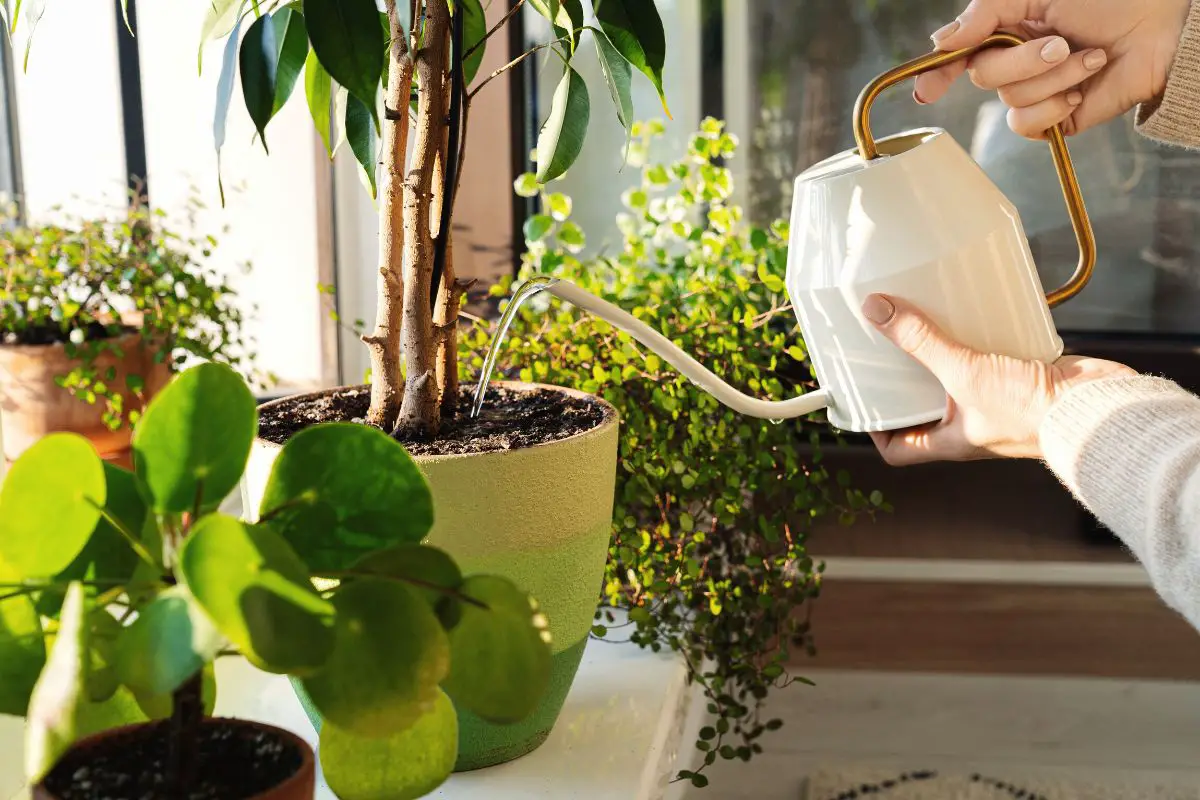
- Use a watering can with a narrow spout and swirl the tip over the soil for thorough rehydration of the root zone.
- Pour water evenly over the soil until the excess drains from the bottom.
- Throw away the water pooling at the saucer. You may need to check every 30 minutes to ensure the soil stops dripping and to prevent it from reabsorbing water.
Bottom Watering
Occasional bottom watering is useful for smaller pots (up to 12 inches or 30 cm tall). Doing it once a month or after 3-4 times of regular top watering helps ensure the root zone is evenly moist by rehydrating dry soil aggregates.
Follow the steps below for bottom watering:
- Soak the bottom third or half of the pot in a tub of water.
- Allow the soil and the roots to absorb water for up to 30 minutes.
- Remove the pot when the soil surface feels moist.
- Place the pot over a drip tray to drain the excess moisture.
Common Mistakes (& Fixes)
Fiddle leaf figs are known for being fussy, and the most common culprit is poor watering.
Here are some common watering mistakes to avoid:
Overwatering
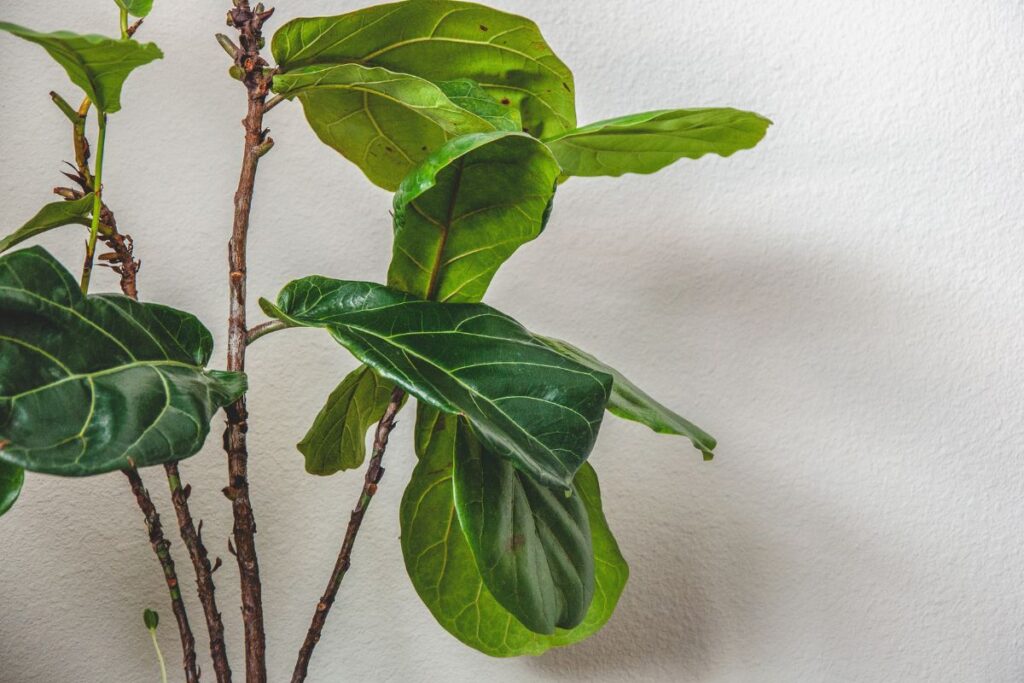
Watering fiddle leaf figs too often without giving the soil enough time to dry out enough can lead to root rot. The lack of oxygen in waterlogged soil can weaken the roots and encourage the growth of rot-causing fungi and bacteria.
Left unaddressed, an overwatered fiddle leaf fig will likely show the following symptoms in progression:
- Soggy soil surface several days after watering
- Red spots or edema on the leaves
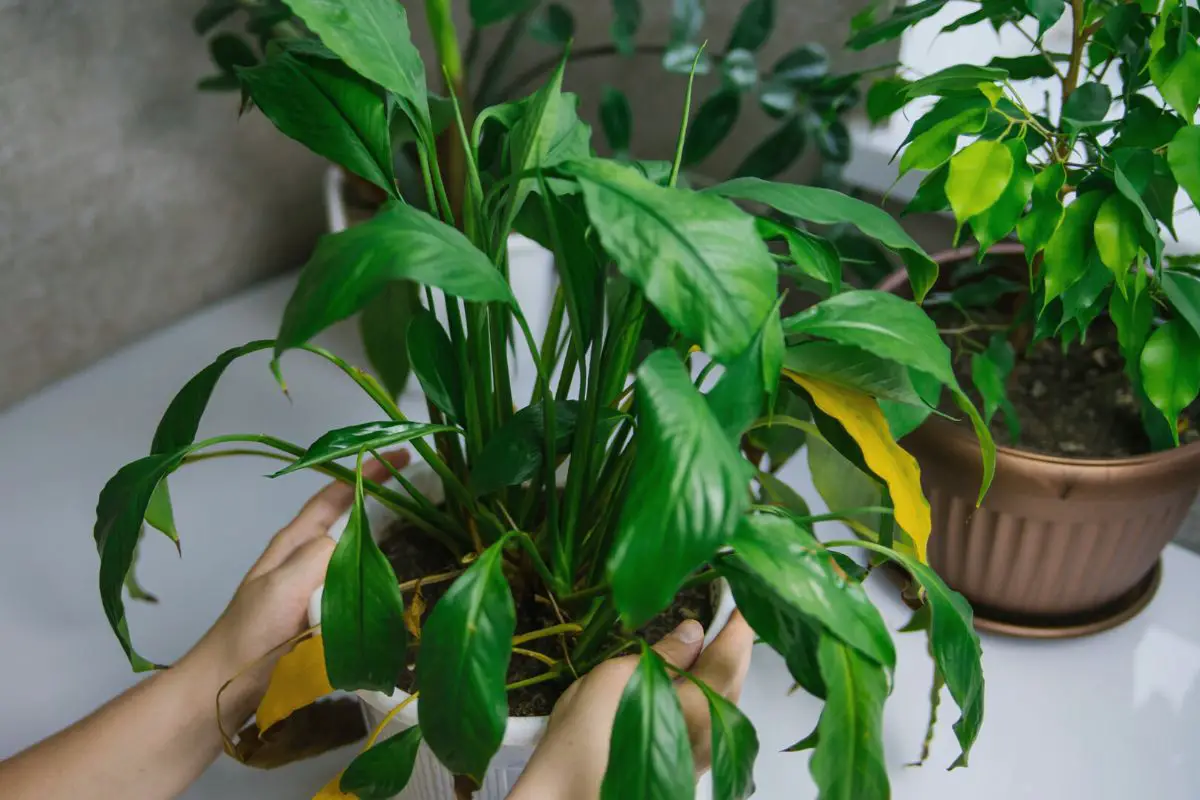
- Water-soaked spots on the leaves that gradually turn brown and mushy
- Black, mushy, and smelly roots (root rot)
- Yellow leaves from lack of moisture and nutrients
- Brown and dry leaves
- Black spots on leaves
- Leaf drop
- Stunted growth
- Plant death
You can treat early signs of overwatering (before root rot) with the following steps:
- Prune the leaves with brown spots using sterile shears because they won’t recover.
- Make it a habit to check the soil moisture between watering. You may use the finger test, chopstick test, or moisture meter.
- Let the soil dry out enough before watering. For instance, wait until the soil’s top 2 inches (5 cm) is dry for younger plants or up to halfway down for older plants in larger pots.
- Check the drainage holes regularly for any sign of plugging that can cause waterlogging. Loosen the plug to improve drainage.
On the other hand, plants that show signs of root rot need a more invasive approach. The only way to potentially save your plant is to repot it in fresh soil and a sterile pot.
Use a hand cultivator or wooden chopstick to dig into the soil’s top 1-2 inches (2.5-5 cm). Inspect the roots to confirm the signs of root rot, such as black, mushy sections that crumble between your fingers.
Here’s how to treat and repot a fiddle leaf fig with root rot:
- Run a spatula around the soil’s edges to release the rootball from the pot.
- Carefully unpot the plant to minimize damage to the roots.
- Break the soil apart with your gloved hands to expose the roots. The soil is most likely wet from overwatering, making it easier to detach from the roots. In case of compaction, use a wooden chopstick or hand cultivator to loosen the soil.
- Rinse the remaining soil off the roots using lukewarm water for a thorough inspection.
- Cut all the rotten roots using sharp, sterile scissors. Clean the blades with rubbing alcohol and cotton balls between cuts to prevent the spread of infection.
- Prune the discolored or damaged leaves as well.
- Soak the roots in 1% hydrogen peroxide for around 10 minutes. You may pour the solution over the roots if the tree is too big.
- Let the roots dry over a clean towel for up to 30 minutes.
- Prepare a new, sterile pot with drainage holes. Use a similar-sized pot if you removed at least a third of the roots. Only use a larger pot (2 inches or 5 cm) if you pruned less than a third of the roots.
- Place a wire mesh over the drainage holes and fill the pot with a mound of fresh and moist FLF soil mix up to 2 inches (5 cm) high. Ensure the soil mix has good drainage to avoid overwatering issues.
- Spread the roots over the mound and fan them out for better anchorage.
- Cover the roots with moist soil until they’re about an inch (2.5 cm) below the soil surface. Ensure the root’s crown is partially exposed over the surface to prevent the recurrence of root rot.
- Place the pot in a warm room (around 70 °F or 21 °C) with bright indirect light and moderate humidity (around 50%) while the plant recovers.
- Hold off on watering until the soil’s top 2 inches (5 cm) dries out.
- Deeply water the plant and let the excess water drain completely.
Adjust based on the tips discussed above to avoid future problems with overwatering and root rot problems.
Underwatering
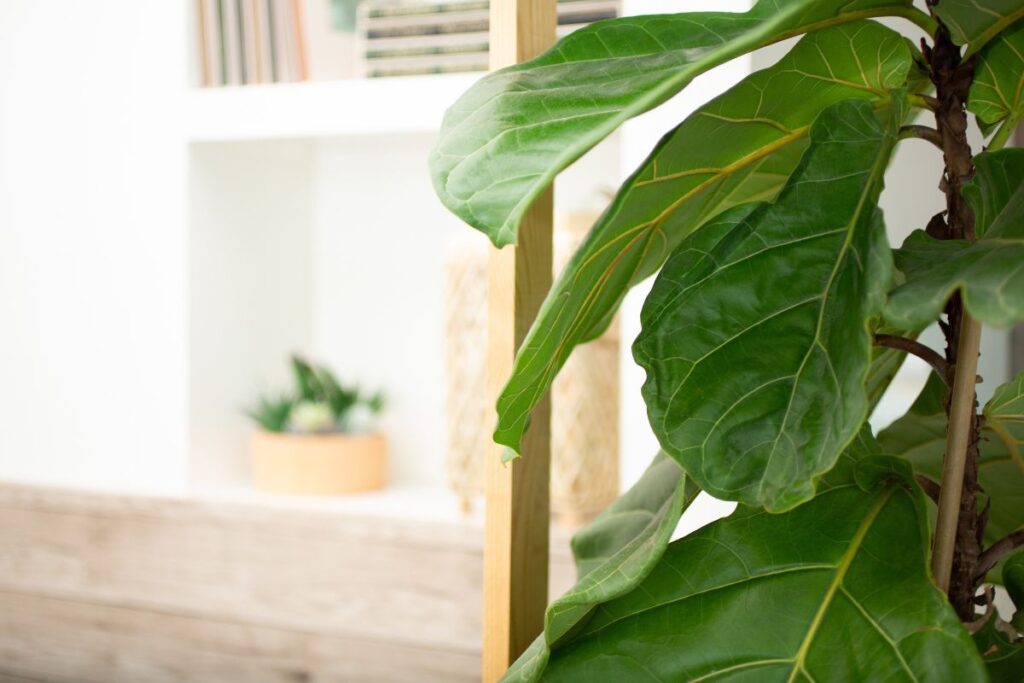
Fiddle leaf figs are also sensitive to dry conditions and will likely show the following symptoms:
- Crusty soil surface with poor water infiltration (a sign of hydrophobicity from chronic underwatering or prolonged drought)
- Drooping leaves or branches
- Yellowing leaf edges
- Brown and crisp leaf edges
- Curling leaf tips
- Leaf drop
- Stunted growth
You can fix underwatering problems with the following tips:
- Use a hand cultivator to rake the soil surface up to an inch (2.5 cm) deep and relieve crusting.
- Work a handful of compost into the soil surface to improve water infiltration.
- Bottom water the plant for up to 30 minutes to evenly rehydrate the soil. You can top water with a watering can with a narrow spout for larger pots.
- Check the soil moisture regularly and deeply water the plant when the soil is dry 2 inches (5 cm) or halfway down (depending on plant size, age, and soil type).
- Avoid shallow watering since peat moss and sand can be hard to re-wet when allowed to dry out.
Environmental Neglect
Failing to adapt your watering schedule to seasonal shifts in the environment can also lead to watering problems.
Here are some changes to watch out for:
- The rise in temperature and light intensity in the summer can increase the fiddle leaf fig’s metabolic activities and transpiration rate. It can also dry out the soil more quickly through evaporation.
- Fluctuating humidity levels and sudden nighttime dips from fall to winter due to cold and dry air can stress fiddle leaf figs and cause leaf drop.
Advanced Tips (for Optimal Watering)
To fix the problem, you may follow the tips below:
- Make it a habit to check the soil moisture before watering, as the rate of water loss can change even within the same season.
- Switch on a humidifier during the driest part of the day. Monitor the humidity level using a portable hygrometer and position the humidifier about 2 feet or so (+0.6 m) away from your plant. Keep the device on for several hours until the reading appears stable around 50% near your fiddle leaf fig.
- Group fiddle leaf figs with succulents with similar environmental needs, such as jade plants, because they transpire at night and can help boost the local humidity in your indoor garden.
- Observe your plant for signs of stress, such as yellowing, browning, or leaf drop. Refer to the additional symptoms discussed above to distinguish between over- and underwatering and correctly apply the appropriate fixes.
Final Thoughts
Getting a fiddle leaf fig’s watering needs is tricky because it loves moisture but dislikes wet feet. Finding the optimal watering routine can take some time of experimenting, patience, and a few lost leaves.
It’s easy to feel frustrated when your fiddle leaf fig sheds leaves, and you’re unsure whether it needs more or less water. These plants can be sensitive and may quickly lose leaves due to stress, but don’t worry—fiddle leaf figs are resilient and can bounce back if you quickly identify and address the problem.
You can get a trusty moisture meter with a light sensor and a hygrometer with a thermometer to monitor environmental conditions more readily.
Please leave a comment below if you have questions or expert advice about a fiddle leaf fig’s watering needs. You may also share general tips about FLF care to support the growing community of indoor plant enthusiasts.