
How to Plant, Grow, and Care for String of Pearls
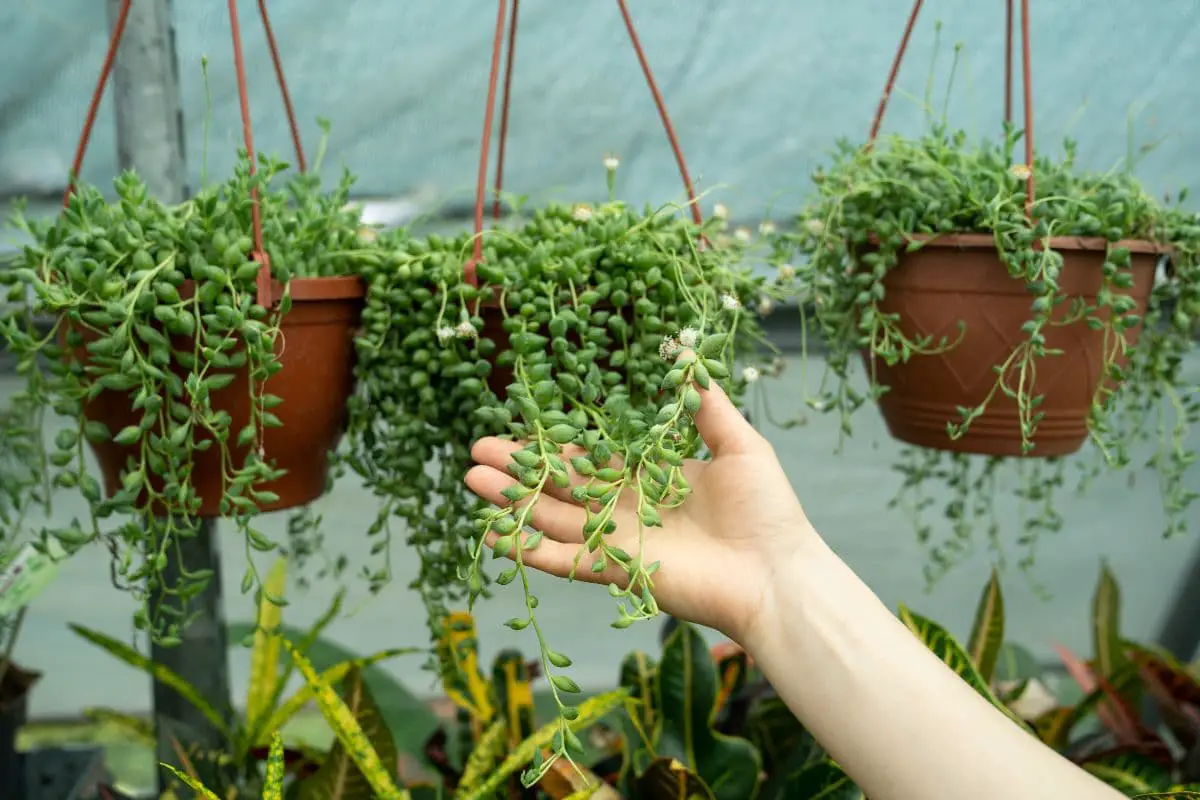
String of pearls is an intriguing plant that’s becoming increasingly common in homes, thanks to its unique bead-like leaves and long, fleshy stems that make it a striking addition to any indoor garden.
String of pearl plants are low-maintenance succulent vines suitable for beginner gardeners. They thrive in bright light, infrequent watering, and moderate indoor temperatures. They’re also easy to propagate and have numerous decorative potentials, making them fantastic houseplants.
The rest of the article will discuss a string of pearls’ qualities and growth requirements. I’ll also share practical tips to help these wonderful plants thrive in your home.
Quick Guide
| Common Name(s) | String of pearls, string of beads |
| Botanical Name | Curio rowleyanus (previously Senecio rowleyanus) |
| Family | Asteraceae |
| Plant Type | Succulent vine |
| Native Area | South Africa |
| Height & Spread | Up to 6 inches (15 cm) tall and 1-3 feet (30-90 cm) long |
| Bloom Time | Spring or summer |
| Flower Structure | Single spike, like pom-poms |
| Color | White |
| Sun Exposure | Dappled sun or partial sun (2-6 hours of direct sunlight) |
| Soil Type | Loose, well-draining |
| Soil pH | 6.5-7.0 |
| Watering | Every 10-14 days in regular pots Every 5-7 days in hanging baskets |
| Pests, Diseases, Common Problems | Aphids, mealybugs, whiteflies, spider mites, fungus gnats Powdery mildew, root rot Dieback after 3-4 years |
| Toxicity | Mild for adult humans (mild skin irritation from sap) Severe for young children and pets Ingestion of sap in the leaves can cause gastrointestinal problems |
| Required Maintenance | Low-maintenance Water every 1-2 weeks during spring and summer or once every 3-4 weeks in fall and winter Propagate every 2-3 years |
String of Pearls: An Overview
The String of Pearls (Curio rowleyanus), formerly known as Senecio rowleyanus, is a fast-growing succulent vine from South Africa, prized for its distinctive bead-like foliage and cascading growth habit. It’s also known as string of pearls or SOP.
Its native environment has the following characteristics:
- Loose, sandy soil
- Dappled sun from surrounding rocks and taller plants
- Infrequent rains (3-9 days a month)
- Moderate temperatures of 65-80 °F (18-27 °C) with frost-free winters that seldom drop below 50 °F (10 °C)
- Low-moderate humidity of around 30%
These environmental conditions are easy to replicate indoors, making the string of pearls an excellent low-maintenance houseplant.
Anatomy

The environmental conditions in their native habitat influenced the following unique traits in the string of pearls.
Bead-like Leaves
In the wild, the stems sprawl on the ground, reaching up to 3 feet (0.9 m) long.
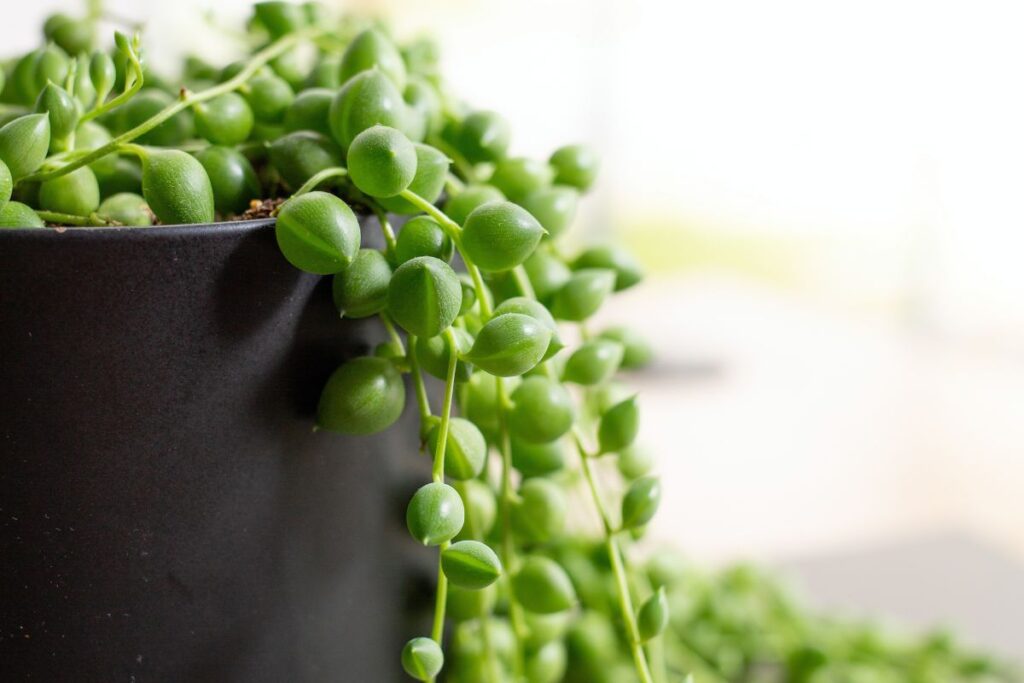
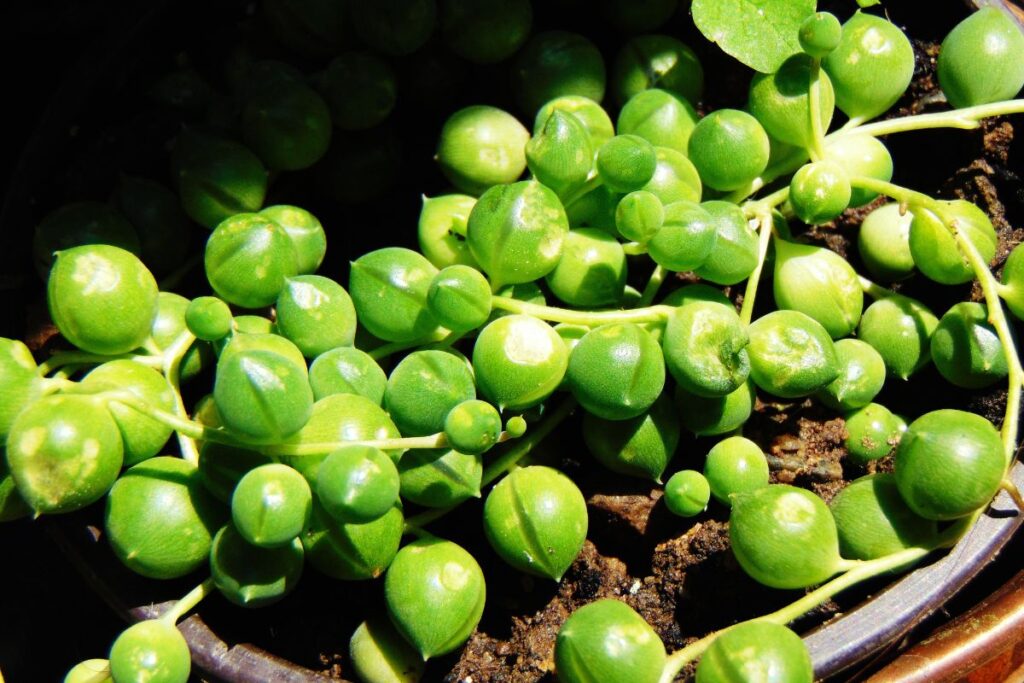
The unique, succulent leaves are almost spherical with tiny pointed tips, earning the plant the nickname string of pearls or string of beads. Each leaf or ‘pearl’ is about ¼ inch (0.6 cm) in diameter.
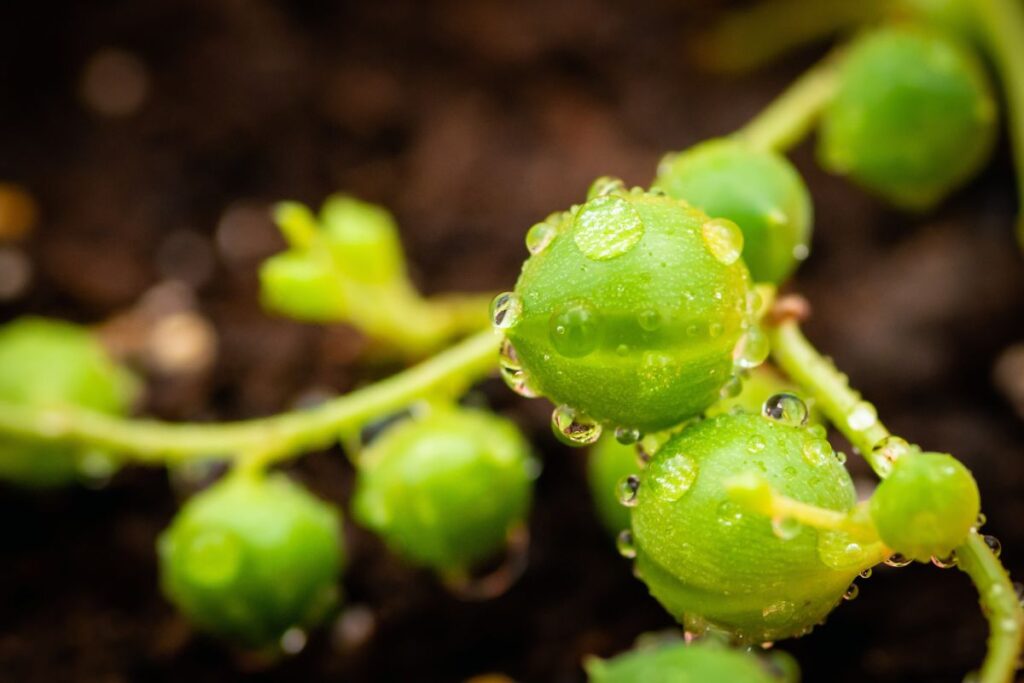
The leaves are green with a translucent streak called the epidermal window, which allows light to enter for photosynthesis. They also have excellent moisture storage capacity, helping the plant survive drought.
Roots
The string of pearls has a shallow and fragile root system that can sprout on any node along the stem that touches moist soil. This adaptation helps the plant absorb moisture quickly as shallow rain hits the ground.
Flowers
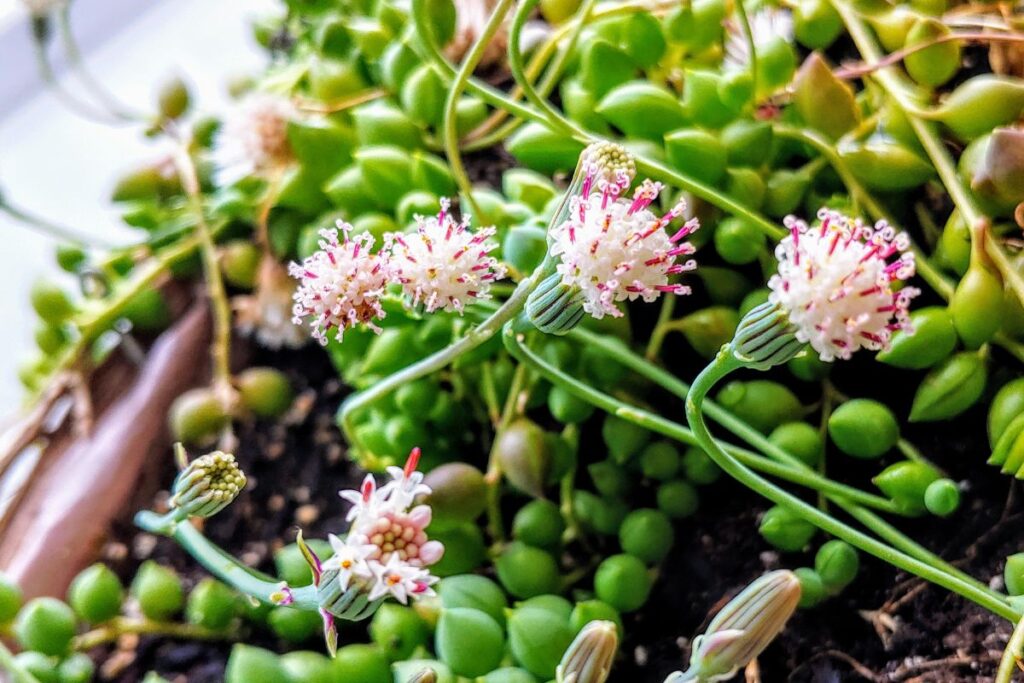
A mature string of pearls plant typically blooms in summer in its native environment. The flowers are white and fluffy like pompoms with red stamens and yellow-orange anthers. They are fragrant and smell like cinnamon.
String of pearls seldom bloom indoors because of insufficient environmental cues in the fall and winter, including the following:
- Stable, cooler nighttime temperatures between 50 and 60 °F (10 and 15.6 °C)
- Less frequent watering (water only when the soil is almost completely dry)
- Less intense natural light (8 hours of bright, indirect light)
Reproduction
In the wild, an SOP can reproduce through seeds dispersed from the flowers by the wind.
The plant may also spread through random nodes along the stems. Although the stems gradually die back after a few years, the terminal ends may continue to grow with new roots if their nodes remain in contact with adequately moist soil.
An indoor plant requires human intervention to extend its lifespan. The trailing stems won’t form roots unless in contact with the soil. They need to be propagated every 2-3 years.
I’ll discuss the propagation process in more detail below.
Dormancy and Growth Rate
Curio rowleyanus is an evergreen succulent that normally doesn’t go dormant in the wild. Instead, it grows more slowly during the cold season to preserve moisture and energy due to less frequent rainfalls and lower light intensity.
Plants kept in stable environmental conditions indoors will likely grow steadily and put on 6-18 inches (15-45 cm) of growth annually.
With proper seasonal adjustments, such as less intense light, lower temperatures, and less frequent watering, they may grow only 1-2 inches (2.5-5 cm) from fall to winter.
Toxicity
The sap in a string of pearls plant leaves contains alkaloids that can affect humans in the following ways:
- Mild skin irritation in susceptible individuals upon contact
- Nausea and/or vomiting from ingestion of the leaves
It can be severely toxic to dogs and cats when ingested in large amounts and can lead to the following symptoms:
- Itchiness in the face or mouth
- Inflammation of the skin or oral cavity
- Vomiting
- Diarrhea
- Loss of appetite
- Weight loss
- Liver failure (accompanied by dark urine and jaundice or yellowing skin)
To prevent these issues, keep the plant inaccessible to pets. Curious children may also try to put the bead-like leaves in their mouths, so it’s best to put the plant beyond their reach. Hanging baskets or high shelves are excellent placement options.
In addition, wear gloves when handling or pruning the stems to prevent skin irritation.
Benefits as Houseplants
A string of pearl plant is a fantastic addition to an indoor garden for the following reasons:
- Low-maintenance: Once you find the right spot in your home, SOPs are easy to grow and care for.
- Multiple decorative options: It can be grown as a spiraling plant in a shallow planter or as a trailing plant in a hanging basket.
- Easy propagation: You can collect multiple stem cuttings, which will readily root in suitable substrate to grow new plants.
Popular Varieties
If you’re interested in plants with unique, trailing foliage, you can find several varieties under the Curio genus.
Here are some examples:
| Species / Variety | Physical Traits |
| C. citriformis (String of tears) | Tear-shaped leaves with distinct pointed tips and stripes of light and dark green Stems are less than 12 inches (30 cm) long and appear bushy instead of trailing |
| C. herreanus (String of watermelons) | Rounded leaves with pointy tips Stripes are purple and green, like a watermelon Trailing stems are typically 12 inches (30 cm) long |
| C. x peregrinus (String of dolphins) | Dolphin-shaped curvy leaves about 1-1.5 inches (2.5-3.8 cm) long Trailing stems can reach 1.5 feet (45 cm) long |
| C. radicans (String of bananas) | Banana-shaped leaves about an inch (2.5 cm) long with two epidermal windows on either side Stems can grow 6-12 inches (15-30 cm) long |
Selecting Your Plant
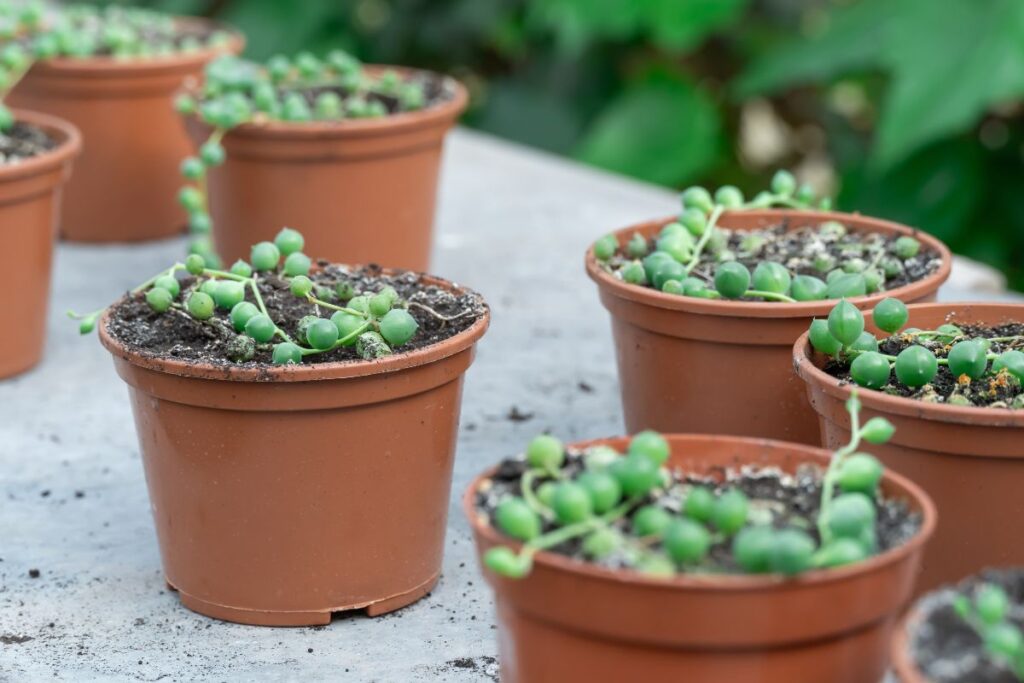
String of pearls and its ‘string’ cousins are becoming increasingly popular in U.S. homes, with numerous enthusiasts sharing attractive photos of their collections on social media.
Here are the things to remember when purchasing a plant from a nursery or gardening store:
- Choose a plant that’s at least 6 inches (15 cm) long with at least five stems. I prefer young string of pearl plants with multiple branches because it can indicate they’re growing vigorously. You’ll also have several stems spilling from the edges of the pot.
- The stems close to the soil must be green and fleshy. It means the plant is healthy, free from rot, and will continue to grow longer. Conversely, browning stems indicate that the plant is aging or in the process of dying back.
- The leaves must be green, plump, and firm. Avoid plants with discolored, shriveled, or mushy leaves because they indicate plant stress.
- Avoid plants with sticky leaves because they may indicate existing problems like overwatering, sun or heat stress, or pest infestation.
- Inspect the leaves and stems for signs of pests. Avoid plants with honeydew, white fluff (mealybugs), small crawlers (aphids), and webbing (spider mites).
Initial Planting
After bringing your plant home, keep it isolated in a warm room with bright, indirect light for up to 8 weeks, which is enough time to reveal and treat any existing pest infestations or diseases.
More importantly, C. rowleyanus has fragile roots, so they don’t respond well to frequent repotting. I recommend keeping the plant in the same pot for at least one year before the initial repotting.
Choosing the right pot and soil mix is crucial to prevent watering problems and ensure your plant maximizes its lifespan.
Choosing the Right Pot
String of pearl plants are short-living perennials, so consider the new pot as their permanent home.
Here are some factors to consider when choosing the pot:
- Size: Choose a pot that’s only 2 inches (5 cm) wider and deeper than the old one. Avoid oversized pots, as they can hold excess moisture, increasing the risk of root rot.
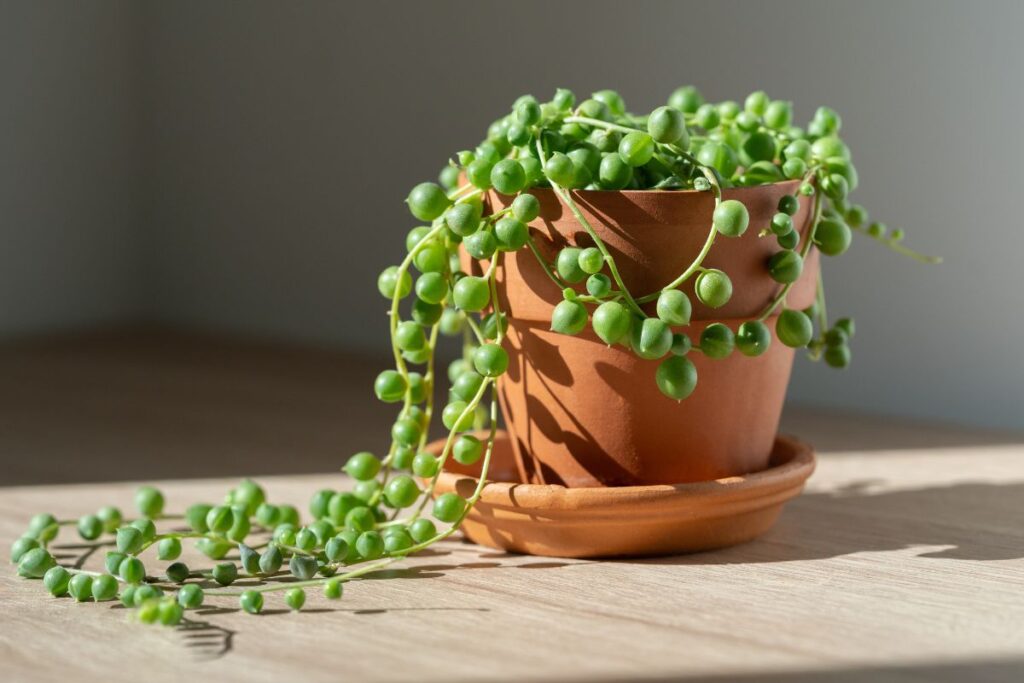
- Material: Unglazed terracotta with a drainage hole is the best option for a string of pearls. The breathable walls can help wick excess moisture and improve air circulation in the soil. If you want to use a decorative ceramic pot, ensure it has adequate drainage holes.
- Cleaning: When reusing an old container, sterilize it with a 10% bleach solution and rinse thoroughly with clean water. Air dry the pot for around 2 days before repotting.
Preparing the Right Soil Mix
A string of pearl plant requires loose, well-draining soil to keep the roots healthy.
You can choose from the following recipes:
- High-quality cactus or succulent mix
- 2 parts standard potting soil, 1 part perlite, and 1 part bark
- Equal parts potting soil and coarse horticultural sand or perlite
Step-by-Step Planting Guide
The vining nature of Curio plants requires special care when repotting to prevent root damage.
Follow these steps to transplant your string of pearls:
- Schedule the repotting in spring when the plant is actively growing so the roots can adapt to the new environment more readily.
- Water the plant deeply several days before repotting (2-3 days for hanging plants, one week for regular potted plants).
- Place a coffee filter or mesh pad over the drainage hole and fill the bottom of the new pot with 2 inches (5 cm) of soil.
- Squeeze the nursery pot to loosen the rootball. You may also lift the trailing stems and scrape the edges of the pot using a sterile spatula or a flat knife before sliding the rootball out.
- Inspect the roots poking out of the soil. White tips indicate that the roots are healthy and growing well. Pro tip: Don’t remove the old soil if the roots appear healthy. Conversely, black or brown and mushy tips indicate root rot and will need a thorough inspection. (I’ll discuss how to address this later in the article.)
- Position the rootball at the center of the new pot, and fill in the gaps around it with fresh soil. Ensure the vines and leaves are flush with the pot’s rim and not buried in the soil. Let them dangle freely from the edges of the pot for better light access and air circulation.
- Water the soil deeply and evenly to encourage the roots to grow into the new soil. Wait until the top ⅔ of the soil is dry before watering again.
- Place the plant in a warm room with bright indirect light for about a week before gradually introducing it to direct morning sun.
Optimal Growing Conditions
Here are the optimal environmental conditions for a thriving string of pearl plant:
Light
Southern or western windows might have scorching light, especially in the summer, so it’s best to filter the light with sheer curtains.
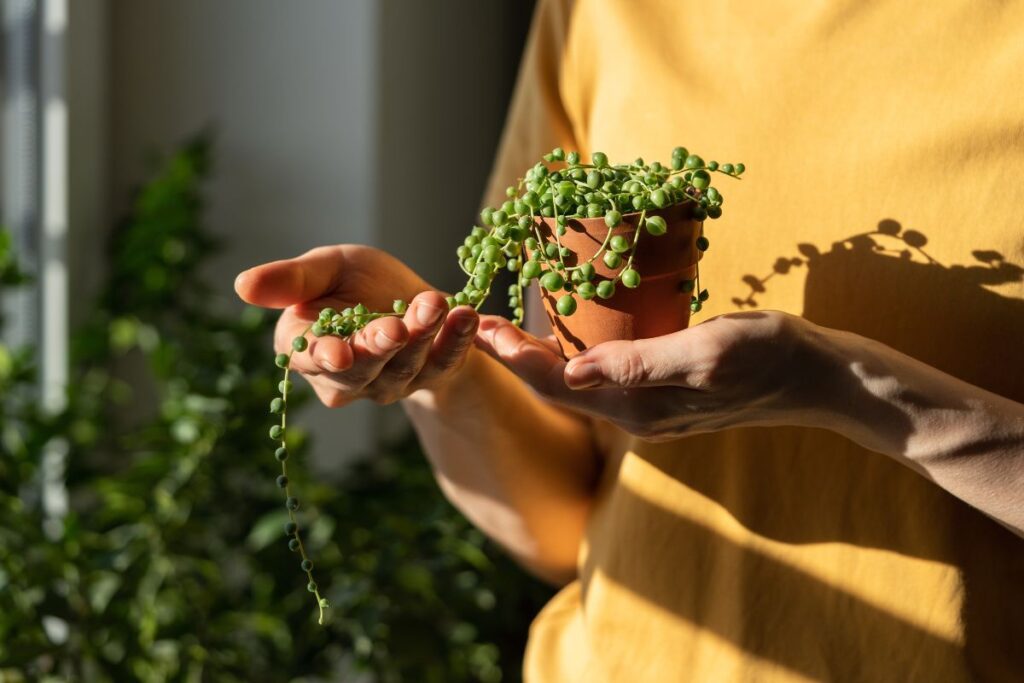
- Plants over one-year-old like up to 4 hours of direct morning sunlight from an eastern window.
- Younger plants will do well with 8 hours of bright indirect or filtered light daily.
Pro tip: Find a location in your home where the top of the pot can get access to sunlight or bright, indirect light. This will encourage the roots to dig deeper into the soil and provide a sturdy anchor to the trailing stems.
It also helps to rotate the container regularly to promote lush and balanced growth. You can give the container a quarter or a half-turn weekly (hanging basket) or every time you water the plant (regular pot).
If your home has insufficient access to natural light, you can use a 40-watt full-spectrum grow light.
Follow these tips for optimal light access:
- Position the lamp at a 45° angle above your plant.
- Place it 6-12 inches (15-30 cm) away.
- Keep it on for 12-16 hours daily in the spring and summer or 10-12 hours in the fall and winter.
- Rotate the pot regularly to give the trailing stems equal access to light.
Temperature
Maintain moderate temperatures between 65 and 80 °F (18 and 27 °C) from spring to summer.
It’s okay to let nighttime temperatures fall to 50-60 °F (10-15.6 °C) in the fall to give your plant a cool-down period. This will cue your plant of a seasonal change, slowing down its growth. This adjustment may also potentially promote spring or summer flowering.
However, finding a cold spot in a home with central heating may be challenging, since nighttime temperatures indoors should be above 65 °F (18 °C) for good health and better sleep. That’s why it’s rare for a string of pearls to bloom indoors.
You may increase the chances of blooming by moving the plant to an unheated room or garage in the fall or winter. Avoid rooms where temperatures drop below 40 °F (4 °C) at night since SOPs are not frost tolerant.
Keep your plant away from heating or cooling vents to prevent drastic temperature fluctuations. It also helps to keep drafty doors or windows closed to prevent chilling injury that can kill
Humidity
String of pearl plants are accustomed to low to moderate humidity in their native habitat. It’s best to maintain humidity levels between 30 and 50% indoors, not only for plant but also for human health.
Levels above 60% can increase the risk of mold growth indoors. They can also keep the soil mix moist for too long by reducing the plant’s transpiration rate and moisture loss from the soil.
Here are some tips to maintain optimal humidity levels around your indoor plants:
- Measure using a hygrometer: Choose a portable hygrometer that you can use to measure humidity in different parts of your home.
- Increase humidity: Place the pot over a pebbled tray with water. For plants in hanging baskets, switch on a humidifier a few feet (+0.6 m) away for 4-5 hours during midday.
- Decrease humidity: Switch on a dehumidifier or an electric fan to improve air circulation.
Watering
Here are the watering tips for a string of pearls:
- Inspect the soil moisture between watering sessions. Use your finger or a wooden chopstick to confirm if the top half of the soil is dry. If so, it’s time to water the plant deeply. Otherwise, wait a few more days until the soil is adequately dry.
- You can also give the leaves a gentle squeeze. Soft and wrinkly leaves can indicate that your plant requires deep watering. Conversely, plump and firm leaves can wait a few more days before watering.
- Use tap water or filtered water. String of pearl plants are tolerant to low levels of salt or minerals in tap water. However, if the water is hard, it can leave some white residue on the beads. In that case, it’s best to use filtered water.
- Use tepid water (around 62-72 °F or 17-22 °C) because cold water can give the plant a false signal of changing seasons. This may lead to stunted growth.
- Water the soil deeply using a watering can with a single, narrow spout. Pour the water directly into the soil and reposition the spout on multiple spots around the pot to ensure the soil is evenly saturated. If the can has a sprinkle nozzle, ensure your home has good airflow to help dry out the foliage throughout the day.
- Water the soil until the excess drains from the drainage holes. Let the pot sit on a drip tray for around 10 minutes to remove the excess water before placing it over the saucer or hanging it back up.
- Reduce watering frequency in the fall and winter. Wait until the top ⅔ or even ¾ of the soil mix is dry before watering.
Watering Based on Potting Conditions
The watering requirements of a string of pearls may vary depending on the potting condition.
Here are some factors to consider:
- Regular pots can hold moisture longer, so the plant may require watering weekly in intense light or every 10-14 days in lower light conditions.
- Hanging baskets tend to dry out faster because of gravity and better air circulation. Therefore, the plant may need watering every 5-7 days. When using planters made of coco fiber, you may need to water the plant more frequently (i.e., every 3-5 days) because the material drains and wicks away excess moisture faster.
Overwatering vs. Underwatering
As a succulent, a string of pearls has better tolerance to drought than overwatering.
Here’s how to distinguish between common watering problems:
| Overwatering | Underwatering |
|
|
Fertilizing and Nutrient Requirements

A string of pearl plant typically needs fertilizers in spring a year after repotting.
You’ll know your plant needs nutrients when it exhibits the following symptoms:
- Stunted growth: If the stems grow less than 6 inches (15 cm) even during the growing season, the plant is likely not getting enough nutrients from the soil.
- Small or deformed leaves: Wrinkly or flat leaves that don’t reach the typical size of ¼ inch (0.6 cm) in diameter.
- Yellowing leaves: A lack of essential nutrients like nitrogen, magnesium, or iron may eventually turn the leaves yellow.
Conversely, feeding your plant too often or using a concentrated solution can lead to over-fertilization symptoms, including the following:
- Browning roots, stems, and leaves
- Dried-out roots
- Stunted growth
After years of observation, here are some fertilizing tips that I’ve found safe and effective for a string of pearls:
- Use half-strength 10-10-10 liquid fertilizer. It’s better to use diluted liquid fertilizer, as higher concentrations and granular fertilizers can burn the beads close to the soil by drawing moisture out.
- Apply the fertilizer once every 2 months from spring until mid-summer. Hold back on fertilizing during the cold season to slow your plant’s growth and eventually promote flowering in the next growing season.
Pruning and Maintenance
Prune your string of pearls during spring or summer because they can recover more quickly during the growing season.
Remember these pruning tips to avoid stressing your plant:
- Use sterile scissors and sterilize it between cuts using rubbing alcohol and cotton balls or paper tissues.
- Focus on removing stems that are yellowing, aging, leggy with sparse leaves, overlapping and dense, or brown, dry, and dead.
- Cut the stems close to the base to prompt the plant to put out new growth.
- Avoid pruning more than ⅓ of the foliage at once.
Proper pruning can benefit your plant in the following ways:
- Prevent mats from becoming too dense and from providing hiding spots for pests.
- Encourage the growth of healthier stems for thick and vibrant trails of green leaves.
- Improve air circulation above the soil.
- Make it easier to inspect the soil surface to check soil moisture and early signs of rot.
In addition, you can keep your plant green, vibrant, and healthy with these simple maintenance tips:
- Check your plant once every 2-4 weeks for new growth, and arrange the stems so they don’t become unruly.
- Position the growing tips over the edge of the pot so they will naturally spill over as they get longer.
- Rotate the pot regularly to prevent legginess.
Propagation Techniques

I notice my string of pearl plants last only 3-4 years before losing vigor. As they reach the end of their lifespan, the stems gradually fade, starting from the base. The leaves and stems become pale, yellow, then brown.
Before the plant fades entirely, you must propagate it every 2-3 years in spring for more active growth.
You can propagate a string of pearls using the following methods:
- Rooting cuttings in soil
- Rooting cuttings in water
- Layering the terminal ends without cutting
It’s also possible to grow them from seeds. However, it’s a method I still have yet to explore, as information about pollinating a string of pearls indoors or the germination process is still somewhat limited.
Moreover, Curio rowleyanus, or string of pearls, hardly bloom indoors, making it challenging to acquire their seeds.
Propagation from Stem Cuttings
Stem propagation is a simple method with an almost 100% chance of success with visible results as early as 3-4 weeks.
I recommend collecting and propagating healthy terminal stem cuttings from plants over 2 years old so you have a steady supply of fresh and vibrant string of pearls.
Here are the steps for collecting viable stem cuttings:
- Choose a stem with green, plump, and firm leaves 4-6 inches (10-15 cm) long.
- Cut about a quarter inch (0.6 cm) from the bottom node. If the plant has narrow gaps between alternating leaves, cut halfway between two nodes.
- Remove the leaves from the cutting’s bottom 1-2 inches (2.5-5 cm).
- Let the cutting form a callus overnight in a cool, dry room (30% humidity). It can sometimes take up to 3 days if the room is humid.
Once the cuttings are ready, you can root them in soil or water:
Rooting in Soil
- Prepare a plastic nursery pot 3-4 inches (7.6-10 cm) deep. An SOP has shallow, fragile roots susceptible to root rot when kept consistently moist. Squeezing the plant out of a plastic pot when repotting is also easier.
- Ensure the pot has a drainage hole. Note that the plant may stay in the same pot for about a year before the initial repotting. The soil and the container should have adequate drainage.
- Fill ¾ of the pot with a high-quality cactus or succulent mix or a homemade SOP soil mix.
- Poke a hole into the soil mix about 1-1.5 inches (2.5-3.8 cm) deep using your finger or a wooden chopstick.
- Bury the bottom, leafless end of the cutting, and tamp the soil around it to keep it steady.
- When planting multiple cuttings in the same pot, space them an inch (2.5 cm) apart.
- Circle the stems around the pot because the rootless base cannot support the weight of the leaves yet.
- Water the soil deeply with filtered water.
- Place the pot in a room with bright, indirect light for at least 8 hours daily. You can place it next to an eastern window or 4-8 feet (1.2-2.4 m) away from a sunny southern window.
- Spray the soil with water every 2-3 days to keep the top inch (2.5 cm) moist and encourage root development.
- Maintain good air circulation around the room to prevent the leaves from staying wet for too long. You can keep a window open or switch on an electric fan several feet (+1 m) from your plants.
The cuttings should form roots within 3-4 weeks. The terminal end of the cutting will grow longer with tiny new beads, indicating good root growth.
Rooting in Water
- Prepare a clear glass about 4 inches (10 cm) tall and fill it with 2-3 inches (5-7.6 cm) of filtered water. Use room-temperature water (around 70 °F or 21 °C). You can maintain the temperature by placing the glass over a heating pad at night.
- Prop a string of pearls cutting in, ensuring none of the beads are touching the water. I usually sandwich the rim of the glass between two beads to prevent the cutting from falling out of the glass. You can put 2-3 cuttings in each glass.
- Place the glass in a warm room (75 °F or 24 °C) with bright natural light. I find that placing it next to an eastern window will help the cuttings root faster. If you have a western or southern window, you can place the glass around 5 feet (1.5 cm) away where the cuttings can get at least 8 hours of bright indirect light daily.
- Replace the water every week.
- Once the roots grow 1-2 inches (2.5-5 cm) long, you can plant the cuttings in a 4-inch (10 cm) pot with your standard string of pearls soil mix. You can use a larger pot if you want to plant multiple cuttings for a bushier or fuller look. Choose a pot 2 inches (5 cm) larger for every cutting you want to add.
Wait a year before repotting the plant in a larger pot. Remember the initial planting steps discussed above to avoid damaging the fragile root system.
Since string of pearl plants live for only 3-4 years, they don’t require another repotting. You may collect new cuttings from the grown plant and restart the propagation method.
Layering
Layering is another propagation method for an aging string of pearls plant that doesn’t involve cutting the stems.
I’ve used this method for the following purposes:
- To give the plant a fuller look: If the plant has a few dangling stems and a bare-looking top, layering can eventually help make the plant look bushier.
- To rejuvenate the plant without repotting it: This method may be less effective than propagating a stem cutting if the base of the plant has started to turn yellow from age since it can no longer deliver moisture to the terminal end. In addition, the top layer of old soil may be depleted of nutrients or have become hydrophobic from the infrequent watering, reducing the chances of the layered stems developing roots.
Here are the steps:
- Select a long, healthy stem with plump, green leaves/pearls.
- Roll the stem over the soil surface with the leaves facing up.
- Split a bobby pin open to give it a U-shape, and use it to fasten the stem into the soil.
- Remove the leaf from the nodes touching the soil.
- Water your plant as usual (as soon as the top half of the pot is dry).
The mother plant will continue drawing moisture through the roots and deliver it to the layered stems. The leafless nodes touching the soil will eventually develop roots and grow new stems, giving your plant a fuller look.
Pest and Disease Management
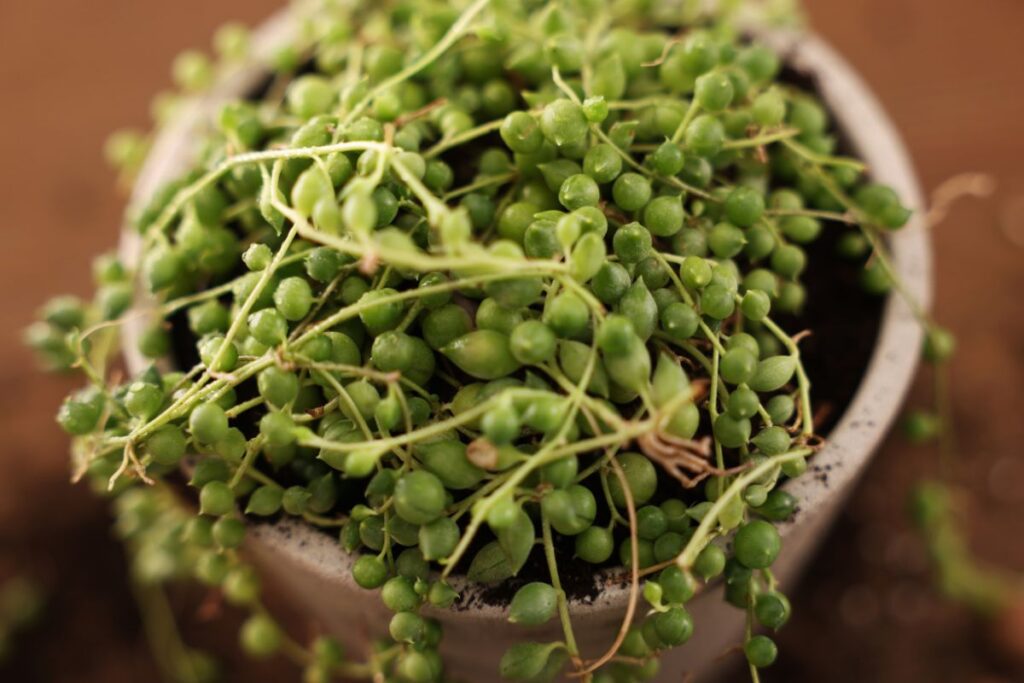
String of pearl plants have few pest and disease problems. However, you may come across common houseplant pests if there’s an existing infestation in your home garden.
Common Pests
Overwatered string of pearls plants are more likely to attract sap-feeding pests because of the high moisture level in the leaves. Soggy soil can also weaken the roots and invite moisture-loving pests like fungus gnats.
Here are the pests to watch out for:
- Aphids: Translucent crawlers that may appear white, green, pink, or brown and about ⅛ inch (0.3 mm) long. They can quickly move between stems and leaves.
- Mealybugs: White cottony pests that form clusters close to the base of the leaves. They’re about the same size as aphids.
- Whiteflies: Tiny, white, winged insects that feed on plant sap. They’re harder to catch because they can quickly fly away when disturbed.
- Spider mites: Almost invisible black, spider-like pests that attack in large numbers. They can be identified from the fine webs on the leaves or between stems.
- Fungus gnats: Overwatered string of pearls plants are likely to be infested with fungus gnats, which lay their eggs on wet soil. As the larvae hatch, they can feed on the rotting roots, worsening the damage caused by root rot.
Refer to the tips below to deal with pest problems:
- Spray a neem oil solution liberally on the plant and soil after sunset. You can dilute the solution with this formula: one tablespoon of neem oil, one tablespoon of liquid soap, and a liter (0.26 gal) of water.
- Move your plant away from direct sunlight for the duration of the treatment, as the neem oil spray can make the plant susceptible to sunburn. Place it several feet (+1 m) from a sunny window or hang sheer curtains.
- Repeat application once a week for up to 4 weeks until the pests are gone. You may also spray the plant once every 2 weeks for prevention. You must keep the plant out of direct sunlight for at least 2 days after spraying.
- Treat the neighboring houseplants to prevent re-infestation. You may also isolate severely infested ones and treat them longer.
- Hang a yellow sticky trap near the pot to catch flying pests like whiteflies.
Note: I don’t recommend using insecticidal soaps to deal with pests on SOPs since they’re only effective upon contact with the insects. Given the proximity of the leaves to the soil, frequent use of insecticidal soaps can increase salt concentration in the soil or even alter its pH.
Common Diseases
Overwatering can also make an SOP vulnerable to the following diseases:
Powdery Mildew
White, powdery spots may form on the leaves and soil surface if they remain moist for too long. Early stages of powdery mildew can be treated with a weekly application of neem oil spray.
You can then prevent future infection with the following tips:
- Use a loose, well-draining soil mix and a breathable pot for faster soil drainage.
- Give your plant sufficient bright light and good air circulation to increase the evaporation and transpiration rate. They can also help dry out the leaf surfaces that were soaked while watering.
Root Rot
Soil pathogens like rot-causing fungi and bacteria grow more actively in constantly moist soil. They can infect the roots and spread the disease quickly along the stems and leaves close to the soil.
Affected roots and foliage may appear black and mushy, giving off a rotten smell.
Due to the fragile nature of a string of pearl’s root system, saving the whole plant may be impractical. The best option is to find and propagate the remaining healthy terminal stems.
Look for stems without yellowing or browning 4-6 inches (10-15 cm) from the growing tip. Cut and propagate them in fresh soil or water. The stem cuttings should form roots within 4 months if the rot hasn’t reached them yet.
If the rot occurred outside the growing season, the cuttings may take longer to form roots. Replicate spring temperatures indoors and give the cuttings 8 hours of bright indirect light daily to speed up the rooting process.
Troubleshooting Common Problems
String of pearl plants are generally hardy and easy to care for.
However, poor care and unsuitable environmental conditions may lead to the following problems:
Wilting or Shriveling Pearls
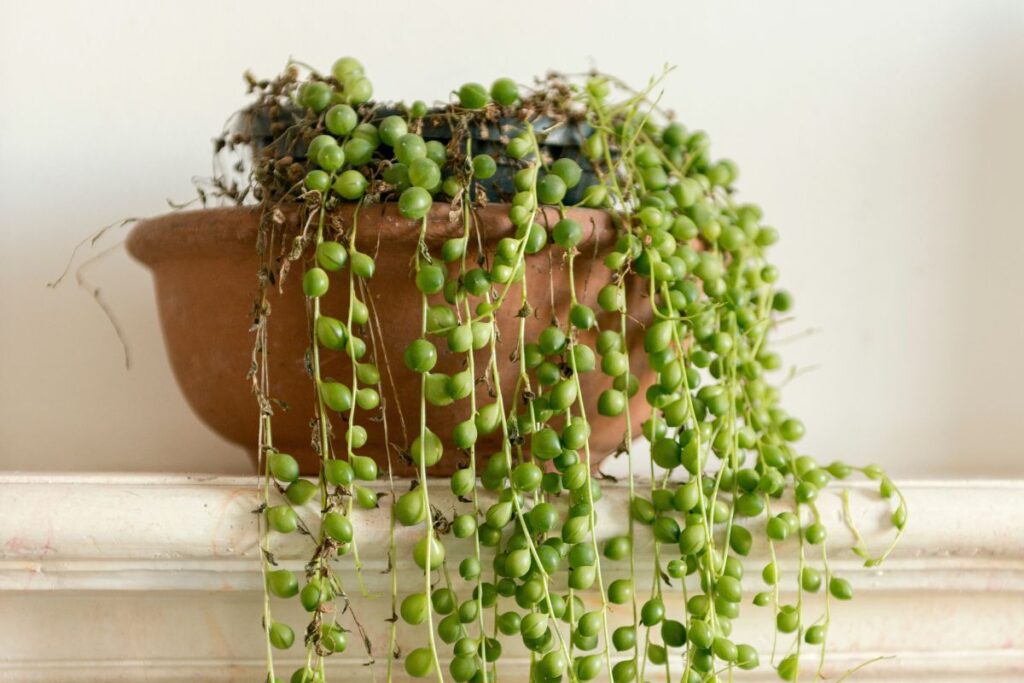
Long periods of drought or frequent underwatering (shallow watering) can lead to wilting or shriveling pearls. Each leaf is only a quarter inch (0.6 cm) in diameter, so there’s a limit to how long the water can keep it hydrated.
Exposure to direct sunlight and high temperatures can also dry out the soil and the plant more quickly, leading to shriveled leaves.
You can fix the problem by giving the plant a deep watering. You may also bottom water it for around 10 minutes to evenly rehydrate the soil or relieve hydrophobic soil clumps that have accumulated over time.
Inspect the soil moisture several days after watering to prevent recurrence. Water your plant as soon as the top ½ or ⅔ of the pot is dry.
Yellowing Pearls
SOP leaves may turn yellow due to the following:
| Causes | Associated Symptoms | Fixes |
| Underwatering | Dry soil Wrinkled leaves | Water your plant deeply. Increase the watering frequency during hot, dry months. |
| Overwatering and/or root rot | Wet soil Guttation Mushy leaves Black rotten roots | Let the soil dry out more between watering sessions. In case of root rot, propagate the remaining healthy leaves. |
| Nutrient Deficiency | Stunted or slow growth, even during the growing season | Feed your plant with a half-strength 10-10-10 liquid fertilizer every month until the leaves regain a green color. |
| Aging | Discoloration occurs on individual stems (in case of stress, the leaves on multiple stems turn yellow) Affected leaves don’t show signs of disease, such as being mushy or wrinkling | Prune the aging stems to make way for fresh growth. |
Dropping Leaves and Sparse Growth
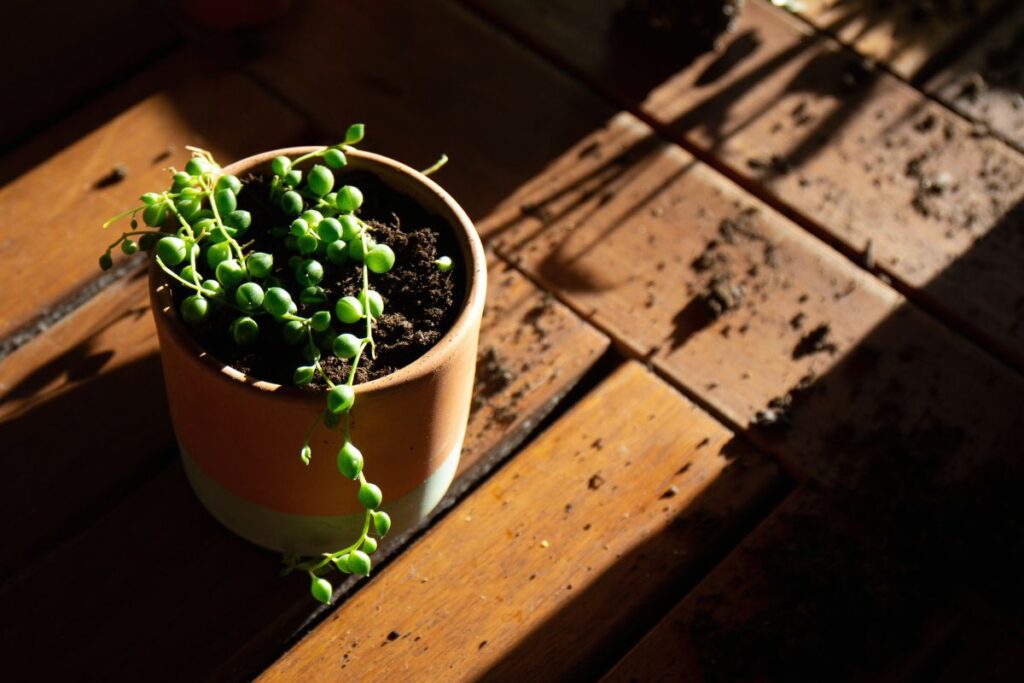
Cold shock and underwatering are the primary causes of dropping leaves, leading to sparse growth.
Cold Shock
Sudden temperature drops below 40 °F (4 °C) can cause cold shock or chilling stress in SOP leaves. It can damage the leaves on a cellular level, causing loss of cell wall integrity and collapse. Affected leaves may then fall off.
Move the plant to a warm room with daytime temperatures around 70 °F (21 °C) and around 55 °F (13 °C) at night. Keep an eye on your plant in the following days to see if it will survive the damage.
Good signs that your plant is recovering include:
- Green, firm leaves
- Formation of new leaves (this may be slow due to the lower metabolic activity during the cold season)
Underwatering
Underwatered SOPs will shed leaves to prevent moisture loss through transpiration.
Prune stems with sparse growth close to the base and improve your watering routine to encourage new growth and bushier foliage.
Legginess
The trailing stems may have unbalanced growth if the plant isn’t receiving enough sunlight.
The stems and leaves may grow denser toward the sun-exposed side of the plant. Conversely, the sun-deprived side may have frail-looking stems with few leaves.
You can prune the leggy stems and reposition the bushy ones so they dangle evenly around the pot.
Rotate the pot weekly or every time you water your plant to ensure even light exposure and balanced growth.
Display and Companion Plants
The curtain of trailing stems from a string of pearls can give off a dreamy vibe in your indoor garden.
Here are some excellent design ideas:
- Plant them in a hanging basket placed near a sunny window or on the balcony during the warm season.
- Grow them in aesthetic ceramic pots, and place them on high wall shelves, letting the leaves trail luxuriantly.
In addition, you can grow SOPs close to other sun-loving houseplants, including the following:
- English ivy: This plant is versatile, as it can tolerate different light conditions. In addition, its maple-like trailing leaves can provide an exciting contrast against the spherical leaves of a string of pearls.
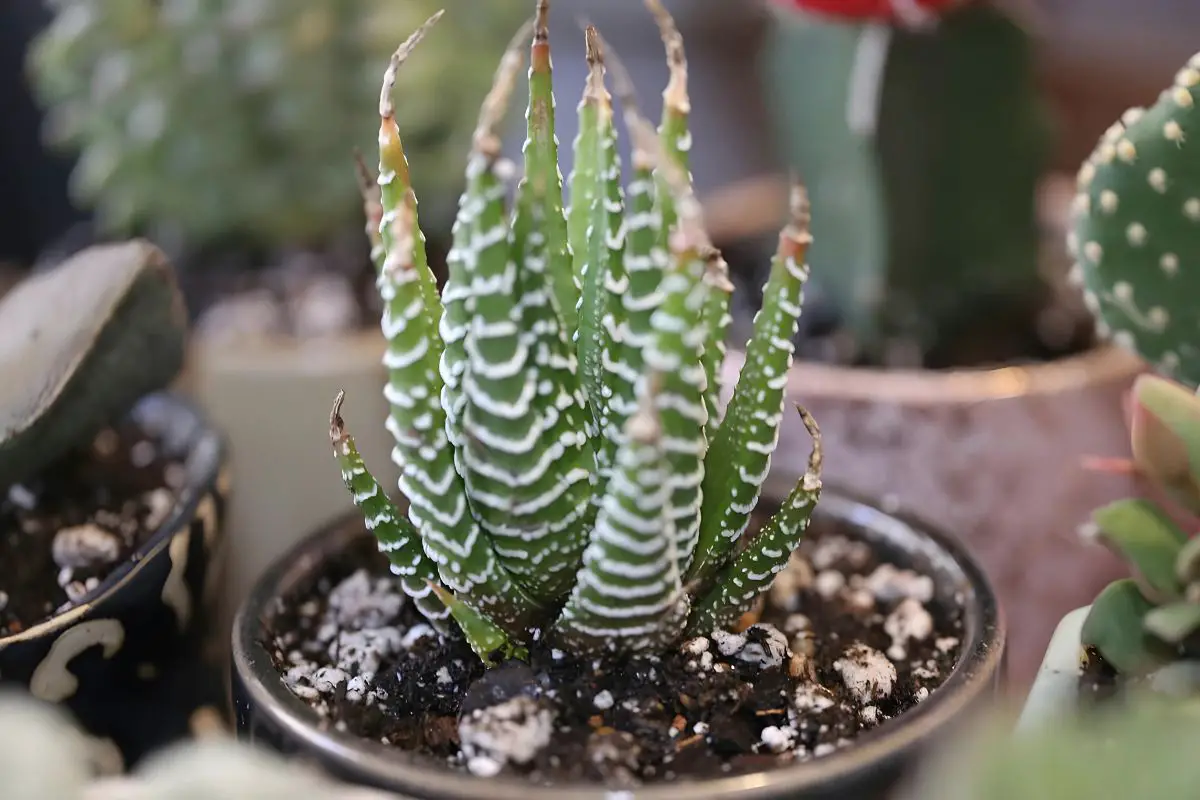
- Haworthia: The compact haworthia succulents can benefit from the partial shade provided by the SOP foliage curtain.
- Tradescantia zebrina: This vining plant is also an excellent addition to your hanging planters. The striped purple-and-green foliage can give a pop of color to a room full of solid-green plants.
Final Thoughts
String of pearls are versatile plants with many aesthetic potentials. They also have easy care requirements once you establish a consistent routine.
Give your string of pearl plant plenty of morning sun, a drench as soon as the top ½-¾ of the soil is dry, warm temperatures, and low-moderate humidity. You’ll be surprised how well they can blend in or add interest to your indoor garden space.
Did you find the tips in the article helpful? If you have questions about SOP plant care or have expert insights, feel free to leave a comment. You may also share photos to help inspire fellow gardening enthusiasts!