
7 Common Pests Affecting Fiddle Leaf Figs: Signs & Treatment
Fiddle leaf figs are popular statement houseplants because of their striking, fiddle-shaped leaves. Although generally resistant to chewing insects in the wild, poor care and environmental conditions indoors can make them vulnerable to common houseplant pests.
The following pests may attack indoor fiddle leaf figs:
- Aphids
- Mealybugs
- Scale insects
- Spider mites
- Thrips
- Fungus gnats
- Whiteflies
In the rest of the article, I’ll discuss common fiddle leaf fig pests in more detail to help you identify which one is affecting your plant. I’ll also provide actionable management strategies to help your plant recover and prevent future re-infestations.
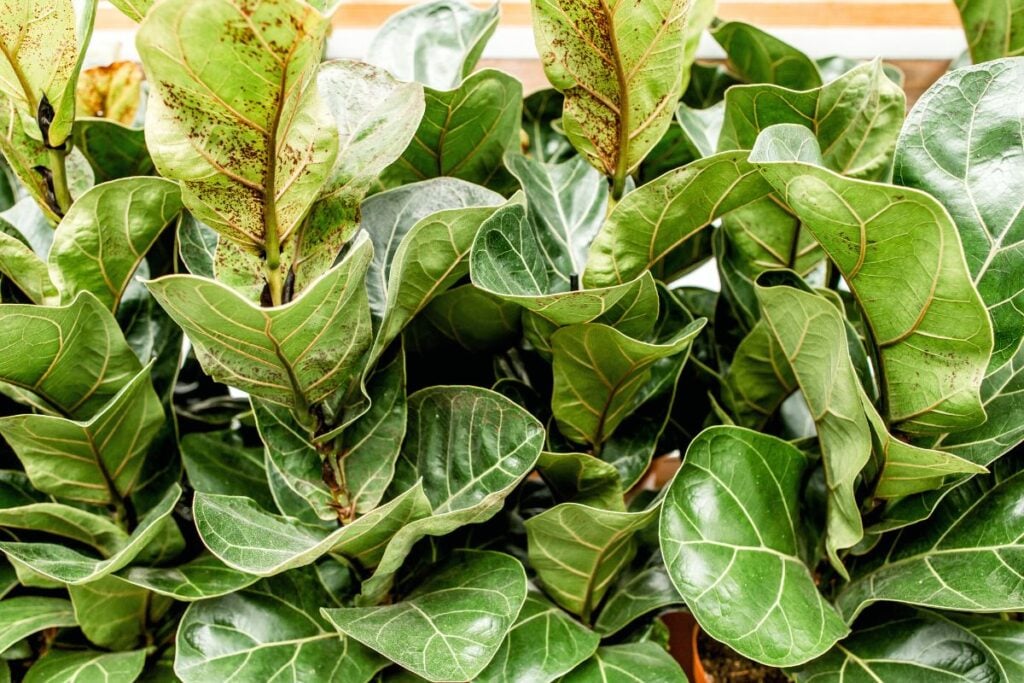
Pest Threats in Natural and Household Environments
Fiddle leaf figs (Ficus lyrata) or FLFs are tall, fruit-bearing trees native to tropical West and Central African rainforests. They’ve become famous ornamental houseplants in colder regions like Europe and North America because of their large, glossy leaves that bring a touch of elegance to any indoor space.
Despite their large leaves, fiddle leaf figs are resistant to many chewing insects because of the calcium oxalate crystals in their sap. The crystals’ sharp and rough texture repels pests and prevents further damage.
Wild fiddle leaf figs are minor hosts to only a few pests, including the following:
- Reniform nematodes (Rotylenchulus reniformis): Microscopic worms about 0.3-0.4 mm (~0.01 inches) in diameter that penetrate and feed on plant roots. They’re known to cause galls on the roots, leading to yellowing leaves and stunted growth.
- Colombian fluted scale (Crypticeria multicicatrices): Immobile scale insects with fluffy white covering about ⅛ in (3.2 mm) in diameter. They typically feed on the sap along leaf veins on the underside of the leaves and cause tiny yellow spots near the area they feed on.
Destructive nematodes are rare in houseplants, especially those cultivated in soilless or sterile potting mixes. Similarly, Colombian fluted scales are endemic to Colombia. There are currently no recorded reports of them affecting indoor fiddle leaf figs in the U.S.
On the other hand, generalist houseplant pests can spread in indoor gardens and indiscriminately feed on neighboring plants, including fiddle leaf figs. Routine inspections are crucial to catching and managing early signs of infestation.
In the next parts, I’ll explore the symptoms and feeding behaviors of common household pests that may be drawn to your FLF’s attractive foliage.
Symptoms of Infestations
The large, overlapping leaves of fiddle leaf figs may make it challenging to spot tiny pests right away.
Choose one of the confirmatory tests below to spot the symptoms and correctly identify the pests:
- Magnifying glass: Use a 10x-30x magnifying glass to closely inspect the leaf undersides because most sap-feeding pests hide there.
- Flashlight: You may also use a flashlight to catch any movement underneath the leaves or spot camouflaging pests.
- Smartphone camera: Use your smartphone camera to take photos of suspected pest-infested spots on the leaves, zooming in to inspect unusual symptoms closely.
Using your preferred tool, look for the common signs of pest infestation in fiddle leaf figs:
- Yellowing leaves (tiny spots on leaf undersides or entire surfaces)
- Sticky, colorless residue
- Black spots on the leaves or stem
- Fine webs on the leaf or between the stem and petioles
- White or yellow speckled appearance on the leaves
- Fluffy white crawlers on leaf undersides
- Brown bumps on leaf veins or stems
- Silvery or bronze patches on the leaves
- Tiny black dots on the leaves
- Mosquito-like insects hovering over wet soil
- Tiny moth-like insects with thin white wings flutter when you move the leaves
Insect pests typically move from one plant to another by flying or through leaf contact. The large FLF leaves are likely to come in contact with neighboring houseplants, making it easier to spread or acquire the infestation.
Detecting and identifying pests early can help you apply appropriate treatments to minimize damage and prevent the spread to nearby plants.
Common Pests
Let’s explore the common houseplant pests that may be drawn to your fiddle leaf figs:
1. Aphids

Aphids (Family Aphididae) are among the most common pests in indoor plants. Depending on the species, these pests can come in various colors, such as green, white, black, orange, or pink. Their translucent body allows them to camouflage against the leaves or stems.
Here are some essential details about aphids that can help you locate and identify them:
- Appearance: The eggs and nymphs are tiny (about 0.5-1 mm) and are often found in clusters on leaf undersides. The adults are about ⅛ in (3.2 mm) long, and they actively crawl on leaves or petioles.
- Damage: Severe infestations at the base of new growth can cause the yellowing or curling of young leaves. Mature leaves, on the other hand, can get by with only a few tiny yellow spots that often go unnoticed.
- Associated symptoms: Aphids excrete a sticky, sugary liquid (honeydew) after feeding on plant sap. Honeydew can attract sooty mold, which grows black thread-like mycelia that take on the shape of the liquid, making it look like a black spot on the leaf surface. Ants may also be drawn to the sugary honeydew and climb up the fiddle leaf fig.
Aphids are pesky little crawlers that are hard to eliminate once they spread indoors completely. I’ve had my fair share of problems with an aphid infestation in my indoor garden and have explored several solutions.
So far, here are the treatments that work well against aphids:
- Manual removal: Scrape the aphids off with a cotton swab dipped in alcohol and drop them into a cup of soapy water (1 ml liquid detergent in 1/2 cup water). This method requires patience and must be repeated every 3-5 days to keep the pest population under control.
- Neem oil solution: Spray the leaves generously, targeting the undersides. Do this after sunset once a week for the next 6-8 weeks until there are no more signs of pests.
- Insecticidal soaps: Commercial insecticidal soap products are formulated to be plant-safe and effective at eliminating pests. However, they don’t have a residual effect, so they need to be applied every 2-3 days. Pro tip: I recommend applying insecticidal soap only once a week (between neem oil applications) because frequent use of soapy solutions can break down the waxy coating on the leaves.
- Routine cleaning: Wipe the black moldy spots on the leaf surface using a clean, damp cloth. Sooty mold doesn’t damage the leaves, and the small honeydew droplets have minimal to no effect on the photosynthetic capacity of the large FLF leaves. However, removing the black moldy liquid can improve the plant’s appearance and prevent an infestation.
- Monitoring: Inspect the leaves weekly or every time you rotate the pot and water the plant to eliminate any new aphids that appear. It also helps to inspect and treat the neighboring plants to prevent re-infestation. It took me the entire spring and summer to keep the aphid population under control because they’re active during the warm seasons.
You may come across several other tips online that may seem helpful at first but may lead to more problems.
Here are some that I don’t recommend:
- Introducing ladybugs or lacewings: Beneficial insects that feed on pests are useful in an outdoor garden because of their voracious appetite. However, when introduced indoors, you can’t trust them to stay only on your plants. Once they’re done feeding on the houseplant pests, they’re likely to explore every nook and cranny in your home, looking for food.
- Homemade insecticidal soap: The soapy component in homemade recipes can dissolve the waxy coating of the FLF leaves, potentially leading to more problems, such as a dull appearance and tissue injury (yellow or brown spots).
2. Mealybugs
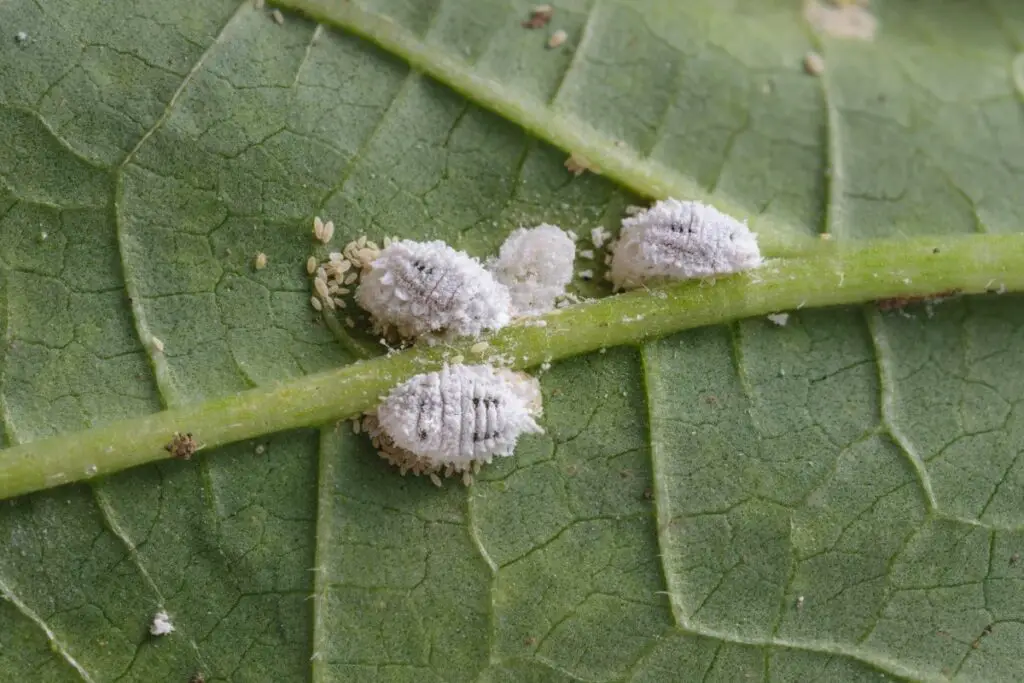
Mealybugs (Family Pseudococcidae) are relatively easier to spot than aphids because of the following traits and symptoms:
- Mealybugs are tiny (⅛ in or 3.2 mm) crawlers with a cottony white, waxy covering that makes them look like white fluff on leaf undersides.
- They form clusters underneath leaf surfaces, resulting in localized yellowing in infested leaves.
- They also excrete honeydew that attracts sooty mold and ants.
Note: Honeydew is a reliable and renewable food source for ants, so they protect the pests that produce it, establishing a mutualistic interaction between ants and mealybugs, aphids, or scale insects.
If the pest infestation remains unaddressed and the FLF leaves contain honeydew, invasive ants will eventually get into your home to collect food. The ants may also be drawn to other food sources in your home, leading to another wide-scale problem beyond your houseplants.
You may also deal with mealybugs similar to aphids with these tips:
- Scrape the pests with a cotton swab with alcohol and drop them into soapy water.
- Spray the leaves with a neem oil solution at night once a week for 6-8 weeks. You may also apply insecticidal soap on leaf undersides once a week between neem oil applications.
- Wipe the honeydew and sooty mold off the leaves.
- Monitor the plant for any signs of re-infestation.
3. Scale Insects
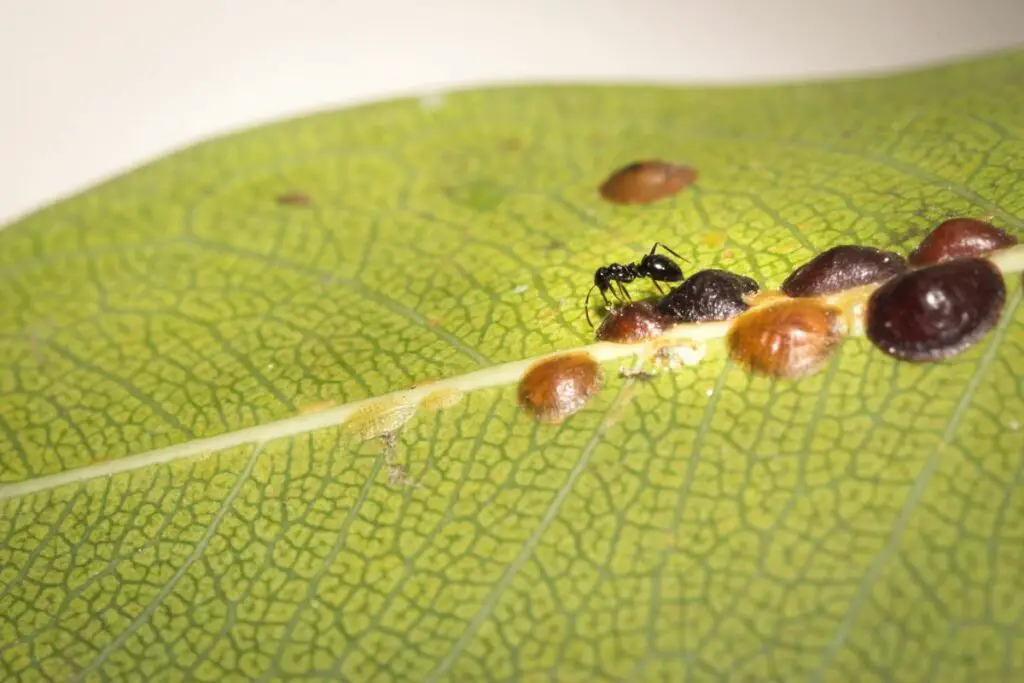
Scale insects (Family Coccidae or Diaspididae) are also common houseplant pests that enjoy feeding on the sap of fiddle leaf figs.
Here are the symptoms to confirm you’re dealing with scale insects:
- Hard or soft brown bumps about ⅛ in (3.2 mm) in diameter on the stems or leaf veins
- Localized yellowing on the leaf surface close to the infestation
- Honeydew, sooty mold, and ants
You can treat a scale insect infestation with the following tips:
- Carefully scrape the shelled insects with a tweezer and drop them in soapy water. Be careful not to wound the plant in the process.
- Spray the plant with neem oil solution for up to 8 weeks to eliminate the microscopic scale insect eggs and nymphs.
- Inspect the plant regularly for new signs of infestation and treat accordingly.
4. Spider Mites

Spider mites (Family Tetranychidae) are a close relative of spiders and ticks. Due to their microscopic size, spider mites are hard to spot. You will need to use a magnifying glass or a smartphone camera to see them.
Here’s a brief guide to help you identify spider mites:
- Eggs: Clear, round, and only about 1/50 in (0.5 mm) in diameter
- Larvae: Spider-like form with six legs, about the same size and color as the eggs
- Nymphs (protonymph and deutonymph): Slightly larger with eight legs, the color can range from yellow to green, depending on plant sap. Two-spotted spider mites are notable for the two dark spots on their back.
- Adult male: Around the same size as the nymphs but with a pointed belly
- Adult female: Largest in the group (up to 1/20 in or 1 mm) with a rounded belly
Note: Spider mites may turn orange-red during the cold and dark season as they enter diapause or a period of inactivity. This typically occurs when daylight falls below 14 hours and nighttime temperatures dip below 59 °F (15 °C) due to higher fat deposits.
You may also confirm spider mite damage with the following symptoms:
- Fine webs on leaf surfaces or between stems and petioles
- Speckled leaves (yellow, white, or reddish-brown specks)
- Dropping of discolored leaves
Here are some ways to deal with spider mites:
- Wipe the webs off with a clean, damp cloth.
- Place a yellow sticky trap underneath the leaves and give the plant a firm shake so the tiny spider mites will fall into the trap.
- Spray the plant with neem oil solution at night once a week for up to 8 weeks.
- Alternative: Use a spinosad-based spray once every 10-14 days for up to 2 months to eliminate the spider mites. Be sure to keep the room well-ventilated for 24 hours after spraying.
- Boost the humidity around your fiddle leaf figs using a humidifier to deter spider mites because they dislike weaving webs over moist surfaces.
- Water your plant regularly, ideally as soon as the potting mix’s top 2 inches (5 cm) or upper half is dry. Spider mites are especially attracted to underwatered fiddle leaf figs because low soil moisture can lead to more concentrated sugars on the leaves.
5. Thrips
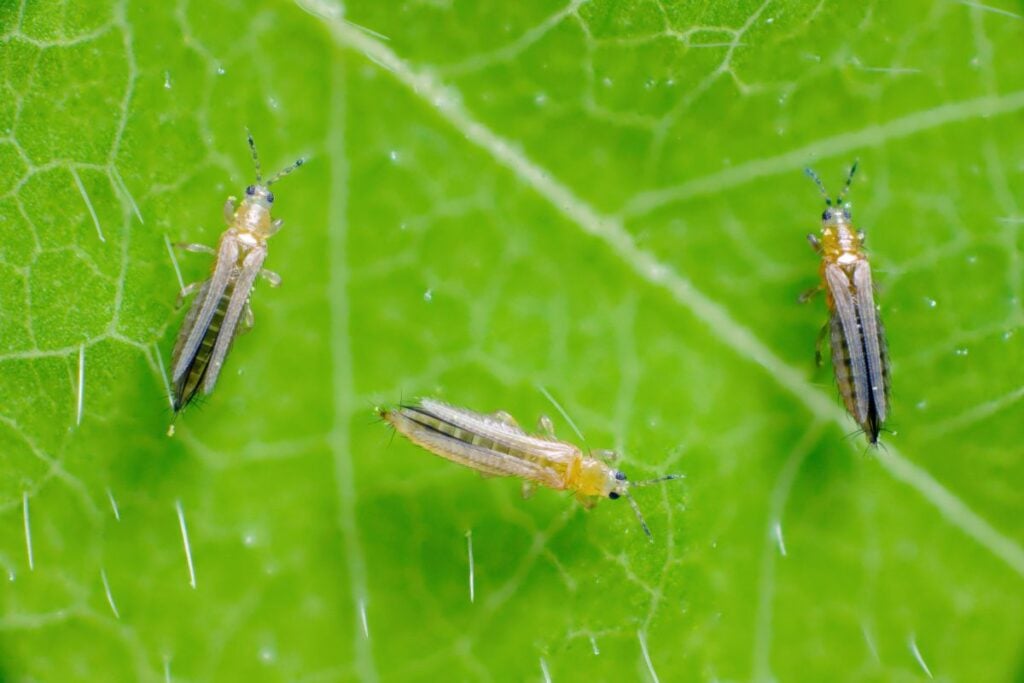
Thrips (Family Thripidae) are troublesome pests that can negatively affect a fiddle leaf fig’s appearance.
Here’s how to identify them:
- Winged adults are slender and tiny, about 1/16-⅛ in (1.6-3.2 mm) long.
- Thrips burrow into the FLF leaf tissue, causing a silvery or bronze patch as the tissue dies.
- After feeding, they excrete waste that looks like tiny black dots close to the discolored patches.
Follow these tips to deal with thrips:
- Prune all the damaged leaves. Using sterile shears, cut off all the leaves with silvery or bronze patches, as they’re likely to house thrips, which can affect the other leaves or nearby plants. The damaged leaves also won’t recover their green color.
- Apply a spinosad-based spray once every 10-14 days for up to 2 months and ensure the room has good airflow for the next 24 hours. Although spinosad typically doesn’t cause allergic reactions, I recommend wearing goggles and a face mask during application to prevent eye irritation or inhalation.
- Place a yellow sticky trap near the plant to attract the flying thrips and keep them off the leaves.
6. Fungus Gnats

Fungus gnats (Family Sciaridae and Mycetophilidae) are typically drawn to overwatered fiddle leaf figs because they need moist potting mixes to lay their eggs on. The decaying roots and organic matter in the soil also serve as a food source to the larvae once they hatch from the eggs.
A fungus gnat-infested plant may exhibit the following symptoms:
- Soggy soil (and eventually root rot)
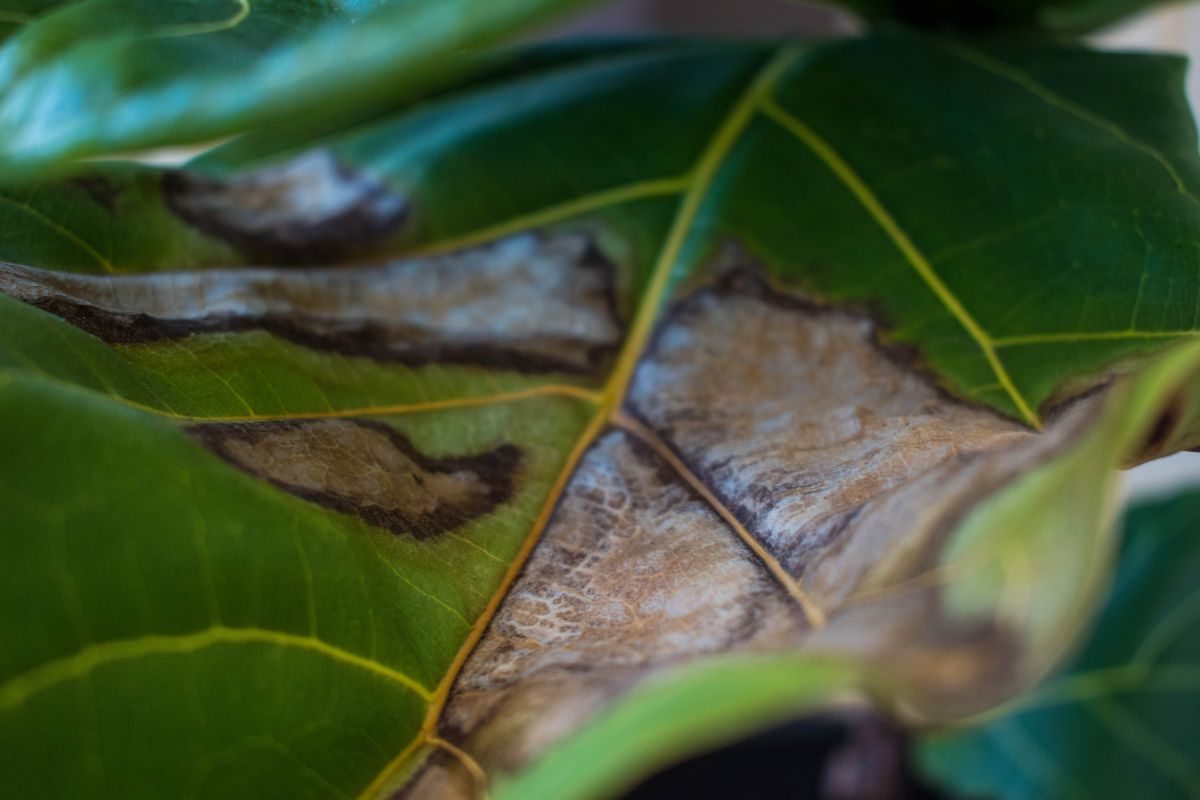
- Brown, mushy spots on the leaves
- Mosquito-like flies about 1/16-⅛ in (1.6-3.2 mm) long near the soil
- Yellowing leaves
- Stunted growth in young plants
You can treat and manage fungus gnat infestations with these tips:
- Neem oil solution: Spray the top 2-3 inches (5-7.6 cm) of the potting mix with neem oil to kill the fungus gnat eggs and larvae, which usually inhabit the soil’s top 2 inches (5 cm).
- Soil and water control: Let the top 2 inches (5 cm) or ⅓ of the soil dry out completely between waterings to deter adult fungus gnats from laying their eggs.
- Yellow sticky traps: Place sticky cards around your plant to attract adult fungus gnats and keep them away from the soil.
Note: Some sources may recommend using beneficial nematodes to eliminate fungus gnat larvae in the soil. However, I feel like this isn’t a practical solution for indoor potted plants because they have a short shelf life, requiring repeated applications and higher costs in the long run.
7. Whiteflies
Whiteflies (Family Aleyrodidae) are tiny pests that occasionally feed on different Ficus plants, including fiddle leaf figs.
Whiteflies prefer warm spring or summer months and rapidly develop from eggs to adults. You can distinguish their life stages below:
- Eggs: Translucent and oblong less than 1/50 in (0.5 mm) in diameter
- First-Stage Nymphs: Tiny, translucent crawlers, only slightly larger than the eggs. They have numerous legs, allowing them to move freely to look for a feeding spot.
- 2nd-4th-Stage Nymphs: Fewer legs, oval, and yellowish. They remain and feed on the same spot and gradually increase in size.
- Adult: Yellow-bodied insects with thin white wings only about 1/16-1/8 inches (1.6-3.2 mm) long, commonly found on leaf undersides
Here are the symptoms of a whitefly infestation:
- Tiny flies gather on leaf undersides and flutter around when you move the leaves
- Honeydew excretions near the cluster of flies, occasionally with sooty mold and ants
- Severely infested leaves turn yellow and fall off
Catching and treating a whitefly infestation in the early stages is crucial to preventing an outbreak in your indoor garden. You can manage and even eliminate minor whitefly infestations with these tips:
- Spray the plant liberally with neem oil once weekly, targeting areas on leaf undersides with visible but slow-moving adults.
- Spray the leaf undersides with insecticidal soap between neem oil treatments (i.e., 3-4 days after neem oil application) to improve your chances of eliminating newly hatched nymphs.
- Install sticky traps near your houseplant or attach them to a chopstick inserted into the potting soil.
During severe infestations, you can use spinosad spray or imidacloprid soil soak products as a last resort. Read the product-specific instructions and precautions to ensure treatment effectiveness while staying safe from the potential health hazards of the chemical treatment.
Imidacloprid works against common houseplant pests, including whitefly nymphs, scale insect crawlers, mealybugs, and aphids. However, it can indiscriminately affect beneficial insects like bees, parasitic wasps, and ladybeetles. Avoid taking your fiddle leaf fig outdoors after using imidacloprid treatment.
Prevention and Management Strategies
Fiddle leaf figs are famous for being sensitive houseplants that easily get stressed with unstable environmental conditions. Poor health can make them more vulnerable to an attack from common houseplant pests.
Preventive Measures
Here are some essential tips and practices to prevent pest infestations in fiddle leaf figs:
- Isolation: Newly acquired plants must be isolated for around 8 weeks to avoid introducing unwanted pests or diseases to your indoor garden. This will give you enough time to detect and treat any pre-existing pest problems before safely introducing the new plant to your other houseplants. If the plants turn out to be infested, contact your supplier to check if you can return your purchase.
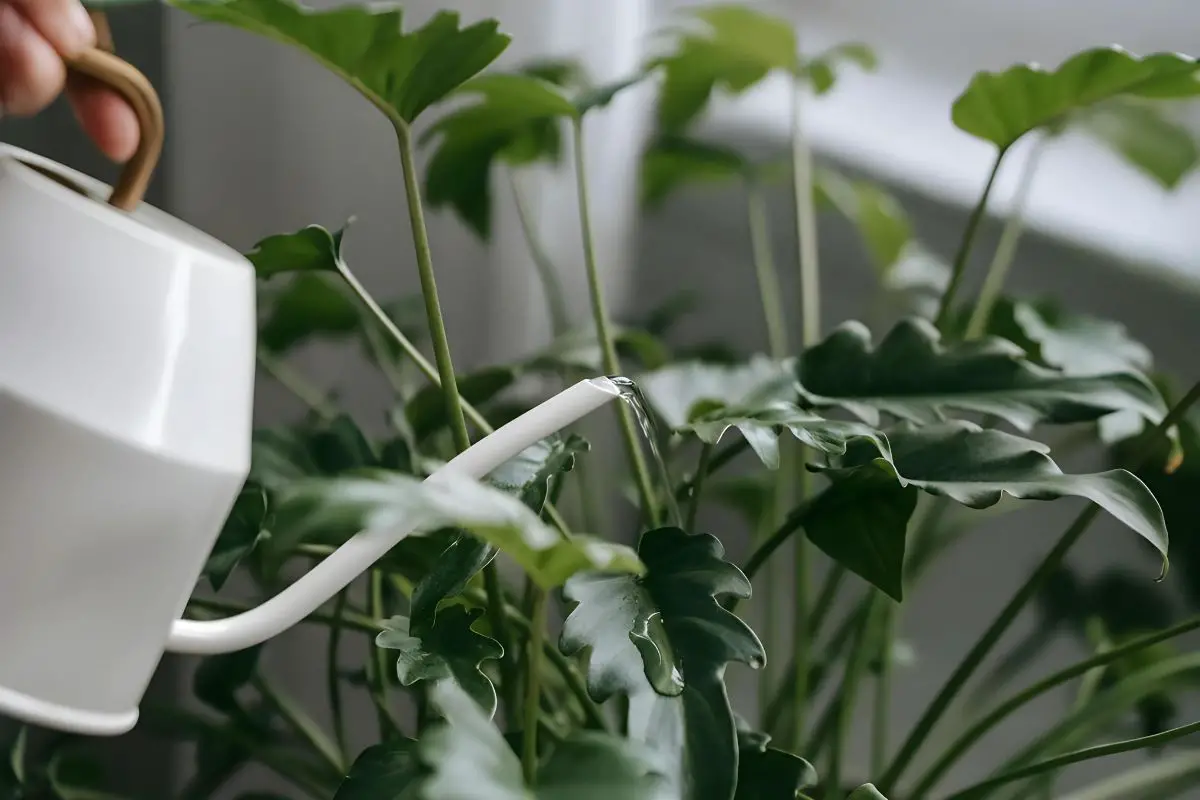
- Proper watering: Avoid overwatering your fiddle leaf figs to prevent fungus gnat infestations. Let the top 2 inches (5 cm) or ⅓ of the potting soil dry out completely between watering sessions.
- Soil management: Use a fresh, sterile soil mix every time you repot your plant to avoid unwanted plant pathogens and pest eggs or larvae. You may add 10% compost to the soil mix to introduce only beneficial microbes.
- Routine pruning: In spring, remove overgrown leaves and branches to aerate the plant and reduce the potential hiding spots for pests.
- Optimal sunlight and temperature conditions: Bright indirect light for at least 8 hours a day and moderate temperatures (65-75 °F or 18-24 °C) help optimize a fiddle leaf fig’s metabolic and transpiration rates. They can also aid in proper moisture utilization, keeping the soil from staying wet for too long.
- Balance between humidity and ventilation: Maintain the humidity between 40-60% all year round for optimal FLF health. High humidity can encourage the plant to retain moisture on the leaves and attract sap-feeding insects. On the other hand, low humidity can attract spider mites, which prefer dry leaves for their webs.
Natural Remedies
If pests still manage to break through your preventive strategies, explore these natural remedies to keep their populations under control:
- Manual removal: Remove pests by hand, tweezers, or with alcohol-dipped swabs.
- Yellow sticky traps: Install sticky traps around your houseplants or near the soil to catch flying insects.
- Liquid traps: Place a tiny bowl of apple cider vinegar or honey water near the pots to draw flying insects away from your FLF potting soil. Avoid placing the bowl over the soil because accidental spills of apple cider vinegar (pH of 2-4.2) can acidify the soil, and honey water can draw ants to your plant. Discard the drowned bugs and replace the liquid regularly.
- Horticultural oils: Neem oil is an organic, plant-safe remedy against numerous houseplant pests, including aphids, scale insects, mealybugs, spider mites, and fungus gnat larvae.
- Insecticidal soaps: Occasional use of insecticidal soaps can help treat minor pest infestations. However, prolonged and frequent use can take away the shine on FLF leaves.
- Systemic insecticides: Thrips have low sensitivity to neem oil but are vulnerable to low-level systemic insecticides like spinosad. Occasional applications of spinosad don’t have a significant effect on beneficial insects, especially when used indoors.
Integrated Pest Management (IPM)
To effectively treat and manage pest problems on fiddle leaf figs, it’s important to integrate multiple methods.
I recommend applying the methods in the following order for maximum efficiency:
- Inspection: Check the symptoms to identify the pests responsible for the damage.
- Isolation: Evaluate the damage and isolate plants with severe infestations.
- Pruning: Remove severely damaged leaves, especially those showing thrip infestation (silvery or bronze patches and tiny black dots).
- Cleaning: Wipe away black spots (sooty mold), honeydew, or fine webs using a clean, moist cloth.
- Manual removal: Remove visible pests using a cotton swab with alcohol or tweezers.
- Organic treatment: Apply neem oil once weekly (and/or insecticidal soap between neem oil applications) to eliminate pests.
- Chemical treatment: Apply spinosad spray to eliminate pests like spider mites and thrips as a last resort.
- Monitoring: Inspect the plant regularly to detect any sign of re-infestation and treat as needed.
Note: If a severe pest infestation persists despite multiple treatments and affects more than half of your houseplant collection, I recommend seeking professional help to exterminate the pests and prevent a recurrence properly.
Here’s a brief guide on how to manage FLF pests:
| Pests | Traits | Symptoms | Management |
| Aphids | ⅛ in (3.2 mm) long Translucent body Green, white, orange, black, or pink | Localized yellowing on infested mature leaves Curling or deformed young leaves Honeydew Sooty mold (black spots) Ants (sometimes) | Remove pests with a tweezer or cotton swab dipped in alcohol and drop in soapy water. Wipe honeydew or sooty mold off using a clean, damp cloth. Spray the plant at night with neem oil solution once a week for up to 8 weeks. Apply neem oil solution every 2 weeks during the warm season to prevent infestations. |
| Mealybugs | ⅛ in (3.2 mm) long Cottony white waxy covering | ||
| Scale Insects | Around ⅛ in (3.2 mm) in diameter Hard brown shell | ||
| Spider Mites | Less than 1/16 (3.2 mm) in diameter | White or yellow speckled appearance on affected leaves Fine webs on the leaf surface or between the stem and petioles | Wipe the webs off with a clean, moist cloth. |
| Prune discolored leaves using sharp, sterile shears. Spray the plant with spinosad-based spray once every 10-14 days for up to 2 months. | |||
| Thrips | 1/16-⅛ in (1.6-3.2 mm) long Long, slender, winged | Silvery (white) or bronze (brown) patches on the leaves Tiny black dots (excrement) | |
| Wipe the black dots off with a clean, moist cloth. | |||
| Fungus Gnats | 1/16-⅛ in (1.6-3.2 mm) long Mosquito-like | Mosquito-like insects hovering above wet soil | Spray the top 2-3 inches (5-7.6 cm) of the soil with neem oil to kill the larvae. Let the top 2 inches (5 cm) or ⅓ of the soil dry out between waterings to deter fungus gnats from laying eggs. |
| Whiteflies | Yellowish body about 1/16-⅛ in (1.6-3.2 mm) long White, moth-like wings | Tiny whiteflies flutter after moving the leaves Yellowing and falling leaves | Spray the leaves with neem oil or insecticidal soap to eliminate slow-moving adults, eggs, and nymphs Install sticky traps near infested plants Use spinosad spray or soak the soil in imidacloprid solution for a systemic and long-term treatment against whiteflies |
Final Thoughts
The large leaves of fiddle leaf figs provide a good source of sap and potential hiding spots, attracting common houseplant pests like aphids, mealybugs, scale insects, spider mites, thrips, and whiteflies. The moisture-retaining soil can also draw fungus gnats.
Routine inspections, such as rotating and watering the plant every time, can help detect and address early pest infestations.
You can also proactively prevent pest problems by pruning damaged or aging leaves to improve air circulation around the plant and spraying neem oil every 2 weeks during the warm seasons.
Let us know through the comments your encounter with fiddle leaf fig pests and how you addressed the problem. Also, feel free to ask questions if you need more tips on general FLF care.