
Fiddle Leaf Figs Flowers and Fruits: Indoor Guide
Fiddle leaf figs are popular ornamental houseplants known for their large, violin-shaped leaves. While most people grow fiddle leaf figs for their lush greenery, these plants are also capable of producing flowers and fruit under the right conditions.
Here are essential facts about fiddle leaf fig flowers and fruits:
- Fiddle leaf figs bear flowers toward the end of the wet season in nature.
- FLF flowers are hidden inside a syconium, which is a round, green, hollow receptacle about 1-1.25 inches (2.5-3.2 cm) in diameter.
- An Agaonidae wasp (Agaon spatulatum) enters the syconium through the ostiole to lay eggs and pollinate the flowers in the process.
- After pollination, the flowers turn into fruits with tiny seeds inside the syconium.
- The fruits taste bland and aren’t harvested for human consumption.
- Fiddle leaf figs rarely flower indoors because they require near-tropical conditions to mature reproductively.
- The flowers rarely develop into fruits indoors due to the absence of Agaon spatulatum, which is native to Central and West Africa.
Although FLF flowers and fruits aren’t attractive or palatable, they can indicate that your plant is in excellent condition. The rest of the article will discuss the environment and care conditions that can promote good health and potential flowering in indoor fiddle leaf figs.

Native Habitat, Morphology, and Reproductive Traits
Fiddle leaf figs (Ficus lyrata) are monoecious fruit-bearing trees that belong to the mulberry and fig family (Moraceae). However, unlike other fig trees bred for their delicious and nutritious fruits, fiddle leaf figs are valued only for their domineering size and aesthetic leaves.
Native to the tropical rainforests of West and Central Africa, fiddle leaf figs (Ficus lyrata) can grow about 50 feet (15 m) tall with leaves over 2 feet (0.6 m) long and 1.5 feet (0.45 m) wide.
At blooming time, the flower receptacles typically grow near the distal end of the branches, just above the leaf axil.
Hidden Blooms and Fruit Development
Fiddle leaf fig flowers are unique, as they’re not externally visible like typical flowering plants. The unremarkable flowers can be found inside a syconium, which eventually develops into the fruit when pollination occurs.
Note: Ripe FLF fruits are a valuable food source for birds in their native habitat, but they’re not harvested for human consumption.
Let’s explore the physical traits of FLF flowers and fruits:
Flower Form and Appearance
Here’s what the FLF flowers look like:
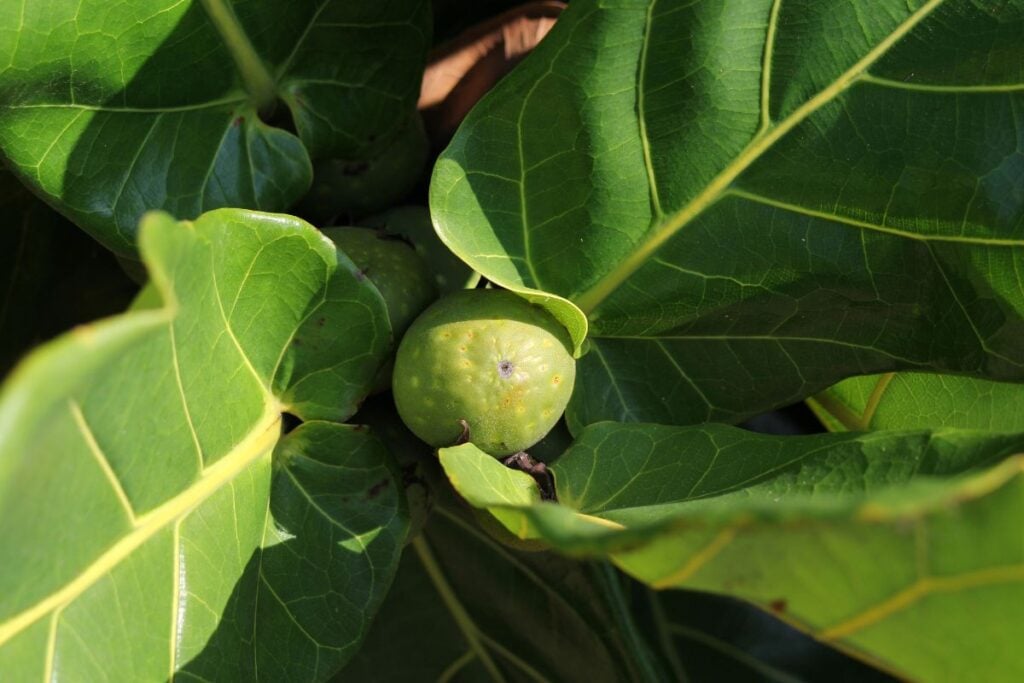
- The flowers grow inside a spherical receptacle or syconium about 1-1.25 inches (2.5-3.2 cm) in diameter—almost the same size and texture as a golf ball.
- Syconia typically grow in pairs or clusters and appear light or dark green with leathery skin and a dimpled surface (white dots).
- The syconium has a tight opening at the distal end called an ostiole, where Agaonidae wasps can burrow to access the flowers, consequently pollinating them.
- The male and female flower parts are white or light brown with small, fibrous florets.
Note: The unpollinated syconium remains green with a leathery skin, and the flowers inside remain fibrous. I don’t recommend tasting the flowers as they contain calcium oxalate crystals, which can leave your mouth feeling dry and uncomfortable. The flowers also have a bitter aftertaste.
Fruit Appearance and Taste
Here are the key characteristics of FLF fruits:
- Once the flowers are pollinated, they swell into juicy, tear-shaped fruits typical of fig trees.
- The syconium gradually turns red or burgundy as it ripens.
- Ripe FLF fruits taste bland compared to other fig species, making them unpleasant and unpalatable for humans.
- In nature, birds feed on the ripe FLF fruits and disperse the seeds.
Factors Influencing Blooming and Fruiting Conditions
Here are the natural physical and environmental factors influencing a fiddle leaf fig’s blooming and fruiting:
- Maturity of the plant: Fiddle leaf figs must reach full maturity before they’re capable of flowering. You can confirm an FLF’s reproductive maturity when it starts producing syconia. In nature, the trees grow and mature more quickly (after 7 years or so) due to the other environmental factors below.
- Full sun exposure: Mature fiddle leaf figs receive full sun or at least 8 hours of direct sunlight in the wild. Since flowering is energy-consuming, trees require plenty of bright natural light to photosynthesize and generate enough food.
- Warm temperature and high humidity: Tropical rainforests have warm and humid conditions all year round. The temperatures range from 70-86 °F (21-30 °C), whereas relative humidity levels remain around 70%.
- Abundant rainfall: Fiddle leaf figs grow in African rainforests where the average precipitation ranges from 40-80 inches (100-200 cm) annually.
- Fertilization or rapid nutrient cycling: Warm and moist soil conditions all year round in tropical rainforests promote steady microbial activity that decomposes organic matter, making nutrients like nitrogen and phosphorus readily available for rapid uptake by plants with shallow fibrous roots like fiddle leaf figs.
The Blooming and Fruiting Process
In the wild, full-grown or mature fiddle leaf figs produce flowers annually, typically at the end of the wet season, after storing enough energy from sufficient moisture, nutrients, and sunlight.
Fruiting is more feasible with less rain because fig wasps are slow flyers and depend on wind to travel long distances. In tropical rainforests with little wind, the wasps can move more easily between FLF syconia to pollinate the flowers when there’s less rain.
Adult female fig wasps also live for only 1-2 days, making it crucial to reach the next syconium within a short period to deposit their eggs and potentially fertilize the flowers.
Note: Fig trees typically evolve with Agaonidae wasps in the wild, with which they have species-specific relationships. For instance, the only pollinator of fiddle leaf figs is the Agaon spatulatum.
Here’s how FLF flower pollination and fruiting occur:
- A winged adult female wasp enters the syconium through the ostiole.
- The female lays eggs in the flowers, which turn into galls.
- As the female wasp moves around inside the syconium, it dislodges pollen and drops them into the female flower parts.
- The wingless male wasps hatch first and mate with unhatched females. Their movements can also disperse the pollen.
- After mating, the male wasps create tunnels to exit the syconium, dying in the process.
- As the mated female wasps hatch, they crawl through the tunnels created by the male wasps, carrying pollen with them.
- After exiting, the winged females look for another syconium to lay their eggs in, consequently introducing the pollen from the first syconium.
Signs a Fiddle Leaf Fig Is Ready to Bloom
The telltale sign that fiddle leaf figs have reached reproductive maturity is when the syconia appear.
However, several other signs can indicate your plant is ready to form flowers, including the following:
- More rounded crown: Juvenile fiddle leaf figs typically have a singular stem with sparse leaves. As the plant matures, natural branching occurs, resulting in a more rounded crown with dense foliage. Note: Pruning to promote branching doesn’t induce or guarantee reproductive maturity.
- Thickening of stems and branches: As the plant prepares to bear flowers, the branches may thicken to support the weight of the fruits.
- Fewer new leaf buds even during the growing season: Fiddle leaf figs that are about to flower typically have fewer new leaf growth and less vibrant leaves as they allocate the energy toward flower development.
Do Fiddle Leaf Figs Bloom Indoors or Bear Fruit?
Fiddle leaf figs hardly flower or bear fruit indoors due to the following issues:
- The limited soil space in pots stunts a fiddle leaf fig’s growth, inhibiting its reproductive maturity. Most indoor fiddles remain in their juvenile or immature form.
- Indoor fiddles rarely live over 10-15 years, as they naturally lose vigor over time due to non-tropical indoor environments. It usually takes around 10 years for fiddle leaf figs to mature in the wild, and indoor plants typically don’t have enough time and resources to reach reproductive maturity.
- Frequent repotting can stress fiddle leaf figs (i.e., transplant shock). Although it may be necessary to repot regularly to accommodate and promote new growth, repotting can reduce your fiddle leaf fig’s vigor and lifespan.
- The absence of natural pollinators (fig wasps) indoors makes it unlikely for FLF to develop into fruits. I’ve been caring for fiddle leaf figs for a little over 10 years now, but I still haven’t seen my own plants flower. I have, however, seen a friend’s greenhouse-grown fiddles laden with syconia due to the near-tropical conditions almost all year round.
Note: Due to the nature of the fiddle leaf fig syconium, it’s not feasible to mimic Agaonidae wasps and hand-pollinate the plant. The ostiole is too narrow, and inserting a sharp tool (i.e., a long needle) may only injure the flesh without dislodging the pollen.
Care Tips for Optimal Plant Health and Potential Flowering
Fiddle leaf figs can flower indoors, but the chances are very low.
Flowering only occurs if the plant has reached reproductive maturity and is kept in near-tropical conditions. Fruiting is even less likely, as it requires pollination by a specific fig wasp (Agaon spatulatum), which does not exist in indoor environments.
In rare cases, syconia have been observed on indoor fiddle leaf figs grown in greenhouse-like environments, particularly in consistently warm and humid climates like Florida.
For better chances of seeing FLF flowers indoors, wait until your plant is at least five years old. If your plant is thriving and in excellent health, you may try the following care adjustments to promote flowering:
- Lighting and positioning: Give your plant at least 4 hours of direct morning sun and about 8 hours of bright indirect light daily from an east- or southeast-facing window. When using artificial lighting as a supplement during the dark or cloudy days, choose a lamp rich in red light, as it promotes flower development.
- Watering: Water the soil deeply when it dries out 2 inches (5 cm) deep. Brighter light conditions will prompt the plant to become more metabolically active and quickly consume water. Check the soil moisture more often, ideally 5-7 days after watering.
- Soil and repotting: Use a well-draining soil mix rich in organic matter, such as 2 parts standard potting soil, 1 part perlite, and 10% compost. Choose a larger pot about 4-6 inches (10-15 cm) wider and deeper than the old one to reduce the repotting frequency to about every 4-5 years and avoid disturbing the roots too often.
- Temperature: Keep indoor temperatures warm at around 75 °F (24 °C) during the day and around 65 °F (18 °C) at night. Avoid drastic temperature fluctuations by keeping your plant away from drafty windows or the path of air from heating or cooling vents.
- Humidity: Switch on a humidifier to maintain the humidity between 50-60% to mimic greenhouse conditions (close to native tropical environments). Check the leaves daily and wipe excess moisture that accumulates using a clean, lint-free cloth to prevent fungal or bacterial growth.
- Fertilizer: Switch to a half-strength 10-10-10 liquid fertilizer every 2 weeks from spring to summer. The higher phosphorus and potassium content can improve the chances of flowering without compromising leaf health.
- Pruning: Routinely remove aging leaves individually. Avoid pruning entire branches as you might unknowingly remove developing syconia.
- Maintenance: Regularly dust leaves to improve light absorption, which aids in photosynthesis and overall plant vigor.
Common Problems
Fiddle leaf figs typically don’t bear flowers or fruits indoors due to the common issues below:
- Overwatering and root rot
- Underwatering
- Low light conditions
- Slow growth (and no blooms)
Let’s explore these issues in more detail:
Overwatering and Root Rot
Fiddle leaf figs prefer moist soil conditions for continuous growth and to mitigate the risk of moisture loss from transpiration due to lower indoor humidity.
However, it’s crucial to let the soil dry out a bit between watering because poor drainage or soggy soil conditions can increase the risk of root rot. Poor root health can significantly reduce the chances of flowering due to inadequate moisture and nutrient uptake. Left unaddressed, root rot can even kill a fiddle leaf fig.
Here are some tips to prevent overwatering problems:
- Use a well-draining substrate and a pot with drainage holes. My go-to recipe for FLFs contains 2 parts high-quality potting mix, 1 part perlite, and 10% compost.
- Check the soil moisture regularly using your finger, a wooden chopstick, or a moisture meter. Water your plant only when the top 2 inches (5 cm) of the soil is dry or when the reading on the meter shows 4.
- Reduce watering frequency during fall and winter. Allow the top half of the soil to dry out completely between watering because lower plant activity and a darker and cooler environment can slow down moisture uptake or evaporation rate.
Underwatering
As tropical natives, fiddle leaf figs are accustomed to constantly moist (but not soggy) soil, which is crucial for their rapid growth and maturity. In contrast, irregular watering for indoor potted fiddle leaf figs can stunt their growth and inhibit maturity.
Follow these tips to water your fiddle leaf figs properly:
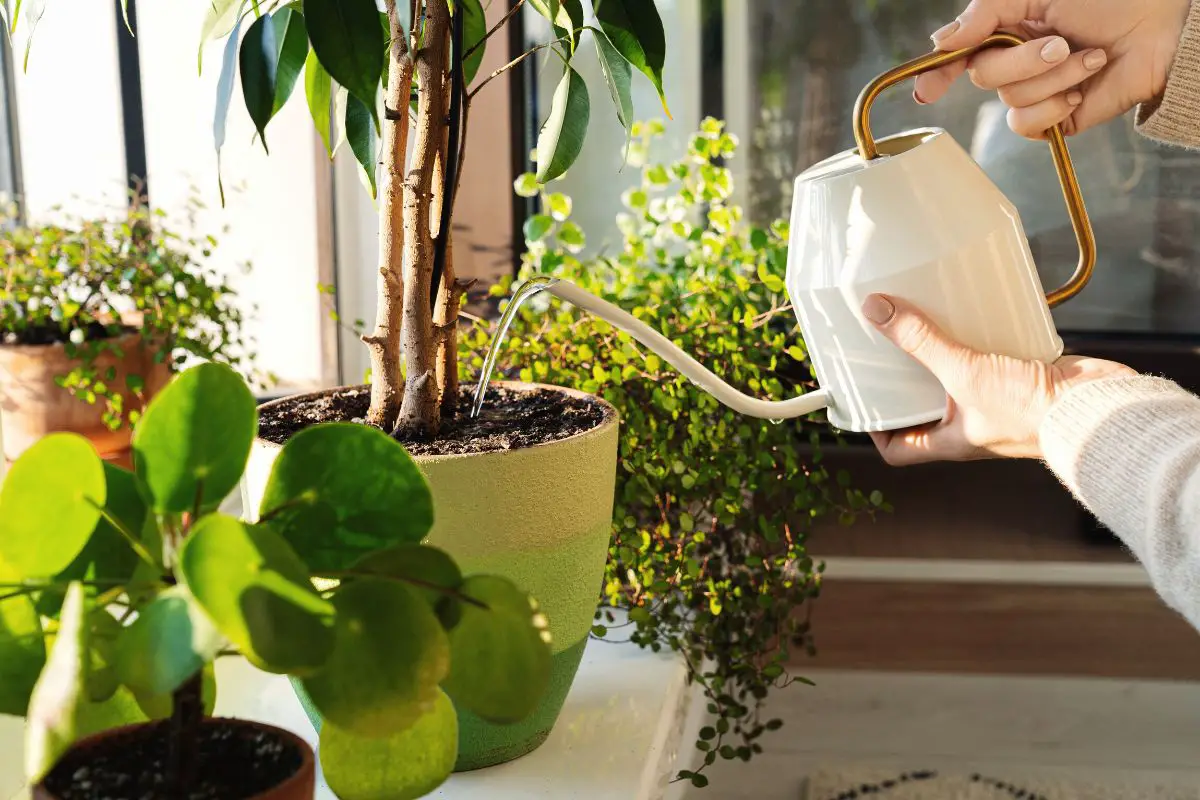
- Water the soil deeply and evenly using a watering can with a narrow spout. Pour the water gradually until the excess drips out of the pot’s bottom holes.
- Avoid shallow watering as it can create dry and hydrophobic spots in the root zone, leaving some parts of your plant dehydrated with yellow or brown leaf edges.
- Bottom water your plant once every 2 months to evenly rehydrate the soil. Soak the bottom half of the pot in water for up to 30 minutes or until the soil surface feels moist. Place the pot over a drip tray to let the excess water drain before placing it back on its saucer.
Pro tip: Repot the plant only in severe cases of underwatering where the soil has become hydrophobic and won’t rehydrate even after soaking it in water for 30 minutes. Note that repotting can stress fiddle leaf figs and will likely delay flowering even further.
Low Light Conditions
Low light conditions can inhibit flower development. Ensure your fiddle leaf figs receive plenty of natural light even in the fall and winter.
Here are some tips to improve the light conditions around your indoor fiddles:
- Place the plant in a spot that receives bright natural light for at least 8 hours daily. A spot with at least 4 hours of direct morning sun is even better for plants over 3 years old.
- Use grow lights with high levels of red light for 6-10 hours daily during winter to supplement natural light. Red light is crucial for flower or fruit development in plants.
- Rotate the pot every time you water the plant to ensure even light exposure, especially to the developing syconia.
Slow Growth or No Blooms
Fiddle leaf figs are naturally fast-growing plants that typically put on 1-2 feet (0.3-0.6 m) every year.
The lack of visible signs of growth (vertical height and new leaf buds) can indicate underlying problems, such as:
- Being potbound: Roots spill through the drainage holes or over the soil surface because of the lack of soil space. Exposed roots are unable to access moisture or nutrients, leading to stunted growth.
- Underwatering or overwatering: Poor watering practices can lead to poor root health. The leaves may turn yellow or develop brown spots (dry or mushy, depending on the watering issue), and the plant may stop growing.
- Insufficient light: Low light conditions can disrupt the plant’s photosynthetic activity, leading to loss of vigor and lack of new growth or blooms.
- Nutrient deficiency: Adequate nutrients are necessary to sustain a fiddle leaf fig’s rapid growth rate. The lack of nutrients will noticeably lead to premature yellowing of leaves and a lack of new growth.
- Environmental stress: Unstable temperature and humidity can stress fiddle leaf figs and cause leaf drop. Stress can also stunt growth and inhibit flower development.
Evaluate your current care practices and check the stress symptoms to identify the underlying cause correctly.
Adjusting or improving your care routine won’t guarantee that your plant will produce flowers. Note that fiddle leaf figs hardly bloom indoors to begin with. However, consistent, excellent care practices can improve your chances of seeing the elusive syconia.
Myths and Misconceptions
I’ve come across several gardening myths while starting out as a fiddle leaf fig collector.
Here are some associated with FLF flowers and fruits:
- Fiddle leaf figs are prolific fruit-bearing trees. Although this might be true in their native habitat, the colder climate in the US and suboptimal indoor environment can inhibit flowering in potted fiddle leaf figs. The Agaonidae wasp responsible for FLF pollination also doesn’t thrive in colder climates.
- Extreme neglect or stress will induce flowering. Fiddle leaf figs aren’t tolerant of neglect. They’re fussy houseplants that’ll droop or shed their leaves at the first sign of stress. That said, stress will further reduce the chances of flowering. I don’t recommend stressing your fiddle leaf fig to induce flowering, as it can only harm your plant’s health.
Note: While flowering and fruiting are possible, most indoor growers will never see it happen naturally. It’s best to appreciate your fiddle leaf fig for its foliage rather than expecting it to bloom.
Final Thoughts
Fiddle leaf fig flowers are not showy and don’t add significant value to the plant’s aesthetic appeal. However, seeing them on your indoor fiddle leaf figs can be a rewarding experience as they indicate that your plant is thriving with your care.
Remember that plant maturity, near-tropical environmental conditions, and proper care are crucial for flower development.
Even when you’re not expecting your plants to bloom, apply the suggested care techniques and focus on overall plant health. With adequate care, flowering may eventually come naturally.
If you’ve seen syconia on your indoor fiddles, please leave a comment to share your experience or tips. For questions, subscribe to the blog for more plant care insights.