
When and How to Prune Jade Plants
Jade plants are popular indoor succulents that thrive with minimal care and can live for decades. Although their slow growth keeps them compact in pots, they can become top-heavy over time, making pruning essential.
Here are some tips on the pruning needs of jade plants:
- Trim or pinch unwanted growth on jade plants any time of the year.
- Schedule hard pruning during the active growing season in spring and summer for faster recovery.
- Cut the growing tip of a stem or branch to halt vertical growth and promote lateral growth.
- Cut above a leaf node to promote branching.
- Limit pruning to less than a third of the foliage, and wait at least a month before pruning again as needed.
- Always use sterile shears or scissors and clean them with alcohol between cuts to prevent the spread of infection.
Jade plants are forgiving and tolerate extensive pruning, but it’s important to trim them properly to avoid issues like infections and uneven growth. In this article, I’ll share practical pruning tips to keep your plant healthy and well-shaped.
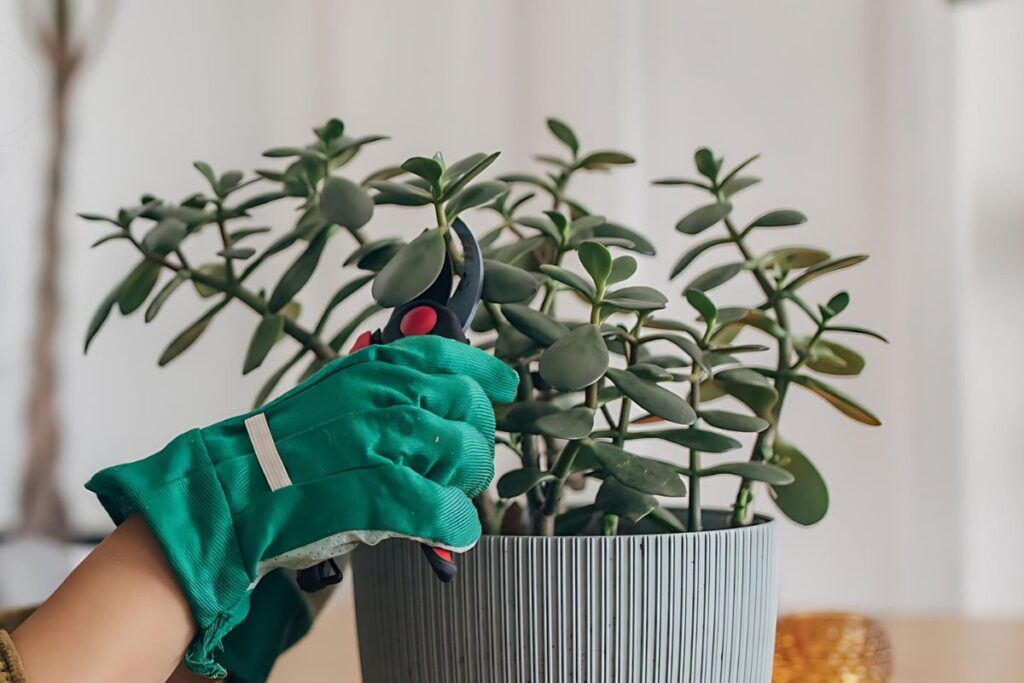
Reasons for Pruning
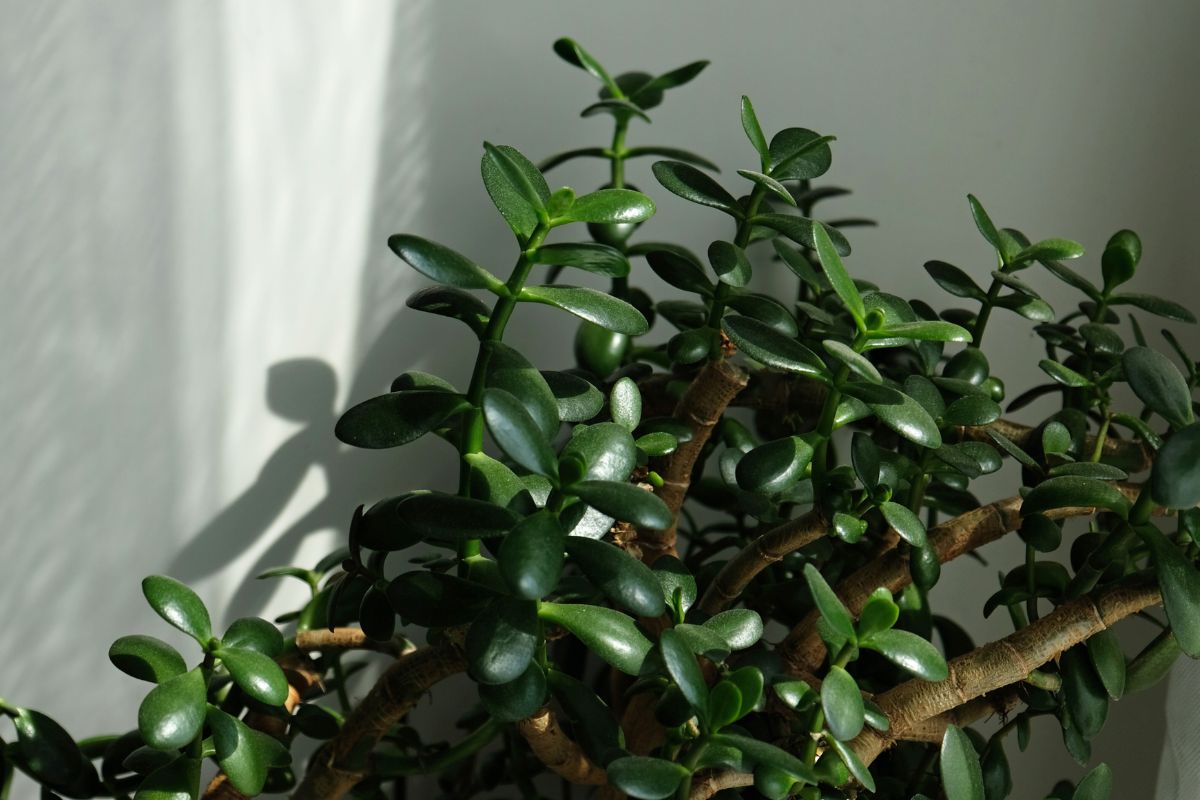
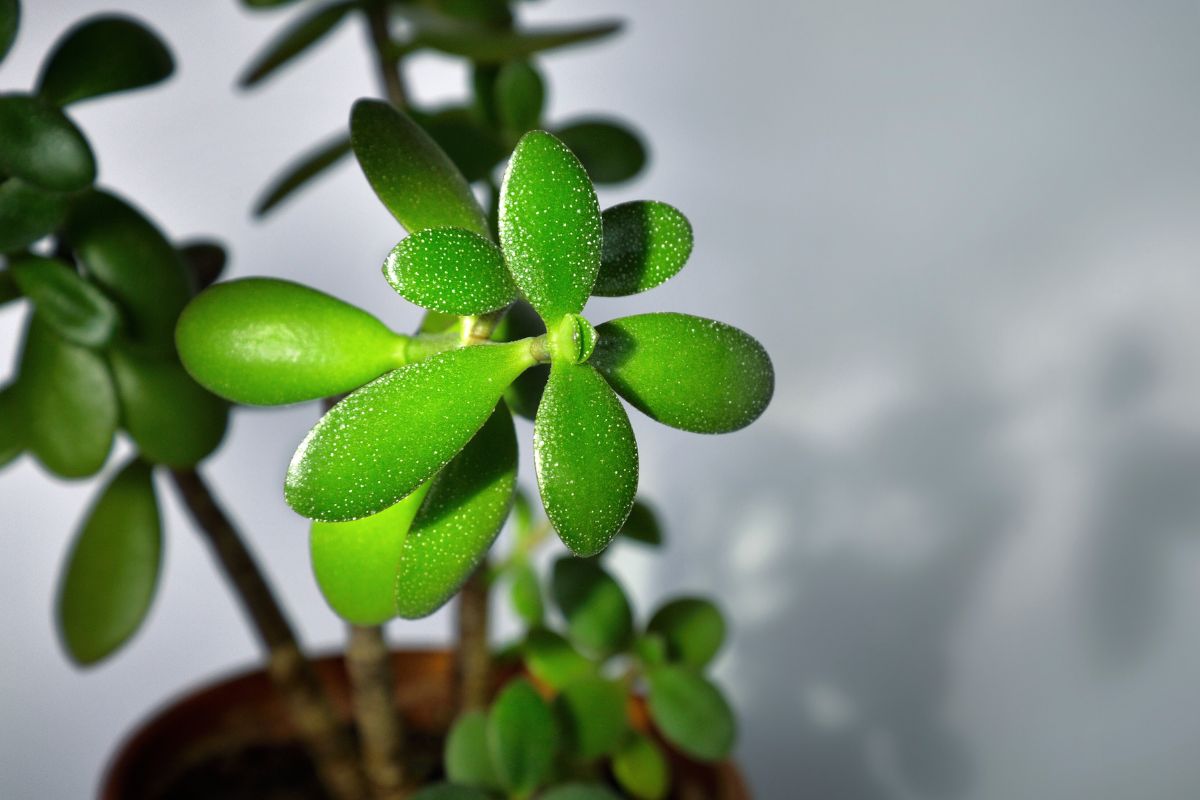
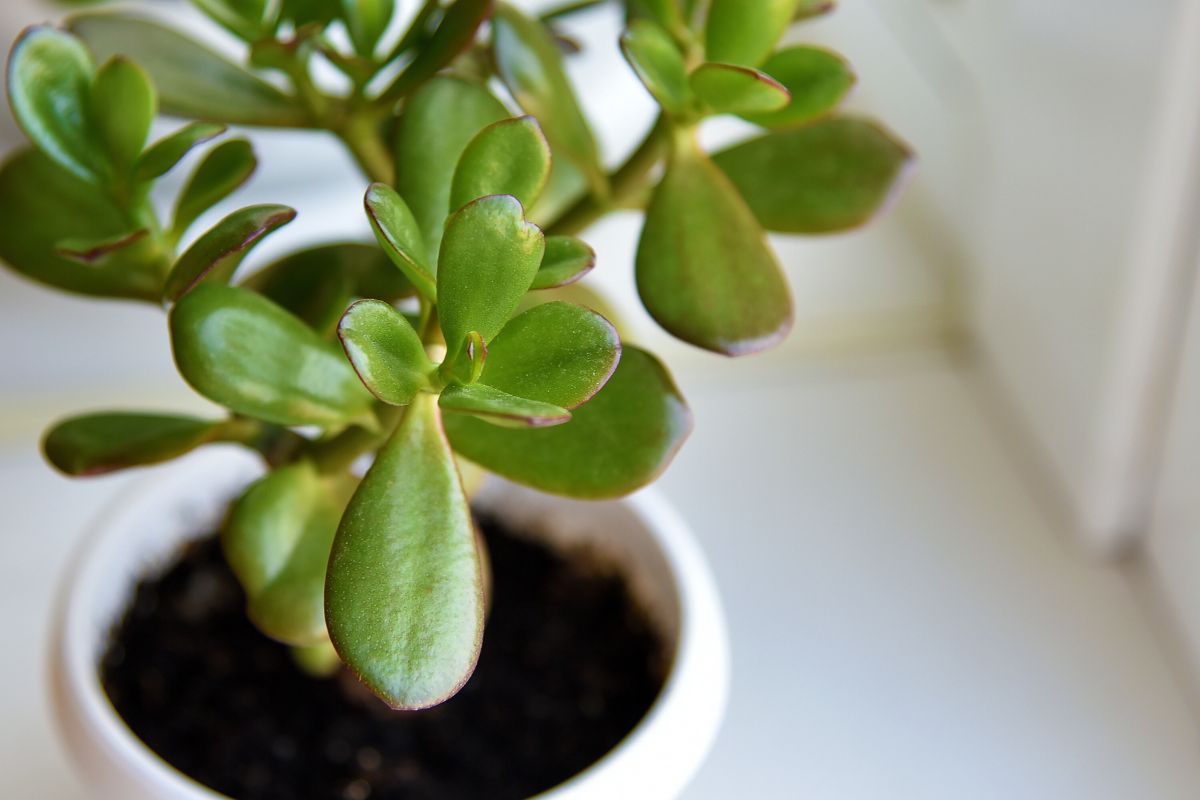
Jade plants (Crassula ovata) are tree-like succulents native to semi-arid and arid regions of South Africa. They have plump, coin-shaped leaves atop fleshy stems that become woody over time.
Despite their slow growth rate, their long lifespan allows jade plants to grow to tree-like sizes of 10 feet (3 m) or more in the wild.
In contrast, indoor jades require regular pruning for the following reasons:
Healthier Growth
Jade plants can grow multiple branches during the growing season in spring and summer. The branches may crisscross and prevent proper light access to the lower and middle leaves. Pruning can help ensure the foliage gets adequate access to light and maintains healthy growth.
Aesthetic Appeal
Jade leaves can store extra moisture to keep the plant hydrated despite long periods between watering sessions. As such, they can become heavy and weigh down the branches, giving the plant a lopsided or droopy appearance.
Removing overlapping or drooping branches can keep your plant looking perky and vibrant. You can also prune and train your plant to grow in a bonsai form.
Bushier or Fuller Growth
You can trim droopy branches to a third of their length (just above a leaf node). This will promote lateral growth that will make your plant look bushier and less droopy. You may then pinch unwanted growth from downward-facing nodes whenever they appear.
Pest & Disease Prevention
Overcrowded leaves can inhibit proper air circulation and encourage diseases, such as powdery mildew. Dense foliage can also provide hiding spots for pests, increasing the risk of an infestation.
Size Management
In the wild, a jade plant can grow multiple offshoots from the base, eventually developing into woody trunks. Pruning can help control this growth behavior to manage the shape and size of potted indoor jades.
When to Prune Jade Plants
Spring and summer are the best times to prune jade plants because they grow more actively during the warm season. They also receive more frequent watering, which aids in their ability to heal from the wounds and grow new and healthier foliage.
Here are some essential reminders about the proper timing of pruning:
- Check if pruning is necessary. Plants with unbalanced growth, droopy or overlapping branches, and sick or discolored leaves will need a trim.
- Avoid pruning jade plants less than a year old, as they need enough leaves to generate energy for the growing roots and shoots.
- Water the plant deeply a day before a hard prune. Well-hydrated plants can use the nutrients from the soil or mobilize the stored nutrients or electrolytes in their cells to help heal the wounds from pruning.
I typically prune my jade plants once or twice a year:
- Initial pruning: I hard-prune the plant in early or mid-spring to remove leggy, damaged, or discolored foliage and promote bushy and balanced growth.
- Touchups: After the plant shows noticeable growth in early summer or mid-summer, I trim or pinch the shoots that grow on unwanted spots along the trunk or stem. Pinching the growing tips of the new stems will also prevent them from growing longer and instead promote branching from the cut end.
- After flowering: If your jade plant is an active and frequent bloomer, you must wait after the flowers fade before pruning to avoid unintentionally cutting off the flower heads.
However, some jade plants might not need hard pruning annually. For instance, older plants that have been sitting in the same pot for several years are likely to grow more slowly.
They may only require occasional trims to address the following issues:
- Leaves with brown or black spots or edges
- Yellowing leaves
- Leaves with yellow or brown scabs from powdery mildew
- Drooping branches from heavy leaves
- Overlapping branches
- Downward-growing branches
- Leggy or leaning stems
- Lopsided appearance with one side bushier than the other
- Unwanted offshoots growing from the base of the plant
- Leaves or branches severely infested with pests
How To Prune Jade Plants
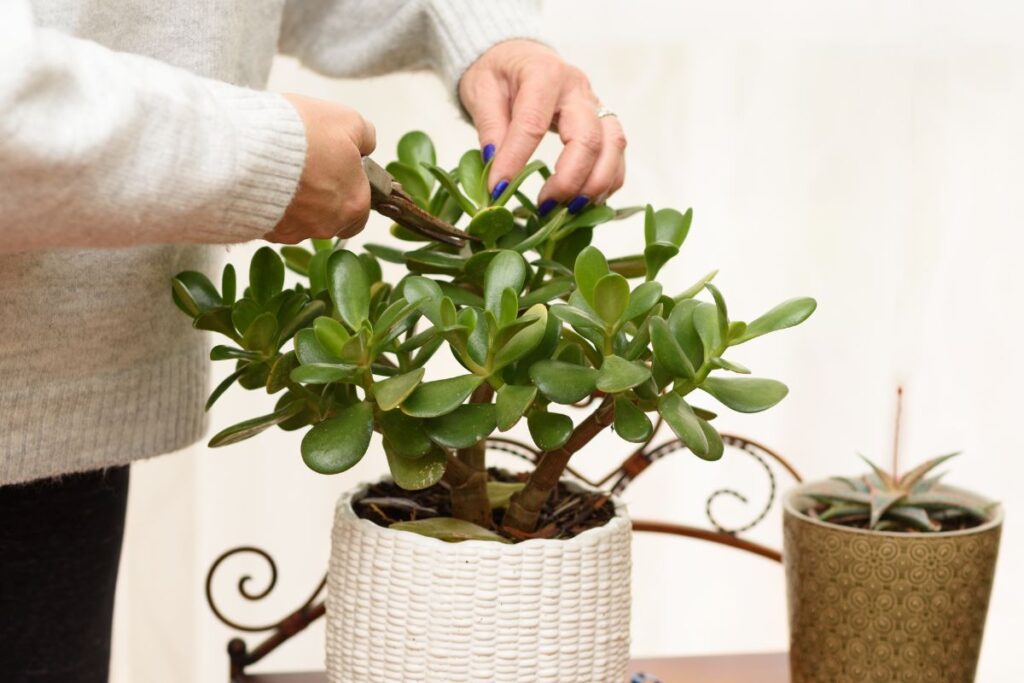
Jade plants are tolerant to pruning and will grow new shoots within 2-4 weeks. Nevertheless, following proper steps to ensure the plant doesn’t sustain long-term damage that can negatively affect its health is important.
Preparation
Below are the tools you will need for pruning:
- Sharp pruning shears, bonsai scissors, and/or utility knife
- 70% isopropyl alcohol or 10% bleach in a spray bottle
- Clean cloth or cotton balls
- Garbage bags
- Cinnamon powder and fine brush
- Tray with newspaper
Once the tools are ready, follow these initial steps:
- Water the plant deeply at least one day before pruning.
- Disinfect the blades of the cutting tools with rubbing alcohol or bleach to prevent the spread of diseases between houseplants. It’s also necessary to continue sterilizing the tool between cuts to avoid spreading pathogens within the same plant.
- Inspect your plant thoroughly to locate the sections that you must cut. Look specifically for downward-growing branches, unwanted offshoots, overlapping branches, leggy sections, and dead or diseased parts.
Pruning Techniques
- Dried or yellowing leaves: Pinch them close to the stem using your clean fingernails or scissors. Be careful not to scrape and remove the node so a new leaf will grow in its place.
- Dead leaves or stems (black or brown and shriveled): Cut them using sterile shears and dispose of them directly in the garbage bag. Cut them off entirely until you see healthy plant tissue, and dust the wound with cinnamon powder to prevent the spread of the disease. Remember to spray the blade with alcohol or bleach and wipe dry with a cloth or cotton ball between cuts.
- Leggy stems: Cut leggy stems back to your desired height or length. Make a clean cut about ¼ inch (0.6 cm) above a node and brush the stump with cinnamon powder. New branches will grow out of the nodes below the cut.
- Young jade stem: You can perform formative pruning on young jade plants (over 1 year old) by cutting the growing tip of the main stem to halt vertical growth and promote lateral branching. Cut the tip to about a quarter of an inch (0.6 cm) above the leaf node where you want branching to occur. Pro tip: Two new branches will grow out of the leaf node. Pay attention to the direction of the leaves on the node because that will be the same direction the new branches will grow.
- Overgrown or droopy branches or stems: You can prevent more growth by using relief or corrective pruning. Slice the branches as close to the stem as possible to remove the nodes. Dust with cinnamon powder to help the wound heal faster and prevent infection.
- Offshoots: Slice them as close to the base of the trunk as possible. The remaining bump will eventually dry out and fall off. You can dust the wound with cinnamon powder to protect the plant from diseases while it heals.
- Downward-growing branches: Cut them as close to the stem as possible to prevent new branches from growing in that direction. These branches sprout from the underside of larger stems and curve upward. Over time, the heavy leaves will weigh them down, making the branches and stems droopy.
Place the stem cuttings on a tray with newspaper for storage. After pruning, inspect the cuttings for potential propagation. I’ll discuss this further below.
Pro tip: For relief or formative pruning, remove only a third of the foliage in spring and repeat in early summer as needed. On the other hand, you may prune more liberally when treating severe damage or diseases, such as cold shock or soft bacterial rot.
You must cut the entire portion of the stems that have turned black or mushy until only healthy plant tissue remains. With adequate post-pruning care, the energy stored within the remaining stems will help the jade plant grow new and healthy branches and leaves.
Root Pruning Tips
Jade roots are sensitive to soggy soil conditions, which can cause root rot. On the other hand, prolonged drought can dry out and kill the roots. That said, you may need to prune the roots and repot the plant occasionally.
Here’s a brief guide on root pruning and repotting, depending on the issue:
| Issue | Symptoms | Solution |
| Overwatering and Root Rot |
|
|
| Underwatering and Hydrophobic Soil |
|
Pruning for Propagation
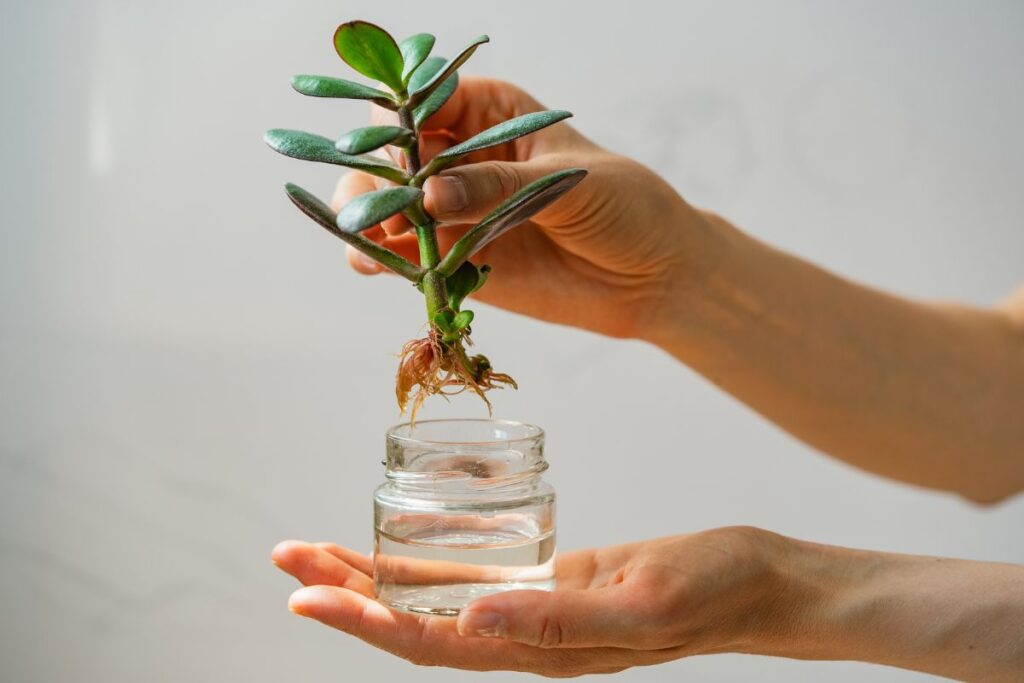
You can grow several new jade plants from healthy leaf or stem cuttings collected from spring pruning. Avoid propagating cuttings collected in the summer because they won’t have enough time to grow enough roots before the cold seasons set in.
Here are the different propagation methods you can use after pruning:
Stem Propagation
Stem propagation is a straightforward and convenient way of growing your jade plant collection.
Below are the traits to look for when collecting offshoots or stem cuttings:
- Choose a cutting that’s 4-6 inches (10-15 cm) long.
- Avoid stems that are curving too much.
- Select stems or branches that are green and fleshy because they root faster.
- Ensure the stem has green, plump leaves without signs of pests or diseases.
After selecting the stems, follow these steps:
- Pinch the leaves off the two bottom nodes. For potential leaf propagation, ensure each leaf has a bit of the node attached because that’s where roots will grow out of.
- Spread the stems over a tray with newspaper and place it in a cool, dry room for 3-7 days to form a callus.
Rooting in Soil or Soilless Mix
- Prepare a 3-4-inch (7.6-10 cm) nursery pot and 100% coco peat or perlite. You may also use a standard jade soil mix.
- Fill ¾ of the pot with your chosen substrate.
- Poke a 1-1.5 inch (2.5-3.8 cm) hole in the middle using a wooden chopstick.
- Optional: Dip the bottom of the cutting in rooting hormone. Jade cuttings readily grow roots from the bottom nodes when kept in suitable conditions. However, rooting hormones can help speed up the process.
- Prop the cutting into the hole and tamp the substrate firmly around it.
- Spray the substrate with water until it’s evenly moist but not soggy.
- Place the pot up to 8 feet (2.4 m) away from a sunny window to give it at least 8 hours of bright indirect light daily.
- Ensure the area has moderate temperature (around 75 °F or 24 °C) and humidity (around 50%) to prevent the cuttings from drying out too quickly.
- Spray the substrate again with water every 2-3 days once the top inch (2.5 cm) feels dry.
- Reduce the watering frequency when the plant grows new leaves or puts on about an inch (2.5 cm) in height. These signs indicate that the roots are growing and the young plant is thriving. Water the substrate only when the top half of the soil mix is completely dry.
Jade stem cuttings typically develop roots within a month and may be repotted after 6 weeks. Young jade plants can grow quickly when propagated during the growing season.
Pro tip: I usually wait until they put on up to 6 inches (15 cm) of vertical growth and numerous branches and leaves before the initial repotting to ensure they have a healthy root system. This can take 2-3 months when propagated in early or mid-spring.
Here are the steps for repotting newly rooted jade cuttings:
- Water the plant deeply 2 days before repotting.
- Prepare a breathable pot with a drainage hole. Choose a terracotta pot one size larger than the old pot.
- Fill the pot’s bottom 2 inches (5 cm) with a moist, well-draining jade soil mix. You can use high-quality succulent soil or prepare a compost-perlite mix.
- Gently squeeze the nursery pot to loosen the soil and easily slide out the young jade plant.
- Loosen the old substrate with a chopstick to release the rootball. Keeping up to half of the old substrate around the roots is okay.
- Spread the roots over the new pot and cover them with fresh soil mix. Tamp the soil firmly to keep the plant steady.
- Wait a full week before watering the plant deeply. Water the young plant when the top half of the soil mix is completely dry.
- Keep the pot in bright, indirect light until the following spring. Rotate the pot by 90-180° every time you water the plant to promote balanced growth and keep it upright.
Rooting in Water
- Prepare a clear glass about 4 inches (10 cm) tall and fill half of it with filtered or distilled water.
- Optional: Dip the bottom of the cutting in rooting hormone.
- Prop the cutting in the water, ensuring no leaves are submerged.
- Place the glass in a warm room (75 °F or 24 °C) with bright indirect light.
- Replace the water every week.
With proper care, the cuttings should root within 4-6 weeks. You can transplant the rooted cuttings in jade soil mix once the roots are at least an inch (2.5 cm) long. You can then follow the steps above for initial repotting.
Leaf Propagation
As discussed, some stems from pruning aren’t suitable for propagation.
You can still use the leaves as long as they possess the following qualities:
- Plump
- Green
- Full-sized (3-4 inches (7.6-10 cm) long and 1.5 inches (3.8 cm) wide)
- No signs of pests or diseases (i.e., yellowing, white fluff, or honeydew)
Here are the steps to propagate leaf cuttings:
- Collect viable leaf cuttings, ensuring there’s a bit of node attached when you pluck it off from the stem.
- Let the cuttings form a callus overnight in cool, dry room overnight.
- Prepare a shallow container about 2 inches (5 cm) deep and fill it with your standard jade soil mix.
- Spread the leaf cuttings horizontally over the soil mix, ensuring contact between the callused end and the soil. Space the leaves at least an inch (2.5 cm) apart.
- Spray the substrate thoroughly until it’s evenly moist.
- Keep the setup in a warm room with moderate humidity and bright indirect light.
- Spray the soil every 1-2 days to keep the surface moist and prevent the leaves from drying out.
The leaf cuttings will sprout new leaf buds from the nodes within 1-2 months, indicating healthy root growth. You can then transplant the young plants in individual 4-inch (10 cm) pots with jade soil mix.
Bonsai Training & Pruning
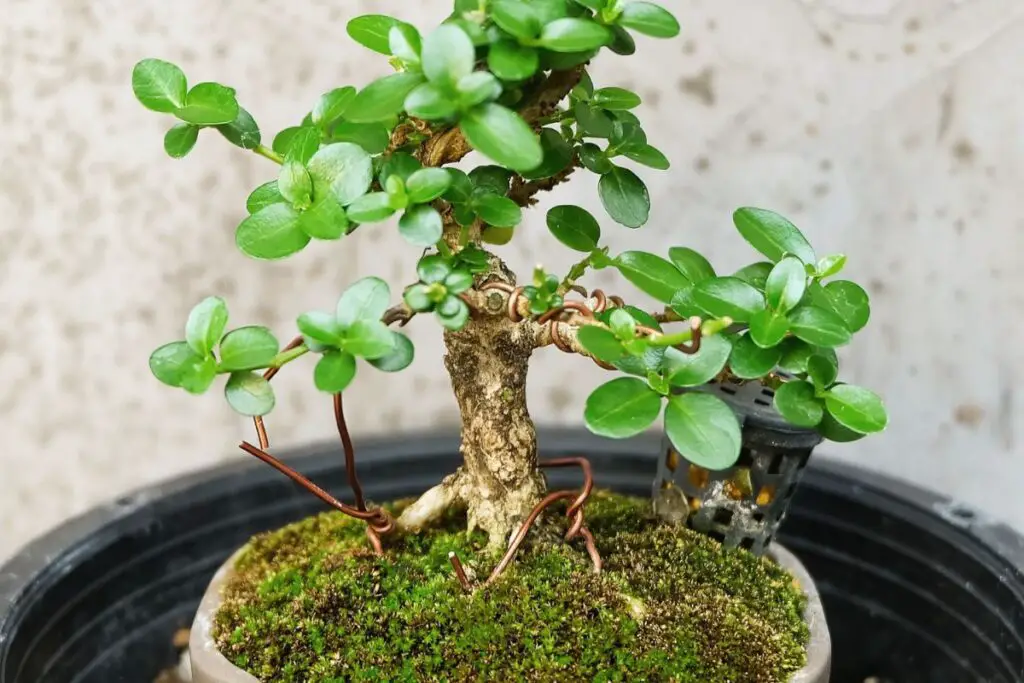
The classic jade plants (Crassula ovata) can grow too large to train into a bonsai. They also develop longer and heavier leaves as they mature.
You’ll have more success with shorter varieties with tinier leaves, such as the following:
- Dwarf Jade Plant (Crassula ovata ‘Crosby’s Compact’)
- Hummel’s Sunset
- Miniature Jade (Crassula ovata ‘Minima’)
- Pixie
A year after propagating a stem cutting, you can train the young plant to grow into a bonsai form. This stage is ideal because the main stem is still soft, fleshy, and easier to train.
You’ll need the following materials:
- Bonsai pot 3-4 inches (7.6-10 cm) deep and up to 6 inches (15 cm) wide with a drainage hole
- Copper wire or bonsai wire 12-18 inches (30-45 cm) long and 1-3 mm in diameter (choose bright-colored wires like gold, pink, or purple to make them easier to spot and remove as needed)
- Sharp and sterile wire cutter
- Wire mesh wider than the drainage hole
- Standard jade soil mix (cactus or succulent soil)
- Sharp and sterile bonsai scissors or pruning shears
Here are the steps:
- Water the plant deeply 2 days before repotting.
- Loop the bonsai wire’s bottom inch (2.5 cm) through the mesh to keep it stable.
- Insert the bonsai wire upward through the drainage hole until the mesh is flush with the bottom of the pot and can anchor the wire.
- Fill the pot with an inch (2.5 cm) of soil mix.
- Carefully unpot the plant to minimize damage to the roots. You can scrape the edges of the pot with a flat knife or spatula to slide the rootball out more easily.
- Remove the old soil from the rootball using a wooden chopstick.
- Prune the roots to make them fit inside the bonsai pot.
- Position the plant over the new soil mix and spread the roots laterally. Make sure the base of the plant is flush with the pot’s rim.
- Cover the roots with more soil mix until they’re buried at least an inch (2.5 cm) deep. Ensure the bonsai wire is poking out of the soil.
- Measure the height of the plant using a ruler. Cut the growing tip at your desired height to promote lateral branching on top. I like keeping my jade bonsai tall at 10-12 inches (25-30 cm).
- Cut the branches liberally using sterile bonsai scissors until you see the sections you want to keep.
- Twist the bonsai wire along the main stem in a spiral pattern. Be careful not to twist it too tightly to avoid scarring as the stem widens.
- Once you reach the tip of the plant, cut the excess wire using a wire cutter.
- Bend or twist the stem carefully into your desired shape. Young jade stems are flexible but they can still snap if you put in too much pressure.
- As new branches and leaves grow, add more wires along the branches to shape them the way you want.
- Pinch or trim leaf buds growing in unwanted spots along the main stem.
- Keep an eye on the wires as the plant grows within the next 4-6 weeks. Depending on the plant’s growth rate and how quickly the main stem and branches thicken, you may need to remove the wires sooner to keep them from digging into the plant tissue.
Post-Pruning Care
Although resilient and forgiving to extensive pruning, jade plants require adequate care after a trim to help them recover and grow healthier foliage.
Remember these essential post-pruning care tips:
Watering
Jade plants require more water during the growing season. However, removing lots of leaves can limit their ability to store moisture.
Keep an eye on the soil moisture and water the plant as soon as the top half of the soil mix is dry. Proper hydration after pruning can encourage faster growth of new leaves and branches.
Light & Environment
Keep newly pruned jade plants away from direct sunlight until they grow enough leaves to help prevent sun stress and dehydration. Aim for at least 8 hours of bright indirect light daily or up to 8 feet (2.4 m) from a sunny southern window.
Rotate the pot regularly to prevent leggy growth.
Temperature & Humidity Conditions
Maintain moderate temperatures (65-75 °F or 18-24 °C) and humidity (30-50%) to avoid common problems like heat stress and dehydration.
Fertilizing
Avoid fertilizing jade plants immediately after pruning. Wait at least 2 weeks for the next watering session before feeding your plant a half-strength balanced 10-10-10 fertilizer. Liquid fertilizers are fast-acting and can mobilize nutrients throughout the plant to help with new growth.
Monitoring
Check the plant regularly—ideally every time you water it—to promptly catch early signs of stress or new growth. Watch out for mushy sections that may indicate infection from contaminated cutting tools. Cut off the infected part with sterile tools and brush with cinnamon powder to prevent reinfection.
Potential Mistakes, Risks, and Challenges
Here are some common issues to watch out for when pruning jade plants:
Over-Pruning
Mature jade plants with a robust root system and thick, succulent trunks will happily bounce back even after removing all of their leaves, especially when treating infection. The cells on the roots and stems have enough moisture and nutrients to generate new growth.
In contrast, young plants have underdeveloped stems and roots that may not have enough resources to grow new foliage quickly. In this case, it’s best to limit pruning to only one-third of the foliage and wait at least a month for another pruning session.
Improper Tool Use
Contaminated cutting tools can transmit diseases to jade plants when pruning.
Be sure to sterilize the blades with 70% isopropyl alcohol or 10% bleach before using them on jade plants. Cleaning them between cuts will also prevent the spread of infection across different plant parts.
In addition, sharpen the blades before use to make a nice, clean cut for a smoother surface once the wound heals. Jagged wounds tend to leave an odd-looking scab or scar.
Challenges in Propagation
You may also encounter some problems when propagating cuttings collected during pruning.
Here are some common challenges:
- Healthy-looking cuttings sometimes fail to root and exhibit delayed symptoms of rot. This can be due to a pre-existing infection at the time of collection or soggy conditions in the substrate during propagation. You must discard the rotten cuttings and contaminated substrate to prevent the spread of infection.
- Roots may develop very slowly if the cuttings don’t receive adequate light or moisture. Propagating cuttings collected during the cold season may also lead to slower growth or development because of the lower light and temperature conditions. You can supplement the light requirement by placing full-spectrum grow lights a foot (30 cm) above your cutting for 12-16 hours daily. You can also place the nursery pots over a heating pad maintained at 75 °F (24 °C).
Post-Pruning Stress
If you’re pruning jade plants to remove sick or damaged foliage, it’s crucial to identify the underlying cause first so you can adjust the post-pruning care accordingly and prevent stress.
Here are some things to look out for:
- Overwatering: After pruning blistered or mushy leaves, you must let the soil dry out more (the top ⅔ or ¾ of the potting mix) between watering sessions.
- Underwatering: The issue of yellowing or browning leaves from dehydration may recur if the plant remains underwatered after pruning. Water your plant regularly and avoid letting the soil become bone-dry to keep it from becoming hydrophobic.
- Insufficient Light: After pruning your plant because of legginess, ensure it receives adequate light with regular pot rotation. Without proper light adjustment, the new growth will remain leggy with sparse leaves.
- Over-fertilization: Avoid fertilizing the plant for the season after trimming foliage with leaf scorch due to over-fertilization. Your plant must first eliminate the excess salt in the soil and its system. Otherwise, the remaining foliage and even the new growth will develop similar symptoms.
Final Thoughts
Jade pruning can be scary for beginner gardeners. I’ve had my fair share of failed pruning attempts, especially with bonsai training.
Remember to visualize your pruning goals and plan ahead to prevent mistakes that may affect your plant’s health. For instance, over-pruning young plants can stunt their growth. Using contaminated or dull tools can also spread diseases to your jade plant during pruning.
Light pruning isn’t something to be afraid of, as jade plants are sturdy. Review the tips outlined in the article and feel free to prune your jade plant when necessary. Once you get into pruning and become more experienced, it will be a routine care thing to do.
Please leave a comment if you have questions or want to share your experience with pruning jades.