
White Patches or Fluff on Fiddle Leaf Figs: Causes & Fixes
Fiddle leaf figs are prized for their large, glossy leaves and striking appearance. However, white patches or fluffy growth on their leaves and stems can indicate underlying issues that may affect their health.
The following issues can cause white patches on fiddle leaf figs:
- Sunburn
- Pest infestation
- Powdery mildew
- Blight
- Hard water deposits
- Leaf shine residue or product buildup
This article will explore the common causes of white patches or fluff on fiddle leaf figs and provide practical solutions to restore their health and prevent future problems.
Fiddle Leaf Figs: An Overview
Fiddle leaf figs (Ficus lyrata) are fruit-bearing tropical trees with large, fiddle-shaped leaves. The upper surface is deep green and smooth, while the underside is pale green, rough, and veiny. Each FLF leaf can last about 12 months before gradually turning yellow and falling off as it ages.
The longevity and vibrance of the leaves in their native habitat are largely due to the following factors:
- Moderate light intensity for younger FLF trees because the sunlight is filtered through the dense tree canopies in West or Central African rainforests. Note: Older trees can tolerate full sunlight due to well-established roots and fully developed leaves.
- Calcium oxalate crystals in the sap grant the leaves natural pest-deterrent properties by injuring the mouth of chewing pests in the wild, like caterpillars or snails.
- High annual rainfall average reaching 40-80 inches (100-200 cm), keeping the leaves well-hydrated
- Warm, frost-free temperatures averaging 70-86 °F (21-30 °C), allowing optimal metabolic processes that preserve leaf health.
- Humid conditions of around 70% relative humidity all year round, inhibiting rapid transpiration or dehydration from intense heat and sunlight.
- Nutrient-rich soil from the continuous cycling of nitrogen sources from leaf litter on the forest floor provides a slow but steady supply of fresh nutrients for healthy leaf growth and development.
The interplay among a fiddle leaf fig’s environmental conditions in the wild helps provide natural defenses against issues that can cause leaf damage.
Indoor gardens typically have suboptimal conditions compared to a fiddle leaf fig’s native habitat because it’s not feasible to replicate rainforest conditions at home.
As a result, fiddle leaf figs become more susceptible to stress, which can lead to leaf damage like white patches, fluff, or spots. Each stressor, such as sunburn, dust, mineral buildup, diseases, or pest infestations, has unique symptoms and requires specific treatments.
Let’s explore the details below:
Symptoms of White Patches or Fluff on Leaves
Depending on the underlying cause, a fiddle leaf fig may exhibit white damage or masses in the following ways:
- White or pale brown and crispy spots on the leaves exposed to the sun
- Silvery white or bronze patches on the leaves with tiny black dots nearby
- Fluffy white crawlers, mostly on leaf undersides
- Small silvery-white spots on leaf undersides
- Tiny moth-like flies on leaf undersides
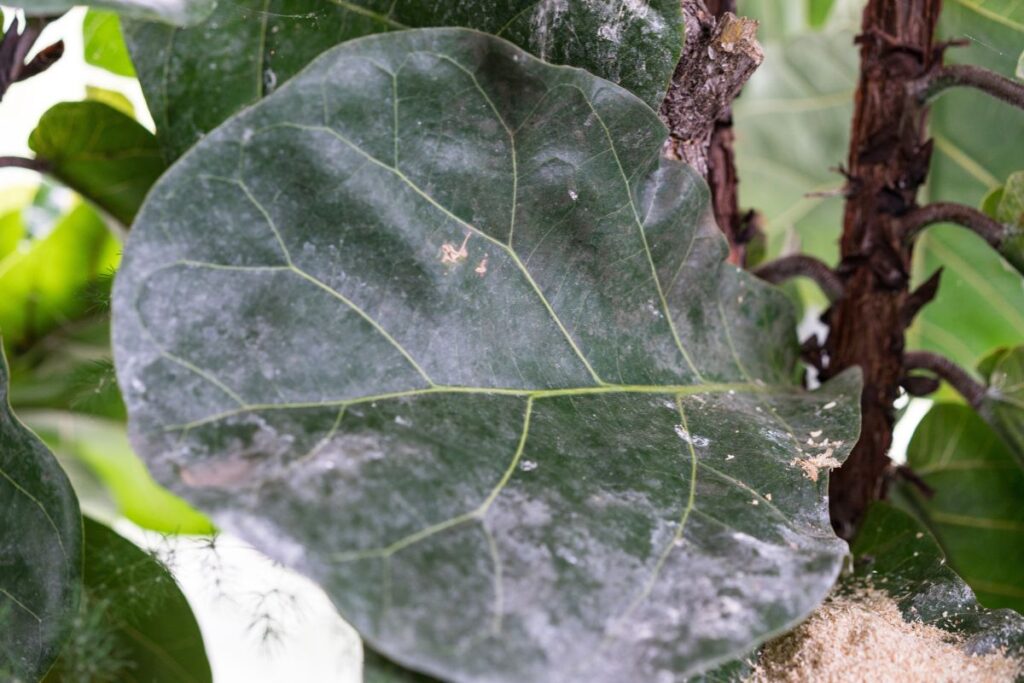
- Powdery white or gray film over the leaf surface
- Feathery or threadlike white or gray mass on the leaves and soil
- Tiny, salt-like white crystals or crusty deposits on the leaf surface
- Dusty white or gray spots on the leaves
The above symptoms may also be accompanied by the following issues:
- Yellowing leaf surface or edges
- Curling leaf edges
- Brown or black spots (leaf scorch)
- Sticky liquid (honeydew) on the leaves, sometimes with sooty mold
- Ants drawn to honeydew (in warm regions)
- Deformed growth on new leaves
- Drooping or wilting leaves
- Leaf drop
Any white mass or discoloration on fiddle leaf figs is unnatural. Inspect the plant regularly to catch issues early, prevent severe damage, and maintain the plant’s health.
Common Causes (& Fixes)
Fiddle leaf figs may show white discoloration or masses due to the following:
1. Sunburn

Full-grown fiddle leaf figs that have lived over 10 years and reached 25-50 feet (7.6-15 m) tall enjoy full sun or at least 8 hours of direct sunlight in the wild. On the other hand, juvenile fiddles receive filtered light through tree canopies.
Indoor fiddle leaf figs seldom reach maturity and remain in their juvenile, non-fruit-bearing form throughout a shorter life span of around 10 years. Note: Fiddle leaf figs live 25 years or so in the wild.
When indoor FLFs are exposed to intense sunlight daily without regular rotation or curtains, the leaves facing the sun may become scorched and suffer the following damage:
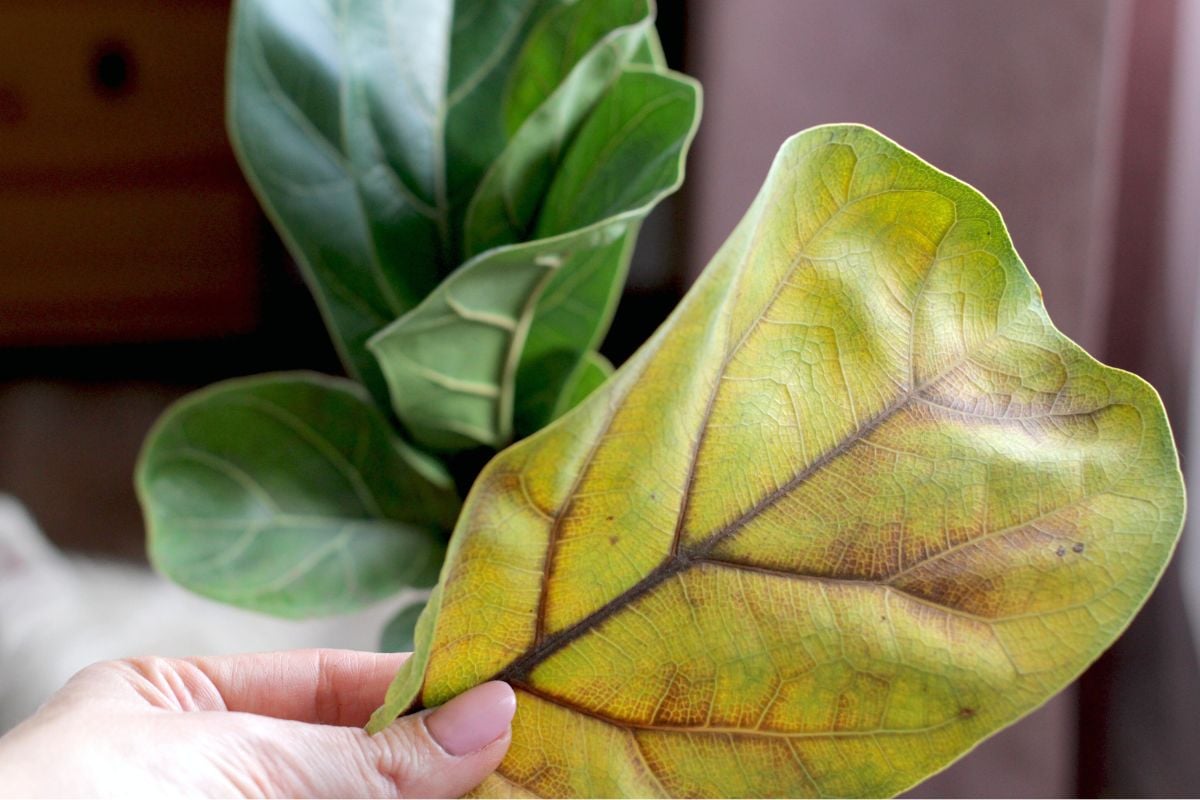
- Brown or tan dry patches on the leaf surface
- Bleached or pale spots on the leaf surface
- The spots turn dark brown and crisp
- Yellowing or browning leaf tips and wilting may occur if the plant is also underwatered
Follow these tips to relieve the symptoms of sunburn:
- Move the plant several feet (+0.6 m) from the sunny window to a spot with bright indirect light. Alternatively, draw sheer curtains at midday to filter the intense afternoon sun.
- Prune the severely damaged leaves. You can cut 1-2 leaves per week to prevent plant stress and maintain a balanced appearance.
- Rotate the pot weekly or before watering to prevent prolonged exposure to sunlight and ensure balanced access to natural light for all sides of the plant.
- Check the soil moisture using your finger or a wooden chopstick, and water the soil deeply when it feels completely dry about two knuckles (2 inches or 5 cm) deep. You may also insert the probe of a moisture meter ⅔ deep on 3-4 spots around the potting mix and water the plant when the average reading is around 4. Well-hydrated fiddles have better tolerance to intense light.
2. Pest Infestations
Several white sap-feeding pests feed on indoor fiddle leaf figs, including the following:
Mealybugs
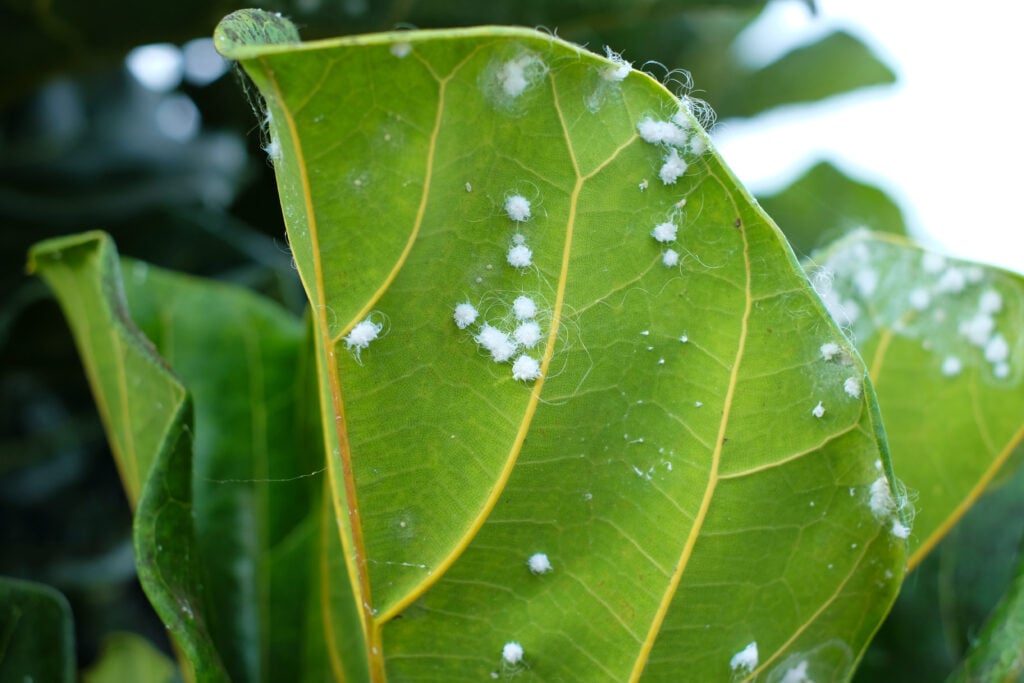
Mealybugs appear as white, fluffy clusters along the leaf veins and stems due to their white waxy covering. Each nymph or adult is about 1/16-⅛ in (1.6-3.2 mm) long, while the eggs are less than 1 mm in diameter and also covered in white fluff.
Mealybugs feed on plant sap on leaf undersides, and an infestation may lead to the following symptoms:
- White cotton-like masses on leaf undersides, typically close to the leaf veins
- Sticky honeydew residue that may sometimes attract sooty mold and ants
- Potential yellowing or curling of infested young leaves
You can treat a mealybug infestation using the following tips:
- Isolation: Isolate the plant to prevent the pests from spreading to other houseplants. Select a spot with similar light, temperature, and humidity conditions to the original spot to minimize relocation stress and potential leaf drop.
- Manual removal: Remove mealybugs manually using a cotton swab dipped in 70% isopropyl alcohol. Repeat this process every 2-3 days until no visible pests remain.
- Neem oil treatment: Apply neem oil spray weekly until the infestation is gone. Spray the plant after sunset to prevent sunburn, which typically occurs when intense sunlight hits the oil on the leaf surface. Oil burn may also occur when you spray the leaves during hot days with temperatures around 90 °F (32 °C).
- Insecticidal soap: Properly formulated commercial insecticidal soaps can kill mealybugs on contact. You can spray the liquid directly on mealybugs, which are readily visible even without a hand lens, and manually remove the dead bugs after 2 days. Reapply the solution once a week until you don’t see any new bugs.
Pro Tip: Inspect your other houseplants for signs of mealybug infestation and treat similarly to keep the pest population under control. Continuous neem oil treatment, applied every 2 weeks, may be necessary to eradicate pests in your indoor garden completely.
Scale Insects
Scale insects are relatives of mealybugs under the superfamily Coccoidea. Most indoor scale insects appear as tiny brown bumps about 1/16-⅛ in (1.6-3.2 mm) in diameter along leaf veins and petioles.
Occasionally, white scale species like Indian wax scales may affect fiddle leaf figs taken outdoors during late spring to summer.
I used to take a few of my older fiddles (over 5 years old) outdoors in late spring to promote robust growth. I’d often place them next to my 5-foot (1.5 m) tall, west-facing boxwood hedge for natural shade from the afternoon sun.
However, the hedge was infested with Indian wax scale one spring, and the problem spread to my fiddle leaf figs, which showed the following signs:
- White, immobile bumps about ¼ in (6.4 mm) long on the branches, petioles, and leaf midribs
- Tiny red crawlers or nymphs (about 1 mm long) along the stem or branches
- Sugary liquid or honeydew near the stationary adult
- Sooty mold or ants drawn to the honeydew
- Leaf yellowing from prolonged severe infestation
The Indian wax scales can survive even when the fiddles are taken back indoors and overwinter as adults. The pest may also spread in nurseries or greenhouses where susceptible plants are stored close together with their foliage touching.
Here are the appropriate methods to eliminate white scales from fiddle leaf figs:
- Isolate infested plants with visible adult wax scales because they likely contain hundreds of crawlers, although not readily visible to the naked eye.
- Pinch or scrape the adults off the plant using a pair of tweezers and drop them in soapy water (1 tablespoon liquid soap in a cup (250 ml) of water). Adults with a white shell covering are resistant to neem oil spray or other pesticides.
- Spray the leaves, stems, and branches with a neem oil solution, focusing on areas near where the adults were, to eliminate the crawlers. Repeat this procedure once a week at night for up to 8 weeks. Reduce the frequency to once every 2 weeks until there are no more sightings of adults.
- Inspect the plant regularly and manually remove the adults as soon as you spot them. Spray the area with neem oil to eliminate any leftover eggs and nymphs.
Thrips

Thrips are common houseplant pests that can easily spread, as they are capable of flying from one plant to another. The adults are slender—about 1/16-1/8 in (1.6-3.2 mm) long—with two pairs of thin white fringed wings, allowing them to fly away when the plant is disturbed quickly.
Thrips like broadleaf plants like fiddle leaf figs because they can burrow into leaf tissue and feed on plant sap, leading to the following damage:
- Silvery white or brown patches on the leaves indicate that the plant tissue has dried out or died
- Tiny black dots (thrips excrement)
- Curling of new growth
Note: Adult thrips remain unaffected by natural contact pesticides, such as neem oil spray and insecticidal soaps, because they can fly away. Larvae and eggs within plant tissue may also be resistant to contact pesticides.
You can treat a thrips infestation on your fiddle leaf figs with the following methods:
- Prune all thrips-damaged leaves with characteristic white patches and black excrement nearby, because there likely are more thrips (eggs, larvae, and adults) within the plant tissue.
- Spray the plant with a spinosad solution every 10-14 days for 6-8 weeks. Spinosad spray is my treatment of choice against thrips because it has a mild systemic activity, providing potential long-term protection against re-infestation.
- Install yellow sticky traps near your houseplants to draw the thrips away from the leaves. You can hang the traps on a nearby wall, stick them on a popsicle or bamboo stick protruding from the potting soil, or carefully hang them on a branch so they don’t turn and touch the leaves.
Whiteflies
Whiteflies are another group of flying pests that are challenging to manage because they have a wide range of hosts and can spread among nearby houseplants. The most common species affecting fiddle leaf figs is greenhouse whiteflies.
Adults have a yellowish body and waxy white wings about 1/16-⅛ in (1.6-3.2 mm) long. Each female can live up to 2 months and lay around 400 eggs, which appear as a mass of tiny, translucent dots on leaf undersides.
The later nymphal stages are hardly visible without a magnifying glass and also appear as immobile, translucent dots on leaf undersides, where they feed on plant sap until they become adults.
In severe infestations, whiteflies can cause the following symptoms on fiddle leaf figs:
- Honeydew on the leaf surface with subsequent sooty mold and ant infestation
- Yellowing leaves
- Leaf drop
You can manage or control whiteflies in your indoor garden with the following tips:
- Identify and isolate all the severely infested plants.
- Spray the leaf undersides with neem oil or insecticidal soap to eliminate eggs, nymphs, and adults that don’t fly away quickly enough. Repeat the treatment weekly until you can no longer see whiteflies.
- Install multiple sticky traps near your houseplants.
Note: Inspect and treat all the remaining plants in your indoor garden, as whiteflies can easily transfer from one plant to another.
3. Powdery Mildew
Fiddle leaf figs may occasionally be affected by powdery mildew if kept in a humid room with other houseplants carrying the fungal spores.
After over a decade of caring for fiddle leaf figs, I’ve encountered powdery mildew on their leaves only once after bringing in an asymptomatic rubber plant (Ficus elastica) I purchased from my local nursery store.
As a regular in that nursery, I didn’t think twice about placing the new rubber plant next to my young fiddle leaf figs, tree philodendrons, and monsteras. I keep the area at a higher relative humidity (around 50-60%) to keep the tropical plants happy.
About 2-3 weeks later, the rubber plant and the fiddle leaf figs started showing powdery mildew infection with the following signs:
- White or gray film of talcum-powder-like mycelia above and below the leaf surface
- Yellow patches underneath the mass of mycelia
- Curled or deformed young leaves (new growth)
- Premature leaf drop
The non-Ficus houseplants weren’t affected by the powdery mildew, and I later found that the disease is caused by a host-specific fungal pathogen that thrives in warm, humid environments with poor airflow.
Powdery mildew fungi require humid conditions at night to germinate and dry leaf surfaces for the spores to spread.
You can manage a powdery mildew infection with the following tips:
- Isolate symptomatic plants right away. Choose an isolation room with bright indirect light, moderate humidity (40-50%), and stable temperatures (65-75 °F or 18-24 °C).
- Prune the severely discolored or disfigured leaves. You may also prune the crowded inner leaves to improve air circulation, but limit pruning to less than 10% of the foliage every 2 weeks to prevent shock. Use sharp, sterile shears or scissors and clean the blades with 70% isopropyl alcohol between cuts.
- Ensure the plant receives at least 8 hours of bright indirect sunlight. The UV rays and natural red light from the sun inhibit powdery mildew growth.
- Prepare a neem oil spray and apply it weekly on leaves with minimal powdery mildew patches. Be careful when wiping the neem oil with a clean cloth so the spores won’t spread. You may also spray the soil surface with neem oil to kill the spores that fall on it.
On the other hand, here are things to avoid when treating powdery mildew in fiddle leaf figs:
- Fertilizing: High nitrogen levels within the plant can encourage faster fungal growth.
- Switching on a fan to improve airflow: Strong wind can disperse the spores of powdery mildew and spread the infection to nearby leaves or houseplants. Proper pruning and plant spacing allow natural and weak airflow, which can help keep the humidity within optimal levels between leaves.
- Overhead watering or misting: Excess moisture on the leaves can drip and carry the fungi to lower leaves. High moisture on the leaves can also temporarily boost the humidity and encourage fungal growth. As the leaf surface dries out, the fungal spores can disperse through the wind.
- DIY treatment using baking soda and milk: I’ve tried using baking soda and milk, and they’ve proven effective against powdery mildew on my other houseplants, like African violets. However, I don’t recommend trying them on fiddle leaf figs, which can be more sensitive to homemade products. Incorrect formulation can be ineffective at low concentrations or may cause staining of the leaf at high concentrations. I’ll discuss this further below.
- Leaf-shine or leaf armor products: Oil-based products can block the leaf stomata and inhibit proper transpiration, worsening plant stress.
4. Blight

Blight-causing fungal pathogens may occasionally affect fiddle leaf figs if there’s an infected plant indoors.
Here are two types of blight on indoor fiddle leaf figs:
Botrytis Blight
Botrytis blight, also known as gray mold, is caused by the fungus Botrytis cinerea, which spreads mycelia over the leaf surface as part of its growth cycle.
The disease can remain dormant on an infected but asymptomatic plant when conditions are unfavorable. However, during warm, humid weather, the spores are activated after 6 hours of wet conditions on the leaves, especially after overhead watering.
Botrytis mycelia appear as white or gray fuzz over young stems and leaves, making it distinct from the talcum-powder-like mycelia created by powdery mildew fungi.
Here’s how botrytis infection symptoms progress:
- Translucent, water-soaked spots appear on the leaf surface
- The spots gradually turn brown and mushy
- Grayish-white pinheads containing spores form on the mushy leaf, giving the infected tissue a fuzzy appearance
- The entire leaf turns brown, droops, and falls off
Botrytis blight mycelia can spread from infected leaves to branches, reaching and infecting healthy plant parts. As such, I don’t recommend propagating fiddle leaf figs with signs of blight.
However, you can treat the blight-infected fiddle leaf figs with the following tips:
- Isolate the infected plant to prevent spores from spreading to nearby healthy plants.
- Prune the leaves with white fuzz from botrytis blight. Use sterile scissors or pruning shears and clean the blade with 70% isopropyl alcohol between cuts.
- Properly discard infected foliage to prevent the spread of fungal spores.
- Improve airflow in the garden by opening the windows during the day when outdoor temperatures are mild. You may also switch on an electric fan around 5 feet (1.5 m) from your plants to promote rapid drying of the leaves on days when you mist and clean them.
- Avoid overhead watering and overwatering your plant to inhibit rapid fungal growth.
- Pro Tip: Use well-draining soil and ensure proper pot drainage to prevent fungal issues.
Southern Blight
Southern blight is caused by Sclerotium rolfsii, which requires hot summers (over 80 °F or 27 °C air temperature) and consistently warm and moist soil to germinate.
Once the fungal spores germinate, you will see the following symptoms on fiddle leaf figs:
- White, threadlike mycelia develop over the soil and stem (or inside plant tissue)
- The mycelia may also reach the lower leaves of young or short plants
- Light to dark brown sclerotia about 1/50 to 1/12 in (0.5-2 mm) in diameter
- Mushy base of the stem (crown rot)
- Water-soaked spots on the leaves
- Premature yellowing and wilting of the leaves
- Plant death within days of infection (from the onset of the initial symptom)
Southern blight affects fiddle leaf figs from the soil up to the stem and leaves. The fungal pathogen is resistant to organic houseplant fungicides, and I don’t recommend using high-level fungicides indoors.
It’s best to discard an infected plant right away, including the potting soil it was in. S. rolfsii usually spreads through contaminated soil containing sclerotia, which can remain dormant and viable in dry soil for about a year or so, although the viability can significantly decline after 6 months.
In addition, you must clean and sterilize the pot with 10% bleach to prevent the occurrence of the disease in your other houseplants:
5. Hard Water Deposits

FLF leaves can develop white deposits due to the following:
- Overhead watering using hard water (tap water with high mineral content) can leave white, chalky, or crystalline residue on the leaves after the moisture evaporates
- Using hard water in humidifiers can cause chalky residue on the leaves
You can solve this issue with the following tips:
- Wipe the leaves with a damp microfiber cloth slightly moistened with distilled water.
- Use filtered or distilled water in your humidifier to prevent future salt buildup and preserve your device’s lifespan.
Pro Tip: Avoid misting if using hard water, as it can accelerate the formation of mineral deposits. In addition, don’t water fiddle leaf figs overhead because the large foliage can displace the water instead of sending it down to the soil. Use a watering can with a narrow spout to deliver the water directly and evenly into the root zone.
6. Leaf Shine Residue or Product Buildup
Using homemade sprays containing the following can leave white stains on the leaves:
- Baking soda: Other sources recommend baking soda sprays to treat fungal diseases or clean leaves. Note that baking soda contains salts that are insoluble in water. If you mix the powder in water and stir it with a spoon, you’ll notice powdery white granules precipitating. Spraying the liquid on leaves will create a white crystalline or powdery residue on leaf surfaces as the water evaporates.
- Milk: Other sources recommend using a milk solution as an effective treatment for leaf shine or powdery mildew. However, undissolved milk particles can also remain on the leaves hours after spraying, potentially attracting plant pathogens and causing bacterial or fungal infections. The particles may also block leaf stomata and inhibit proper plant transpiration.
- Horticultural oils: Neem oil, coconut oil, or other oil-based leaf shine products can cause leaf burn (bleached or dark brown spots) when applied during hot (around 90 °F or 32 °C) and sunny weather. When wiped on the leaves (in contrast to spraying), the oil can remain in the ridges over the FLF leaves and trap dust, causing a white or gray film on the surface.
In addition, spray residues and leaf shine products can clog leaf stomata, inhibiting proper transpiration.
Below are the tips to remove the white stain on FLF leaves:
- Wipe the leaves with a damp microfiber cloth.
- Use a mild soapy water solution (3-5 drops of liquid soap in a liter (0.26 gal) of water) to remove oil buildup.
- Pro Tip: Instead of commercial or homemade sprays, use a cloth moistened with pure water for natural leaf cleaning every week.
Routine Care and Prevention
White patches, fluff, or residue on fiddle leaf figs can range from minor to severe issues.
Regardless, they can be prevented with proper care, including the following:
- Proper light exposure: Provide your fiddle leaf figs with at least 8 hours of bright, indirect, natural light, typically found up to 4 feet (1.2 m) from an east-facing window or up to 8 feet (2.4 m) from a south-facing window. Allow older plants (over 4 or 5 years old) up to 4 hours of morning sun by placing them next to an east-facing window. Rotate the pot weekly or before watering to prevent sunburn.
- Isolating new plants: Keep new plants in a separate room for up to 8 weeks to monitor potential pest or disease development and treat them as needed before introducing them to your other houseplants. Alternatively, contact your supplier to inquire about returning the plant and/or requesting a refund. I don’t recommend exchanging an infested or sick plant, as there’s a risk that the other plants from the same nursery also have the same problems.
- Regular pest or disease inspections: Check the leaves and stems regularly for mealybugs, scale insects, thrips, whiteflies, or mold growth. Treat promptly if detected.
- Balanced humidity and airflow: Keep humidity between 40-60% while ensuring adequate airflow to prevent fungal growth. Monitor the humidity using a wall-mounted or portable hygrometer and switch on a humidifier for up to 4 hours when the reading shows 30% or less. Alternatively, open the windows, switch on a fan, or use a dehumidifier when indoor humidity exceeds 65%. Note: Avoid using electric fans in case of a powdery mildew infection to prevent the spread of fungal spores.
- Optimal temperatures: Maintain moderate temperatures between 65 and 75 °F (18-24 °C) to keep the plant healthy while preventing oil burn from neem oil treatments.
- Watering best practices: Use filtered or distilled water in humidifiers or when cleaning leaves to avoid mineral deposits and prevent conditions that favor fungal growth.
- Avoiding product overuse: Apply neem oil spray weekly when treating an existing pest infestation or fungal diseases like botrytis blight and powdery mildew. Reduce the frequency to once every 2 weeks as a preventative measure against re-infestation or re-infection. Dilute the spray solution by mixing 1 tablespoon of neem oil with 1 tablespoon of liquid soap and 1 liter (1 quart) of water to avoid oil buildup on the leaves.
- Proper leaf cleaning routine: Wipe leaves weekly with a slightly damp microfiber cloth to prevent pests, dust, or residue buildup. Regular cleaning can also maximize the leaves’ photosynthetic capacity.
Final Thoughts
Fiddle leaf figs develop white patches, fluff, or stains on the leaves primarily due to sun stress, pests, diseases, and mineral buildup.
Choose a reputable source for a healthy fiddle leaf fig free from pests and diseases. Observe and care for your plant proactively until it acclimates to your home and you establish an efficient care routine that keeps it happy.
Remember that regular inspections, proper care, and timely intervention can keep fiddle leaf figs looking healthy and vibrant.
Feel free to share similar experiences, ask questions, or discuss effective tips or solutions in the comments. Your insights can help nurture the budding enthusiasm of new FLF gardeners.